
Yoga Sequencing
Sequencing is the craft of ordering poses so a class builds, peaks and settles without hurting anyone. Here is how it works — and a free tool to do it in.
Used by teachers in 40+ countries · 420+ illustrated poses · free to start, no card needed.
On iPhone & iPad — or build in your browser.
Knowing the poses is not the same as knowing the order
Most teacher trainings spend two hundred hours on asana and an afternoon on sequencing. Then you are handed a 60-minute slot and told to fill it. The gap between "I can do the pose" and "I can build a class around it" is where new teachers get stuck — and where experienced ones quietly recycle the same flow for years.
- •The class peaks too early and the last twenty minutes sag.
- •A deep backbend goes straight into a deep twist with nothing in between.
- •Hips get five minutes of prep for a pose that needs fifteen.
- •Every Tuesday class is the same class, and you know it.
- •An hour of Sunday planning for something you teach once.
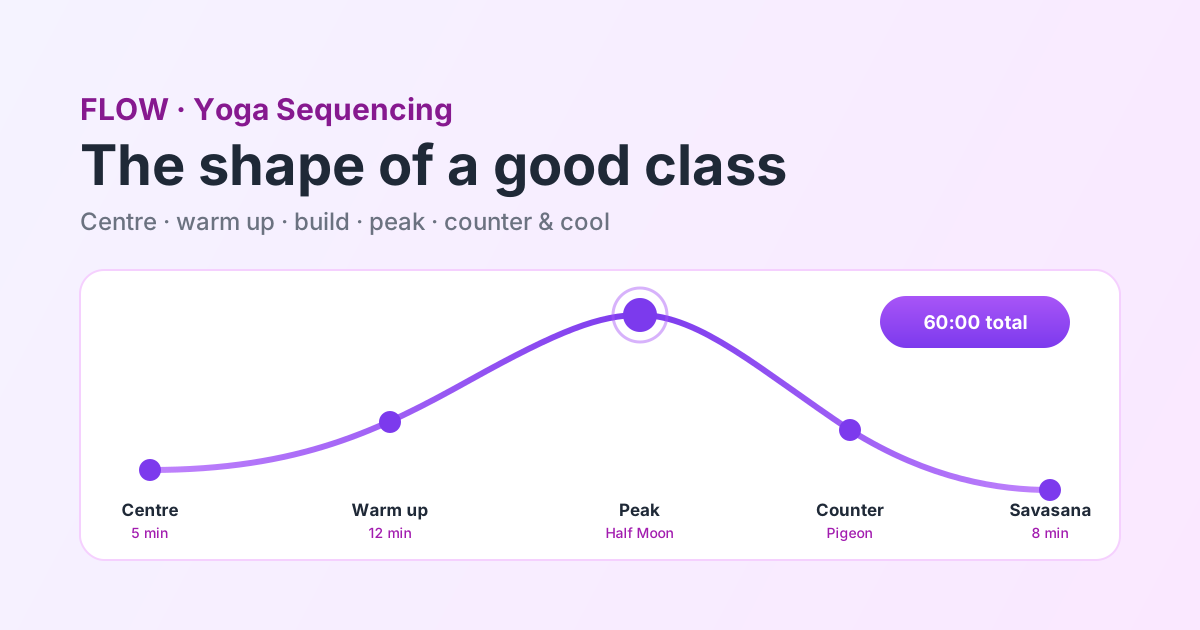
The shape underneath every good class
Sequencing has a grammar. Once you can see it, you stop guessing. Almost every well-built class — vinyasa, hatha, yin, restorative — moves through the same five stages, and the peak pose you choose determines everything that comes before it.
Sequence it in FLOW
Everything above, in a tool that keeps the timing honest while you build.
Drag to Order
Move poses until the arc feels right. Reordering a class is three seconds, not a rewritten page.
420+ Illustrated Poses
Every pose with Sanskrit name, cues, benefits, modifications and contraindications — so you can check before you teach.
Live Class Length
Set hold times and watch the total update. You find out your 60-minute class is 78 minutes now, not in the room.
Counter-Pose Suggestions
Each pose links to its preparatory and counter poses, so the pairing you half-remember is one tap away.
Duplicate and Vary
Copy last week’s class, swap the peak, and you have a fresh sequence in two minutes instead of an hour.
Export to PDF
A clean, printable plan for the mat, the studio binder, or a cover teacher.
Who this is for
Sequencing changes by style
The five-stage arc holds, but the pacing and the peak look very different.
Vinyasa
Breath-linked and continuous. Sequencing here is about transitions as much as poses — what gets you from one shape to the next without a stumble.
Hatha
Held poses with pauses between. You have room to cue in depth, so fewer poses done longer beats a crowded list.
Yin
Three to five minutes per shape, targeting connective tissue. A whole class might be six poses. Sequencing is about which tissues you visit and in what order.
Restorative
Fully propped, nothing to achieve. The sequence is a descent — each pose quieter than the last, ending somewhere the nervous system can let go.
Power / Ashtanga-inspired
Strong and heat-building. The peak is usually an arm balance or inversion, which means the shoulders and core need real preparation, not a token warm-up.
Prenatal
Contraindication-led. The sequence is shaped as much by what you leave out — deep twists, prone poses, breath retention — as by what you include.
What is yoga sequencing?
Yoga sequencing is the practice of ordering poses within a class so that the body is progressively prepared, reaches a peak safely, and is then counter-posed and settled. A well-sequenced class moves through centering, warm-up, a build phase, a peak pose, and a cool-down. The order matters as much as the poses themselves: the same ten poses in a different order can be a safe class or an injury.
How do you sequence a yoga class?
Choose the peak pose first, then work backwards. Ask what that pose demands — which joints must open, which muscles must be warm, which actions the student needs to understand — and build the earlier part of the class to deliver exactly that. Then add counter-poses that reverse the peak, and finish with a cool-down and savasana. Timing is the other half: set your hold times and check the class actually fits the slot.
What is the correct order of poses in a yoga class?
The conventional order is centering and breath, gentle warm-up, sun salutations or another heat-builder, standing poses, balance work, the peak pose, counter-poses, seated or supine cool-down, and savasana. This order moves from small joint movements to large loaded ones and back down, which is why it is near-universal across styles even though the pacing differs.
What is a counter-pose in yoga?
A counter-pose is a shape that reverses the action you just did, releasing the tissue you loaded. After a deep backbend such as Camel, a gentle forward fold or a supported twist restores neutral. The rule is to counter in the opposite direction but with less intensity — following a deep backbend with an equally deep forward fold is its own problem.
How long should each pose be held?
It depends on the style. Vinyasa typically holds three to five breaths, hatha thirty seconds to two minutes, yin three to five minutes, and restorative five to ten with full prop support. The practical check is total class length: hold times multiplied across a sequence add up faster than most teachers expect, which is why building in a tool that totals it for you saves the awkward rush at the end.
Sequencing on paper vs sequencing in a builder
Plenty of excellent teachers sequence in a notebook, and there is nothing wrong with it. The difference shows up in the second year: a notebook class cannot be reordered without rewriting, cannot tell you it runs eighteen minutes long, and cannot be duplicated and varied in two minutes. FLOW is a visual builder — drag to reorder, live timing, 420+ poses with cues and contraindications attached, PDF export and shareable links. Free to start, and the pose library stays free forever. See our honest comparison pages.
Sequence your next class
Open the builder and lay out a flow in a few minutes. Free, no card needed.
Frequently asked questions
What are the principles of yoga sequencing?+
Four hold across every style. Progressive preparation: warm and open what the peak pose demands before you ask for it. Counter-posing: reverse each significant action with a gentler opposite. Arc: build intensity to a peak, then descend. Contraindication awareness: know which poses are unsafe for the bodies actually in your room, and have a modification ready before you need it.
Should I plan every class in advance?+
Plan it, then hold the plan loosely. A written sequence means you are not improvising under pressure, and it makes the class repeatable and reviewable. But the plan meets a real room — if half the class is new, drop the peak. Experienced teachers usually plan fully and then deviate by choice rather than panic.
How do I choose a peak pose?+
Pick something one clear step beyond what your regulars can already do comfortably, and make sure it can be modified downward. The peak sets the theme and gives the class a spine. If you cannot articulate what the class is preparing for, students will feel the class as a list of poses rather than a build.
How long does it take to plan a yoga class?+
New teachers commonly spend forty-five to ninety minutes on a single 60-minute class. With a library and a builder, most of that becomes reuse — duplicate a prior class, swap the peak, adjust the build — which brings a typical plan down to ten to fifteen minutes.
Is there a free yoga sequencing tool?+
Yes. FLOW’s pose library is free and complete, the builder is free to try, and all the calculators under /tools work without an account. Unlimited saved flows, PDF export, shareable links and full AI drafting are part of Pro at $7.99/month, or $59.99/year with a 7-day free trial.
Can AI sequence a yoga class?+
It can produce a reasonable draft, and FLOW will generate one from a style, level and focus. What it cannot do is know your room — who is pregnant, whose shoulder is recovering, who has never inverted. Treat an AI sequence as a first draft that saves you the blank page, then apply your own judgment before you teach it.
How do I make my sequences less repetitive?+
Change one variable at a time rather than starting over. Keep the arc and swap the peak; or keep the peak and change the route to it; or hold the sequence and change the theme and cueing. Saving your past classes is what makes this possible — you cannot vary a class you cannot look at.
Do I need to sequence differently for beginners?+
Yes, and mostly by subtraction. Fewer poses, longer holds, more repetition across weeks, and transitions that do not require a pose they have not learned. A beginner class needs a peak too — it is just a more modest one, and the preparation for it is proportionally longer.