
Table of Contents
Introduction
There is a particular kind of unease that doesn't have a clear cause — a background feeling of not quite being okay, of floating without anchor, of waiting for something bad to happen. It shows up as chronic low-level anxiety, an inability to feel settled even when life circumstances are objectively fine, a difficulty being present in the body.
In the yoga tradition, this unease is often associated with an imbalanced root chakra — the energetic centre at the base of the spine that governs our sense of safety, stability, and belonging. Whether you approach this as literal truth or as a useful metaphor, the framework offers something genuinely valuable: a way of naming an experience that many people feel but struggle to articulate, and a set of practices that directly address it.
This guide introduces the root chakra through the lens of yoga — physical poses, breathwork, and affirmation — in a way that is warm, accessible, and grounded itself. You don't need to be steeped in yogic philosophy to benefit. You just need to want to feel more settled in your own skin.
Pro Tip: The most powerful thing you can do in a root chakra class is take off your shoes and stand barefoot on the earth. Before any poses, before any breathwork, just stand outside and feel the ground under your feet. This simple act of physical contact with the earth speaks directly to the root chakra in a language the body understands immediately.
What Is the Root Chakra?
The root chakra — Muladhara in Sanskrit, from mula (root) and adhara (base or foundation) — is the first of seven chakras in the yogic energy system. It is located at the base of the spine, at the perineum, and is associated with the earth element.
Core themes: Safety, security, survival, belonging, physical health, material stability, family, home, identity as a physical being.
Colour: Red — the colour of earth, blood, and vitality.
Element: Earth — solid, stable, heavy, reliable.
Body associations: The feet and legs, the base of the spine, the bones, the large intestine, the adrenal glands. The adrenal association is particularly interesting because the adrenals govern the stress response — and chronic stress is both a cause and symptom of root chakra imbalance.
Mantra sound: LAM (pronounced "lum") — a grounding, resonant sound that can be chanted or hummed as part of practice.
In practical terms, the root chakra is about our relationship with the basic conditions of existence. Do I have what I need? Am I safe? Do I belong here? Am I welcome in my own body? These questions are so fundamental that their answers — held in the body as tension, ease, openness, or bracing — shape everything else in our lives.
The yoga tradition holds that a balanced root chakra is the prerequisite for all other development. You cannot build higher without a stable foundation. Creativity, love, personal power, communication, intuition — all of these rest on the bedrock of basic safety and security.
Signs of Root Chakra Imbalance
Physical signs of underactive root chakra (deficiency):
Emotional and psychological signs of underactive root chakra:
Physical signs of overactive root chakra (excess):
Pro Tip: In a yoga class context, you don't need to diagnose your students' chakras. Instead, offer the framework as an invitation to self-inquiry. Ask them to notice which themes resonate — "Does anything about the concept of groundedness feel relevant to where you are right now?" — and let the practice do the rest.
10 Grounding Yoga Poses
1. Mountain Pose (Tadasana)
Stand with feet hip-width apart or touching. Press all four corners of each foot firmly into the earth — the big toe mound, the pinky toe mound, the inner heel, the outer heel. Feel the ground pushing back up through your feet, your legs, your spine. Engage the legs subtly, lift the chest, and breathe.
Root chakra connection: Tadasana is the pose of the root chakra made physical. The downward pressing of feet into earth is a direct physical enactment of grounding. Cueing students to feel the earth beneath them — its solidity, its support — is a root chakra invitation. Hold for 10 slow breaths. See our pose library for detailed mountain pose cues.
2. Warrior I (Virabhadrasana I)
Step one foot back, turn it out 45 degrees, and bend the front knee to 90 degrees. Square the hips forward, root the back foot firmly, and reach the arms overhead. Feel the spread of weight through both legs — the dual anchoring of grounded feet.
Root chakra connection: The earthbound stability of Warrior I, especially the pressing back foot, creates a strong physical sensation of being held by the earth. This pose builds physical strength in the legs and hips — the body area most directly associated with Muladhara.
3. Warrior II (Virabhadrasana II)
Wide stance, front knee bent, arms reaching in opposite directions. Settle into the hips and feel the weight of your body supported by the ground.
Root chakra connection: Warrior II cultivates the steadiness of someone who is both engaged with the world and rooted in themselves — an embodiment of the root chakra's quality of stable presence. Gaze forward with soft, steady eyes.
4. Tree Pose (Vrksasana)
Stand on one foot, place the sole of the other foot on the inner calf or thigh (not the knee). Press foot and leg together. Hands at heart or reaching up. Balance.
Root chakra connection: Tree pose is one of the most potent root chakra metaphors available: a tree's height depends entirely on the depth of its roots. As students practice balance, remind them that wobbling is part of the practice — just like life's instability doesn't mean you aren't rooted.
5. Standing Forward Fold (Uttanasana)
From standing, hinge from the hips and let the torso hang toward the floor. Bend the knees generously if the hamstrings are tight. Let the head hang heavy. Press the feet firmly into the floor while releasing the upper body completely.
Root chakra connection: The combination of strongly rooted feet and a completely released upper body is a beautiful physical demonstration of root chakra balance — strong foundation, soft expression.
6. Low Lunge (Anjaneyasana)
Step one foot forward, lower the back knee. Sink the hips, reach the arms up. Feel both the stretch through the hip flexor and the grounding through both feet and the back knee.
Root chakra connection: This pose opens the hip flexors — the muscles most associated with the survival response. Chronically tight hip flexors often correspond to chronic stress. Releasing them has a direct effect on the root chakra's sense of safety.
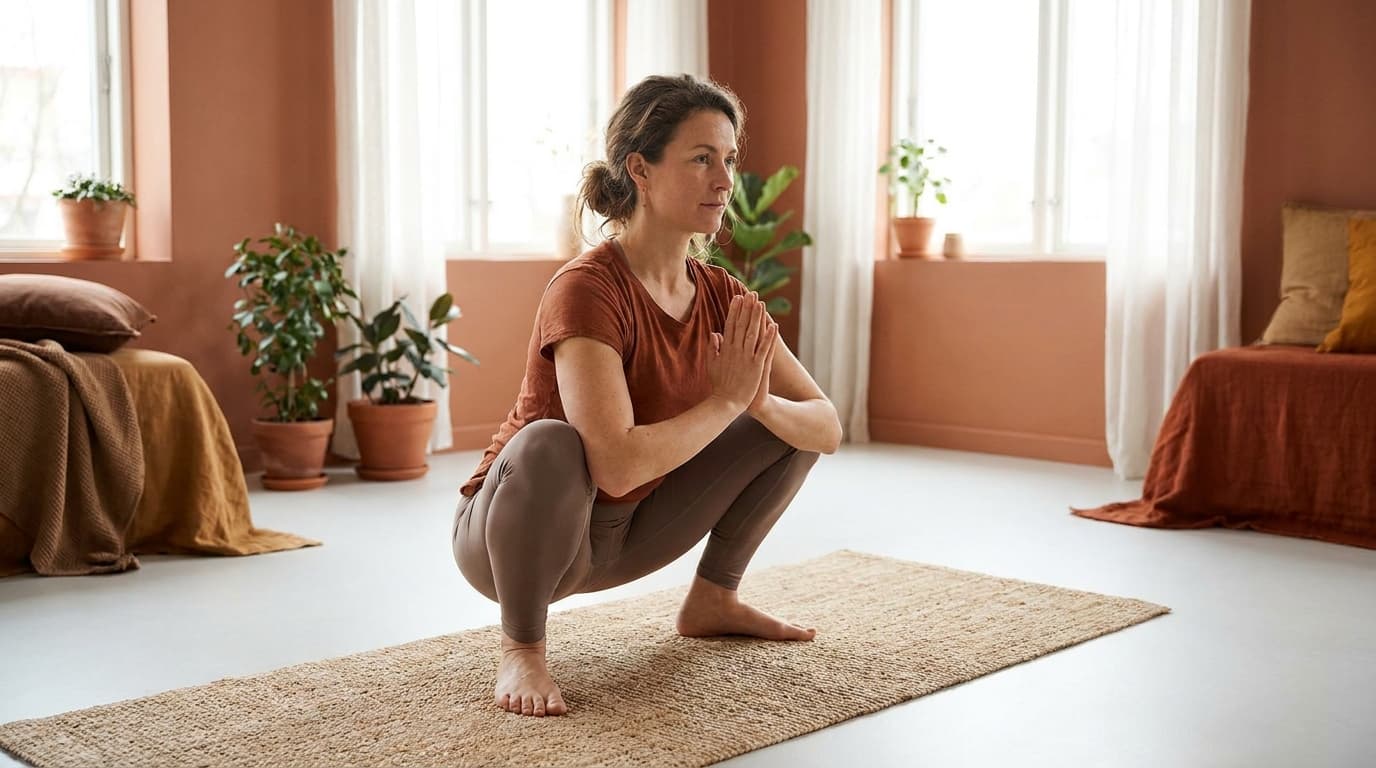
7. Garland Pose / Yoga Squat (Malasana)
Bring feet to the edges of the mat, turn them out, and lower into a deep squat. Hands at heart, elbows pressing the inner knees wide. Heels can be elevated on a rolled blanket if needed.
Root chakra connection: Malasana literally brings the base of the spine (the location of the root chakra) closest to the earth. It opens the hips, groin, and sacrum — the entire foundation of the body. This is a primal, earthy pose that many students find surprisingly emotional.
8. Child's Pose (Balasana)
Knees wide, big toes touching, sit hips toward heels and stretch the arms long or fold them under the head. Forehead rests on the floor.
Root chakra connection: Child's pose is surrender to the earth. The forehead on the floor is particularly powerful — the ajna (third eye) making contact with the earth element. This is a deeply restorative and safe-feeling pose, ideal for times of stress or overwhelm.
9. Seated Forward Fold (Paschimottanasana)
Sitting with legs long, hinge from the hips and fold forward. Use a strap if needed. Allow the spine to round after the initial hip hinge. Stay for 90 seconds or more.
Root chakra connection: The complete contact of the backs of the legs and sitting bones with the floor creates full embodied connection with the earth. This pose is also deeply calming for the nervous system, which directly supports root chakra function.
10. Savasana (Corpse Pose)
Lie flat on the back, feet falling open, arms slightly away from the body, palms up. Eyes closed. Let the body be completely heavy, completely supported by the earth.
Root chakra connection: Savasana asks us to surrender control and trust that the earth will hold us. It is the ultimate root chakra pose — complete release into the ground, complete trust in the support that is always there. Guide a visualisation of the body growing heavy and warm, sinking deeper into the earth's embrace.
Build this sequence on your phone
The same 420+ pose library and drag-and-drop builder, free on iPhone, iPad and Android.
Complete 45-Minute Sequence
Intention setting (3 min): Begin seated or lying in constructive rest. Invite students to place one hand on the low belly or the base of the spine. Ask them to set an intention around safety, stability, or groundedness: "What does it feel like to be truly safe?" Allow 3 breath cycles for this to land before beginning.
Breathwork opening (3 min): Box breathing (4 counts in, 4 hold, 4 out, 4 hold) for 3 rounds. This directly activates the parasympathetic nervous system and creates the safety conditions in the nervous system that allow the root chakra to open.
Seated grounding (3 min): Seated cross-legged, feel the connection of sitting bones to floor. Practice the LAM mantra — either silently or as a soft hum. Visualise the colour red spreading through the feet, legs, and base of the spine.
Warm-up on all fours (4 min): Cat-cow × 10, then child's pose × 3 minutes.
Standing sequence (12 min):
Floor sequence (12 min):
Grounding Savasana (8 min): Guide a full-body scan emphasising heaviness and contact with the earth. Use the red colour visualisation — a warm red light beginning at the soles of the feet, spreading slowly through the legs, the pelvis, the base of the spine. Allow the body to feel completely held.
Closing (3 min): Return to seated. Offer one or two root chakra affirmations (see below). Bow forward to acknowledge the earth. End with hands at heart.
Use FLOW's free sequence builder to map out this sequence with timing notes and modifications for each pose.
Affirmations and Breathwork
Root Chakra Affirmations
Affirmations work best when they are felt in the body rather than just repeated in the mind. Encourage students to say them slowly, placing a hand on the low belly or on the floor, and pausing between each one to notice any somatic response.
These affirmations are particularly powerful in Savasana or at the end of the sequence, after the nervous system has downregulated and the body is receptive.
Box Breathing (Sama Vritti)
Inhale 4 counts — hold 4 counts — exhale 4 counts — hold 4 counts. This equal breath technique directly stimulates the vagus nerve and activates the parasympathetic nervous system. For root chakra work, the holds are particularly important — they cultivate the capacity to pause, to wait, to be present in stillness without panic. Start with 3 rounds and build to 5–7.
Extended Exhale Breathing
Inhale 4 counts — exhale 6–8 counts. The extended exhale activates the parasympathetic system more directly than any other breathing technique. It's simple, immediately effective, and can be practised by anyone. This is the breath of safety.
Belly Breathing with Earth Contact
Lie on the belly or in child's pose. Feel the belly pressing against the floor with each inhale. This direct physical contact with the earth on the breath creates a loop of physical and metaphorical grounding that is powerful and immediate.
The breathwork practices outlined here also appear in our guide to yoga for stress and anxiety, which explores the nervous system science in more depth.
Teaching a Root Chakra Class
Making the theme accessible: Not all students are familiar with chakra terminology, and some may be sceptical. The key is to translate the theme into universal human experience. Instead of opening with "today we're working on the root chakra," try: "Today's practice is about feeling more at home in your body and in your life. We'll explore what it means to feel grounded — to have a stable foundation beneath you, whatever is happening around you."
Layering the theme: A well-themed class weaves the root chakra through every element — the physical poses (earth-heavy, standing, grounding), the breathwork (slowing, stabilising), the language ("press into the earth," "feel what supports you," "you are held"), the music (earthy, bass-heavy, rhythmic), and the closing affirmations.
Using red in class: Lay out a red blanket on each mat before class. Suggest students bring red clothing. Use a soft red light or warm-toned candles. These visual anchors create the class environment before a word is spoken.
Music suggestions: For root chakra classes, choose music with strong bass frequencies, a slow tempo (60–70 BPM), and earthy tones — drumming, hand pans, Tibetan bowls, or acoustic guitar. The bass frequencies are physically grounding in themselves.
Closing ritual: End every root chakra class with a gesture of acknowledgment — pressing the palms to the floor before rising, standing barefoot in mountain pose and pressing into the earth, or placing both hands on the low belly in stillness for three breaths. These small rituals anchor the experience.
Sequencing considerations: Root chakra classes work beautifully as the opening class of a chakra series, and also as a standalone offering for times when students are collectively experiencing upheaval — a difficult news cycle, seasonal transition, or community stress. You can also pair root chakra work with the yin approaches in our yin yoga guide, which shares the long-hold, earth-element energy of Muladhara.
The root chakra teaches us something profound: that safety is not found in controlling circumstances. It is found in knowing, in your body, that you can meet whatever comes. That the earth beneath your feet is always there. That your breath is always available. That you belong here, now, exactly as you are.
That is the gift of a root chakra practice — not a permanent solution to life's uncertainty, but a reliable return to the ground of your own being.
Frequently Asked Questions (5)
Do I have to believe in chakras to benefit from a root chakra yoga class?
Not at all. You can understand the root chakra purely as a metaphor — a useful framework for focusing a class on themes of stability, safety, and grounding. The physical yoga poses, breathing practices, and reflective themes produce real benefits regardless of your metaphysical beliefs. Many students who consider themselves secular or scientifically minded find chakra-themed classes deeply meaningful precisely because the themes are so universally human.
What does it feel like when your root chakra is balanced?
When the root chakra is functioning well, people describe feeling grounded, settled, and safe in their body and in their life circumstances. There's a quality of presence — being able to be here, now, without constantly scanning for threats. Practically, this often manifests as better sleep, steadier emotions, a sense of financial adequacy (even without material change), and feeling at home in your body.
How long does it take to balance the root chakra through yoga?
This is not a linear or measurable process, but most people who practise a grounding yoga sequence consistently for 3–4 weeks report a noticeable shift in their baseline anxiety levels and sense of stability. The practices work on the nervous system in ways that are physiologically real — activating the parasympathetic system, reducing cortisol, improving proprioceptive connection to the body — even if the chakra framework is metaphorical.
Can children benefit from root chakra yoga?
Yes, enormously. Children who feel unsafe, anxious, or disconnected respond beautifully to grounding practices. Adapt the language: instead of "root chakra," use "tree roots," "mountain feet," or "strong and steady." Grounding breathing, barefoot standing, and being asked to feel the floor under their feet are particularly effective with children.
What colour is associated with the root chakra and how do teachers use it?
The root chakra is associated with the colour red — the colour of earth, blood, and vitality. Teachers use it in class by incorporating red props (blankets, bolsters), asking students to visualise red light or warmth spreading through the feet and legs in Savasana, using red in class decor, or inviting students to wear red. These sensory anchors help students connect the abstract theme to a felt experience.