
Table of Contents
Introduction
Yin yoga is one of the fastest-growing styles in the yoga world — and one of the most misunderstood. Students sometimes expect a gentle, easy practice and are surprised by how confronting 4 minutes in dragon pose can be. Teachers sometimes underestimate how much skill goes into holding space for long, intense holds. And both sometimes wonder how sitting still in a handful of poses for an hour counts as yoga.
It counts because yin yoga works on a different tissue system than almost any other physical practice available. While most yoga — and most exercise — targets muscle tissue, yin yoga targets the connective tissue: fascia, tendons, ligaments, and joint capsules. These tissues are denser, slower to respond, and require the particular stimulus of sustained, moderate stress over time. The result, practiced consistently, is improved flexibility and joint health that does not come from stretching alone.
This guide is written for yoga teachers who want to teach yin well — with confidence, safety, and depth. We will cover the philosophical and physical differences between yin and yang yoga, the five principles that define a true yin practice, a light introduction to meridian theory, 20 essential poses with hold times, and four complete sequences ready to teach.
To plan your own yin sequences visually, FLOW's free sequence builder is well-suited to the yin format — you can set hold times for each pose, add prop notes, and see the full class structure at a glance.
Yin vs Yang Yoga
Understanding yin yoga starts with understanding what it is not. Almost all yoga that most students have practiced — vinyasa, power, hatha, Bikram, Kundalini — is yang in nature. This does not mean aggressive or intense (though it can be). It means rhythmic, repetitive, and primarily targeting muscle tissue through active contraction and dynamic movement.
Yang yoga characteristics:
Yin yoga characteristics:
Philosophically, yin and yang are the two complementary poles of the Taoist worldview. Neither is better or more complete than the other. Most modern lives are dominated by yang activity — constant movement, output, stimulation. Yin yoga provides the balancing pole.
Paul Grilley and Sarah Powers are largely credited with developing modern yin yoga into a teachable system in the West, drawing on Taoist philosophy, Traditional Chinese Medicine, and an anatomical understanding of connective tissue. Their work remains foundational for yin teachers.
Why Connective Tissue Matters
Muscles respond to stretch within seconds to minutes. Connective tissue — fascia, tendons, ligaments — responds much more slowly. It requires a sustained, moderate load held for several minutes before it begins to yield. Short holds do not reach it. Dynamic movement slides past it. Only the yin approach — still, sustained, and patient — applies the precise stimulus connective tissue needs to adapt.
Well-hydrated, pliable connective tissue means better joint mobility, reduced injury risk, and more comfortable aging. For students who already have flexible muscles but feel restricted in their joints, yin is often the missing piece.
The 5 Principles of Yin Practice
These five principles define what makes yin yoga distinctly yin, and knowing them deeply allows you to teach with clarity rather than simply running a timer.
1. Find Your Edge
The edge in yin is the point where sensation is present but tolerable — not the point of maximum stretch. Students should feel something genuine, but they should also be able to breathe easily, relax the surrounding muscles, and remain reasonably still. If they are clenching, holding the breath, or in pain, they have gone past the edge.
Teach students that the edge moves. It will shift between sessions, between sides, and even within a single hold as the tissue releases. The practice is not to push to the same point every time, but to find where the edge is today.
2. Be Still
Once at the edge, the student becomes still. This is yin's most distinctive (and most difficult) instruction. Movement engages the muscular system and prevents the connective tissue from receiving the sustained load it needs. Even micro-movements — subtle adjustments, fidgeting, rhythmic breathing — reduce the effectiveness of the hold.
Stillness in yin also means stillness of the mind, which is where the practice becomes meditative. This is the part that surprises students expecting a relaxing stretch class.
3. Hold for Time
The minimum effective dose for connective tissue adaptation is generally considered to be 90 seconds to 2 minutes. Most yin poses are held for 3 to 5 minutes. Some teachers and experienced students hold for 7 to 10 minutes in certain shapes.
Time is the mechanism. You cannot shortcut it. A 30-second pigeon is a different exercise than a 4-minute pigeon. Make sure students understand that the whole point of the hold is the duration.
4. Honor the Meridians (Optional Lens)
In Traditional Chinese Medicine, the body contains a network of energetic pathways called meridians, through which life force (qi or chi) flows. Specific poses are understood to compress, stretch, or stimulate specific meridian lines, affecting the organs and systems associated with those meridians.
This is an optional lens for teaching yin, not a medical claim. But for many students, the meridian framework adds meaning and helps them understand why certain poses feel emotionally charged or why they leave a class feeling balanced in a particular way. We will cover the most relevant meridians in the next section.
5. Rebound
The rebound is the period of stillness immediately after releasing a yin pose. The body has been under sustained load and now needs a moment to integrate and redistribute. This is not downtime — it is part of the practice. Teachers often rush through reboundss to keep to time. Do not.
After each pose, guide students into a neutral position — usually supine or tabletop — and invite them to notice the sensations: tingling, warmth, spaciousness, the echo of the stretch. Give at least 30 to 60 seconds. The rebound is when the body processes what just happened.
Pro Tip: The rebound is often when students feel the most profound effects of the practice. If you rush it, they miss the gift. Build rebound time into your class plan from the start — add 1 minute between each pose.
Meridian Lines Explained
You do not need to be a TCM practitioner to incorporate meridian awareness into your yin teaching. Here is a practical overview of the meridian lines most relevant to yin poses:
Kidney and Urinary Bladder Meridians — Run along the entire back of the body, from the sole of the foot up the back of the leg, along the spine, to the head. Poses that stretch the back body (forward folds, child's pose, sleeping swan) are said to stimulate these meridians. In TCM, the kidneys are associated with deep vitality and fear. Many students experience emotional releases in forward-fold yin poses.
Liver and Gallbladder Meridians — Run along the inner and outer leg. Hip openers (butterfly, sleeping swan, dragon) work these lines. The liver is associated in TCM with the emotion of anger and the movement of qi through the body.
Spleen and Stomach Meridians — Run along the front body, from the foot up the inner leg, through the abdomen. Backbend poses (saddle, sphinx, seal) work the stomach line. Associated with digestion, worry, and the process of transformation.
Heart and Lung Meridians — Run through the inner arm and chest. Chest openers (supported fish, melting heart, square pose) work these lines. Associated with grief (lungs) and joy (heart).
When you give students a brief, light meridian note — "This pose is thought to open the kidney meridian, which in Chinese medicine is associated with deep vitality and the emotion of fear — see if you notice anything arise in this hold" — it often deepens their inner attention without requiring them to believe anything specific.
20 Essential Yin Yoga Poses
Spine-Focused Poses
1. Child's Pose (Balasana)
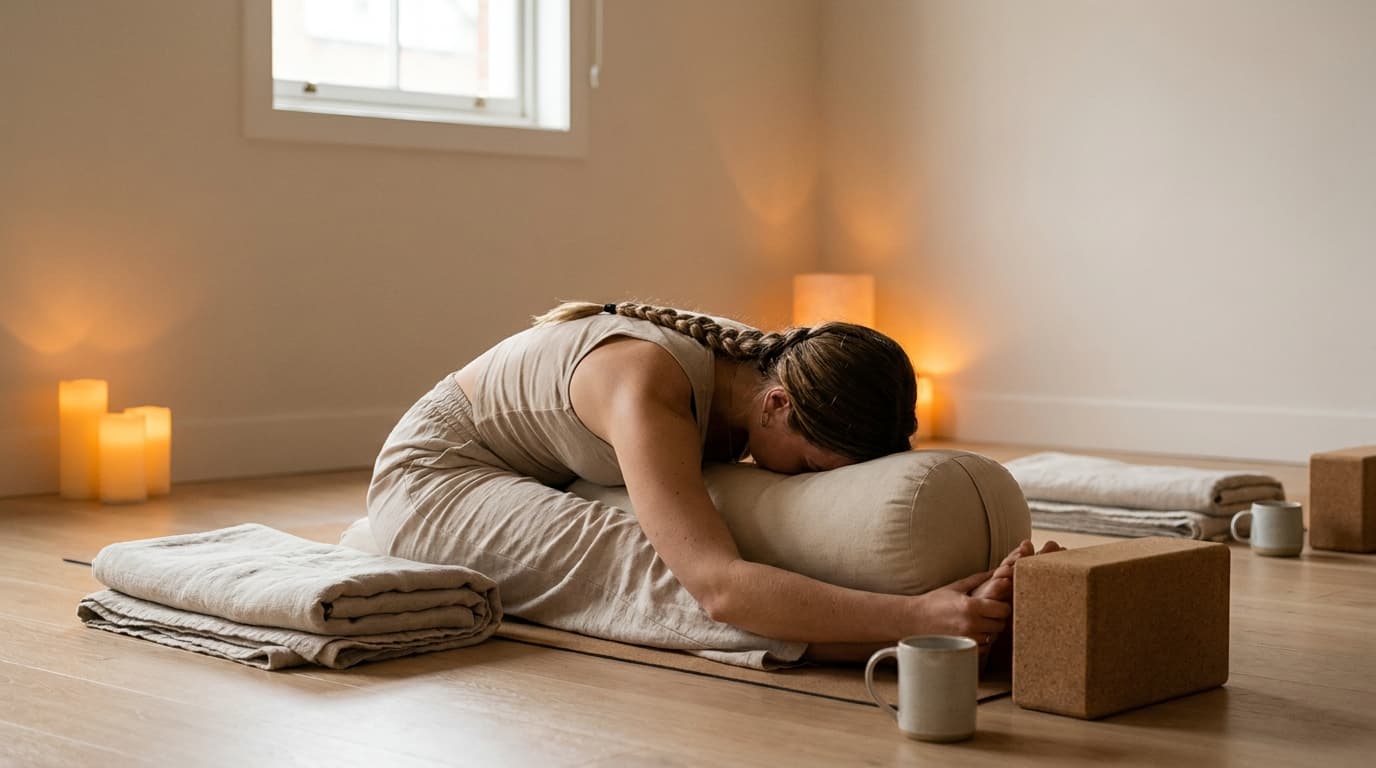
The classic forward fold. Hips to heels, forehead toward the mat, arms extended or alongside the body. Targets kidney and bladder meridians along the back. Deeply calming.
Hold: 3-5 min2. Caterpillar (Seated Forward Fold)
Legs extended, torso folding forward. The spine rounds gently — this is intentional in yin, unlike the flat-back instruction in yang forward folds. Compresses and lengthens the entire back chain.
Hold: 3-5 min3. Snail Pose
A supine pose where legs fold over the head toward the floor. Intense compression of the cervical spine. Not for beginners. Keep the neck long and avoid rolling the weight onto the cervical vertebrae.
Hold: 3-5 min (never with head weight on floor)4. Supported Fish
Lie over a bolster or block placed horizontally under the shoulder blades. The chest and front body open passively. Works the stomach meridian. Deeply counterbalancing after seated forward folds.
Hold: 4-5 min5. Melting Heart (Anahatasana)
In tabletop, walk the hands forward and melt the chest toward the floor, keeping the hips over the knees. Profound opener for the thoracic spine, shoulders, and heart meridian.
Hold: 3-4 minHip-Focused Poses
6. Butterfly (Baddha Konasana Yin version)
Soles of feet together, torso folding forward. Unlike the upright yang version, in yin the spine rounds over the feet. Opens inner groin and liver/spleen meridians.
Hold: 4-5 min7. Sleeping Swan (Yin Pigeon)
Front shin at an angle, back leg long, torso folds forward. The most popular yin hip opener. Works the gallbladder and kidney meridians along the outer hip and lateral leg.
Hold: 4-5 min per side8. Double Pigeon (Firelog / Agnistambhasana)
Both shins stacked. Very intense external rotation for experienced students. Gallbladder meridian.
Hold: 3-4 min per side9. Dragon (Yin Lizard)
Front foot outside the same-hand, back knee down or lifted. The most accessible deep hip flexor opener in the yin repertoire. Multiple variations: low dragon, twisted dragon, winged dragon.
Hold: 4-5 min per side10. Deer Pose (Square Pose)
Front shin horizontal, back shin at 90 degrees. Simultaneously targets both hips in different rotations. Unique and effective.
Hold: 3-4 min per side11. Square Pose (Agnistambhasana variation)
Both shins stacked, upright torso for a more active version, or folding forward for deeper yin.
Hold: 3-5 min per side12. Half Saddle
One leg straight, the other bent beside the hip (like a yin hero pose on one side). Powerful hip flexor and quadriceps release.
Hold: 3-4 min per side13. Saddle Pose
Both knees bent, feet beside the hips, lying back. Intense quad and hip flexor stretch. Requires significant preparation and is not suitable for students with knee issues.
Hold: 3-5 min (with full prop support)Supine and Twisting Poses
14. Reclined Butterfly
Supine bound angle — soles of feet together, knees open. Fully passive. Suitable as an opener or closer.
Hold: 5-10 min15. Twisted Roots (Reclined Twist)
Both knees bent, stack and lower to one side for a spiraling spinal twist. Works bladder and stomach meridians. Excellent for the middle back.
Hold: 4-5 min per side16. Shoelace (Yin Gomukhasana)
One knee stacked over the other, both feet beside the hips. Intense outer hip. Torso can be upright or folding forward.
Hold: 4-5 min per side17. Happy Baby
Supine, knees wide, hands hold feet or shins. Traction in the hip joints, inner groin release. One of the most universally accessible yin poses.
Hold: 3-5 min18. Legs Up the Wall
Supine inversion against a wall. Cooling, calming, restorative. Good transition between yang and yin or as a cool-down after a hip-heavy sequence.
Hold: 5-10 min19. Seal Pose / Sphinx Pose
Prone backbend — Sphinx on the forearms, Seal with arms extended. Works the stomach and kidney meridians. Gently compresses the lumbar spine.
Hold: 3-5 min (Sphinx); 2-4 min (Seal)20. Savasana (Corpse Pose)
The essential closing pose for any yin class. Full supine rest, body fully released. The class is not complete without at least 5 to 7 minutes here.
Hold: 5-15 minOur full pose library includes detailed descriptions and modifications for each of these poses.
Build this sequence on your phone
The same 420+ pose library and drag-and-drop builder, free on iPhone, iPad and Android.
4 Complete Yin Sequences
Sequence 1: Spine Focus (75 minutes)
| Pose | Hold | Notes |
|---|---|---|
| Rebound (supine) | 1 min | |
| Supported fish | 4 min | Block under thoracic spine |
| Rebound | 1 min | |
| Melting heart | 4 min | Bolster under chest if needed |
| Rebound (tabletop) | 1 min | |
| Twisted roots — right | 4 min | |
| Twisted roots — left | 4 min | |
| Rebound | 1 min | |
| Child's pose | 5 min | |
| Rebound | 1 min | |
| Sphinx | 4 min | |
| Rebound (prone) | 1 min | |
| Happy baby | 5 min | |
| Savasana | 10 min | Full support: blanket, eye pillow |
Sequence 2: Hip Focus (75 minutes)
| Pose | Hold | Notes |
|---|---|---|
| Rebound | 1 min | |
| Dragon — right | 5 min | Low variation, block under hands |
| Sleeping swan — right | 5 min | Bolster under right hip if needed |
| Rebound | 1 min | |
| Dragon — left | 5 min | |
| Sleeping swan — left | 5 min | |
| Rebound | 1 min | |
| Butterfly fold | 5 min | Bolster on feet to rest torso |
| Rebound | 1 min | |
| Deer pose — right | 4 min | |
| Deer pose — left | 4 min | |
| Rebound | 1 min | |
| Happy baby | 4 min | |
| Savasana | 10 min |
Sequence 3: Full Body (90 minutes)
| Pose | Hold | Notes |
|---|---|---|
| Melting heart | 4 min | |
| Rebound | 1 min | |
| Dragon — right | 4 min | |
| Twisted dragon — right | 3 min | |
| Sleeping swan — right | 5 min | |
| Repeat left side | ||
| Rebound | 1 min | |
| Butterfly fold | 5 min | |
| Caterpillar | 4 min | |
| Rebound | 1 min | |
| Twisted roots — right | 4 min | |
| Twisted roots — left | 4 min | |
| Supported fish | 4 min | |
| Legs up the wall | 5 min | |
| Savasana | 10 min |
Sequence 4: Evening Wind-Down (60 minutes)
| Pose | Hold | Notes |
|---|---|---|
| Rebound | 1 min | |
| Child's pose | 5 min | |
| Rebound | 1 min | |
| Sleeping swan — right | 5 min | |
| Sleeping swan — left | 5 min | |
| Rebound | 1 min | |
| Caterpillar | 4 min | |
| Rebound | 1 min | |
| Twisted roots — right | 4 min | |
| Twisted roots — left | 4 min | |
| Legs up the wall | 7 min | |
| Savasana | 10 min | Longest holds in evening practice |
Use FLOW's free sequence builder to build and customize any of these sequences. Add your hold times, prop notes, and meridian cues directly to each pose card.
For context on how yin fits into a broader teaching curriculum, see our guide on how to create a yoga sequence.
Timing and Long Holds
Managing the time in a yin class requires more attention than in a dynamic class, where movement naturally marks time. Here are practical approaches:
Use a soft chime timer. Set a timer with a gentle sound (singing bowl, soft bell) for each pose. This frees you from watching the clock and allows you to walk the room or practice alongside your students.
Announce time updates. At the midpoint of a long hold, tell students how long they have been in and how long remains: "You have been in this pose for about 2 minutes. Take a moment to check in — can you soften somewhere?" At the 30-second mark, begin guiding the exit.
Build in buffer. A 75-minute class typically fits 6 to 8 poses including reboundss and opening/closing. Plan for 10% more time than you think you need — transitions, settling, and unexpected moments always take more time than the sequence suggests.
Let students come out early. Always tell students they can exit a pose before the time is up. This maintains student agency and reduces the risk of injury from overstaying.
Teaching Tips for Yin
Cue less, listen more. In a yin class, students need space more than instruction. Cue the entry to the pose carefully, give one or two alignment tips, then let silence do the work. Check in with voice every minute or so — a quiet "keep breathing" or "see if you can soften the jaw" — but do not lecture.
Walk the room slowly. Your calm, unhurried presence is itself a cue. Move slowly and quietly. If you stop beside a student, do so with permission in mind.
Use the pause. Before cueing the exit from a pose, tell students you will count down: "In about 30 seconds, we will begin to come out. Start to soften your breath." This avoids the jolt of sudden instruction.
Validate discomfort without solving it. "It is normal if this feels intense — that is the yin edge" is more useful than rushing to offer more props. Some discomfort is the practice. Help students distinguish between appropriate yin sensation and pain that requires them to come out.
Teach the why. Yin students who understand why they are holding for so long — connective tissue adaptation, meridian stimulation, nervous system regulation — are more committed to the practice and more patient with the discomfort. Weave in brief, accessible explanations.
Pro Tip: The best yin teachers are the quietest teachers. Your job is to create the container and get out of the way. Students often report that their most profound yin experiences happened in the silence between your cues.
For teachers who are building a yin curriculum alongside other styles, our beginner yoga flows guide can help you sequence introductory classes that prepare bodies for the demands of yin.
Frequently Asked Questions
Frequently Asked Questions (6)
How long should yin yoga poses be held?
The standard range is 3 to 5 minutes for most poses in a general yin class. More experienced students can hold 5 to 7 minutes or even longer in certain shapes. Beginners should start at 2 to 3 minutes and work up gradually. The hold time is less important than the quality of the release — students should feel a distinct softening in the tissue, which typically takes at least 90 seconds to begin.
What is the difference between yin yoga and restorative yoga?
Yin yoga intentionally applies stress to the connective tissue through long holds, often with mild discomfort at the edge of the pose — therapeutic stress is the goal. Restorative yoga uses props to eliminate all muscular effort and stress, aiming for complete passive release. Both are excellent practices, but with different mechanisms and outcomes. Yin strengthens and hydrates connective tissue; restorative down-regulates the nervous system.
Should students experience pain in yin yoga?
No — but they will often experience intense sensation, and the distinction matters. Appropriate yin sensation is diffuse, dull, achy, or stretching — felt in the belly of the muscle or in the connective tissue. Inappropriate sensation is sharp, shooting, electrical, or localized to a joint. Teach students to find their personal "edge" — the point where sensation is present but tolerable — and stay there rather than pushing past it.
Do I need to know Traditional Chinese Medicine to teach yin yoga?
No, and it is important not to present TCM meridian theory as medical fact in a yoga class. You can introduce meridians as an additional lens for understanding the practice — one tradition's map of energy pathways — without claiming clinical authority. Many excellent yin teachers reference meridians lightly while focusing primarily on the physical and breath-based aspects of the practice.
How do I handle students who cannot tolerate long holds?
Start with shorter holds (2 minutes) and build gradually. Give students permission to come out of a pose before the time is up — the goal is never endurance for its own sake. Offer props that reduce intensity. Give them a breath focus or body scan to occupy the mind. Over time, most students develop greater tolerance for stillness as their nervous systems learn to trust the practice.
How do I plan a yin yoga class efficiently?
Choose your theme first (spine, hips, full body, etc.), then select 6 to 8 poses that address that area from different angles. Plan for transitions and rebound poses between each held shape. Set timing for each pose and count up to confirm your total class time. Use FLOW's sequence builder to map this out visually — you can see the whole class at once, adjust timing, and print your sequence card with notes for each pose.