
Table of Contents
Introduction
The peak pose method is the most logical approach to yoga sequencing. Instead of randomly stringing poses together, you work backwards from a destination—a challenging pose that everything else prepares for.
This method ensures:
This guide will teach you how to analyze any peak pose, identify its requirements, and build a sequence that gets students there safely.
Build peak pose sequences easily: FLOW's sequence builder helps you design flows with 420+ poses organized by preparation needs.
What Is the Peak Pose Method?
The Concept
Peak pose sequencing structures class like a story:
Why It Works
The peak pose method works because:
Peak Pose vs. Theme-Based Sequencing
| Peak Pose Method | Theme-Based Method |
|---|---|
| Anatomically driven | Energetically or philosophically driven |
| Clear preparation logic | More flexible structure |
| Best for challenging poses | Best for gentler classes |
Both are valid—peak pose is ideal when targeting a specific challenging posture.
Analyzing Your Peak Pose
The 5 Questions
Before sequencing, answer these questions about your peak pose:
1. What joints are involved?
Example—Wheel Pose: Shoulders (extension, external rotation), Spine (extension), Hips (extension), Wrists (extension)
2. What muscles need to be open/flexible?
Example—Wheel Pose: Chest/pectorals, Hip flexors, Quadriceps, Shoulders (front), Spine (front)
3. What muscles need to be strong/active?
Example—Wheel Pose: Glutes, Hamstrings, Back extensors, Triceps, Core (for support)
4. What's the most challenging element?
Example—Wheel Pose: For most students: Shoulder flexibility. Secondary: Hip flexor length
5. What are common compensations?
Example—Wheel Pose: Feet turn out (hip flexor tightness), Elbows splay (shoulder tightness), Lower back compression (glute weakness)
Creating a Preparation List
From your analysis, create a preparation list:
Wheel Pose Preparation List:
Building the Sequence
Phase 1: General Warm-Up (10-15 min)
Start with poses that:
Universal warm-up elements: Breath awareness, Cat-Cow (spinal mobility), gentle twists, hip circles, Sun Salutations (optional)
Phase 2: Targeted Preparation (15-25 min)
Now address your preparation list with specific poses:
For Wheel Pose:
| Need | Poses |
|---|---|
| Open shoulders | Puppy Pose, Thread the Needle, Eagle arms |
| Open hip flexors | Low Lunge, Crescent Lunge, Warrior I |
| Open quads | Low Lunge with quad stretch, Hero Pose |
| Strengthen glutes | Bridge, Locust |
| Strengthen back | Cobra, Locust |
Phase 3: Progressive Intensity (5-10 min)
Build toward the peak with related but easier poses:
Wheel Progression:
Phase 4: Peak Pose (5-10 min)
At the peak:
Timing: Don't rush—students need time. But don't over-stay—muscles fatigue.
Phase 5: Cool-Down (10-15 min)
After the peak:
After Wheel:
Build this sequence on your phone
The same 420+ pose library and drag-and-drop builder, free on iPhone, iPad and Android.
10 Peak Pose Breakdowns
1. Crow Pose (Bakasana)
Primary needs: Hip flexion, Core strength, Wrist preparation, Forward weight shift
Key preparation poses: Malasana (Garland/Squat), Boat Pose, Plank, Wrist stretches
Sequence skeleton: Warm-up → Core work → Squats → Plank variations → Crow prep → Crow → Child's Pose → Savasana
2. Half Moon (Ardha Chandrasana)
Primary needs: Standing leg strength, Open hamstrings, Hip stability, Balance
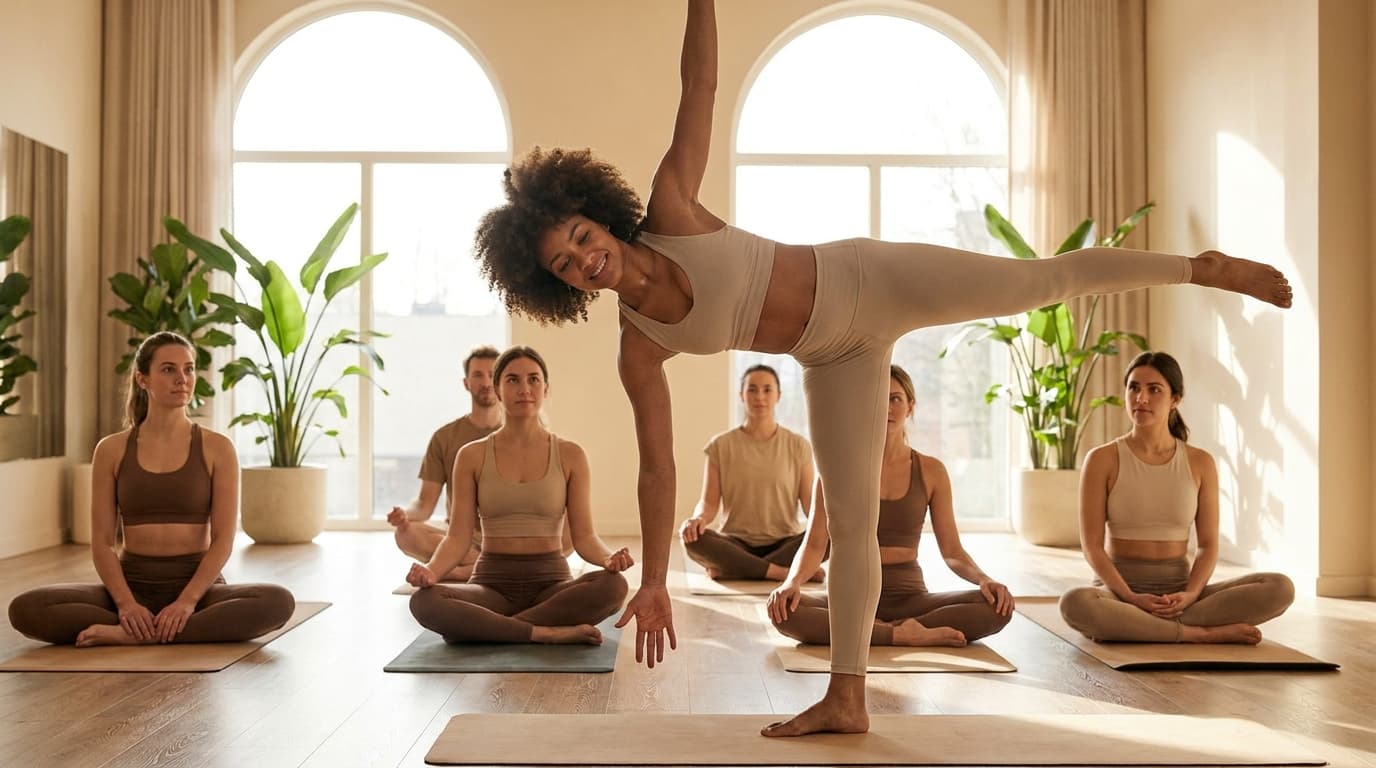
Key preparation poses: Warrior II, Triangle, Extended Side Angle, Standing splits prep
Sequence skeleton: Warm-up → Standing leg strength → Warrior series → Triangle → Extended Side Angle → Half Moon → Standing Forward Fold → Savasana
3. King Pigeon (Eka Pada Rajakapotasana)
Primary needs: Deep hip opening, Quad flexibility, Shoulder opening, Backbend capacity
Key preparation poses: Low Lunge with quad stretch, Pigeon (standard), Camel variations, Dancer Pose
Sequence skeleton: Warm-up → Hip openers → Lunges with quad stretch → Pigeon → Backbends → King Pigeon → Supine stretches → Savasana
4. Handstand (Adho Mukha Vrksasana)
Primary needs: Shoulder strength/stability, Core strength, Wrist preparation, Inversion comfort
Key preparation poses: Downward Dog, Dolphin, Forearm Plank, L-shape at wall
Sequence skeleton: Warm-up → Shoulder openers → Core work → Down Dog holds → Dolphin → L-handstand → Handstand attempts → Child's Pose → Savasana
5. Dancer Pose (Natarajasana)
Primary needs: Standing balance, Quad flexibility, Shoulder opening, Backbend
Key preparation poses: Tree Pose, Standing quad stretch, Camel prep, Bow Pose
Sequence skeleton: Warm-up → Balance work → Quad stretches → Backbends → Dancer prep → Dancer → Forward Fold → Savasana
6. Splits (Hanumanasana)
Primary needs: Extreme hamstring flexibility, Hip flexor opening, Hip stability
Key preparation poses: Standing Forward Fold, Low Lunge, Half Splits, Reclined leg stretches
Sequence skeleton: Warm-up → Hamstring stretches → Lunge series → Half Splits → Supported Splits → Full Splits → Pigeon → Savasana
7. Firefly (Tittibhasana)
Primary needs: Hamstring flexibility, Hip flexibility, Arm strength, Core engagement
Key preparation poses: Wide-Legged Forward Fold, Malasana, Crow Pose, Boat Pose
Sequence skeleton: Warm-up → Wide-leg folds → Squats → Core → Arm balances → Firefly → Seated Forward Fold → Savasana
8. Compass Pose (Parivrtta Surya Yantrasana)
Primary needs: Open hamstrings, Open shoulders, Hip external rotation, Twist capacity
Key preparation poses: Seated twists, Bound Side Angle, Head-to-Knee variations, Seated wide-angle stretches
Sequence skeleton: Warm-up → Shoulder openers → Seated stretches → Twists → Compass prep → Compass → Counter-twist → Savasana
9. Bird of Paradise (Svarga Dvijasana)
Primary needs: Hip opening, Hamstring flexibility, Balance, Bind capacity
Key preparation poses: Extended Side Angle, Bound Side Angle, Standing Hand-to-Big-Toe, Half Moon
Sequence skeleton: Warm-up → Standing poses → Side Angle series → Binding practice → Bird of Paradise → Forward Fold → Savasana
10. Eight-Angle Pose (Astavakrasana)
Primary needs: Hip flexibility, Arm strength, Core strength, Twist capacity
Key preparation poses: Elephant Trunk Pose, Side Crow, Boat Pose, Seated twists
Sequence skeleton: Warm-up → Core → Hip openers → Twists → Arm balance prep → Eight-Angle → Seated rest → Savasana
After the Peak
Immediate Counter-Pose
Right after the peak, include an immediate release:
| Peak Type | Immediate Counter |
|---|---|
| Forward Fold | Gentle extension |
| Twist | Neutral spine, opposite twist |
| Arm balance | Wrist stretches, Child's Pose |
| Hip opener | Hip-neutral pose |
Cool-Down Sequence
After the immediate counter:
Don't Skip Integration
The cool-down is where the body integrates the peak work. Rushing through it leaves the nervous system activated and feels incomplete to students.
Common Peak Pose Errors
Error 1: Peak Too Early
Problem: Doing the hardest pose in the first half of class. Fix: Peak should happen at 60-70% of class time.
Error 2: Wrong Preparation
Problem: Preparing body parts that aren't needed for the peak. Fix: Analyze the peak pose first, then build preparation list.
Error 3: Insufficient Build
Problem: One or two prep poses, then immediately to peak. Fix: Include 4-6 poses that progressively approach the peak.
Error 4: No Regression
Problem: Only teaching full expression of peak pose. Fix: Offer 2-3 levels: prep, partial, and full expression.
Error 5: Forgetting Counter-Poses
Problem: Peak pose → Savasana with nothing between. Fix: Always include counter-pose and cool-down.
Start Building Peak Pose Sequences
The peak pose method gives your classes:
Ready to design your peak pose sequence?
Try the Free Sequence Builder →
Browse our pose library with 420+ poses organized by category and preparation needs.
Frequently Asked Questions
Frequently Asked Questions (8)
What is the peak pose method in yoga?
The peak pose method is a sequencing approach where you choose one challenging pose as the 'destination' of your class, then build every other pose to prepare for it. The class structure mirrors a story arc: warm-up (exposition), building poses (rising action), peak pose (climax), cool-down (falling action), and Savasana (resolution).
How do I choose a peak pose for my yoga class?
Consider: student level (beginners need accessible peaks like Warrior II; advanced students can work toward arm balances), class theme (hip opening → Pigeon; strength → Crow), time of day (energizing peaks for morning; gentler for evening), and what you've been building toward in recent classes.
When should the peak pose happen in a yoga class?
The peak pose should occur around 60-70% through the class. In a 60-minute class, that's around the 35-45 minute mark. This allows sufficient warm-up and preparation before, and adequate cool-down and Savasana after.
What makes a good peak pose for beginners?
Good beginner peak poses are challenging but accessible: Warrior II (strength and alignment), Tree Pose (balance), Triangle (multiple elements), Bridge Pose (backbend), and Pigeon (hip opening). These poses feel like accomplishments without requiring advanced flexibility or strength.
How many preparation poses do I need before a peak pose?
Generally, include 4-8 poses that specifically prepare for your peak, plus general warm-up. More complex peaks need more preparation. For Wheel Pose, you might need 6-8 specific prep poses; for Triangle, 3-4 might suffice. Quality matters more than quantity.
What should come after the peak pose in yoga?
After the peak: immediate counter-pose (Knees to Chest after backbends), 2-3 gentle floor poses, supine twist, and full Savasana. This cool-down allows the body to integrate the peak work and the nervous system to calm.
Can a yoga class have multiple peak poses?
A single peak is usually most effective—it gives clear focus. However, you can have a 'primary peak' and a 'secondary peak' if they require similar preparation (e.g., Wheel and Camel both need similar prep). Avoid multiple peaks that need completely different preparation.
How do I modify peak poses for different levels?
Offer 2-3 levels: preparation version (e.g., Crow with toes on floor), partial expression (e.g., one foot lifted in Crow), and full pose. Describe all options positively and let students choose. Everyone should feel successful at their level.