
Table of Contents
Introduction: Before We Begin, Let's Clear the Air
If you've ever peeked through the window of a vinyasa class and thought "that looks impossible" — this guide is for you. And if you're a teacher preparing to lead your first beginner vinyasa class, this is for you too.
Vinyasa yoga has a reputation problem. It looks athletic, fast, and intimidating from the outside. New students assume they need to be fit to start, flexible to begin, or experienced to keep up. None of that is true. Vinyasa, at its core, is simply movement linked to breath — and literally anyone who is breathing can practice it.
In this guide, we'll demystify vinyasa completely: what it actually is, how it differs from other styles, what beginners commonly misunderstand, and exactly what to teach (or do) in a 60-minute beginner class. We've included modifications for every single pose, because good teaching means every body is included.
What Vinyasa Actually Means
The word vinyasa comes from Sanskrit: vi (in a special way) + nyasa (to place). Literally, it means "to place in a special way." In practice, it refers to the intentional linking of movement with breath.
Every time you inhale and reach your arms overhead, then exhale and fold forward — that's vinyasa. The breath is not background music to movement; it IS the movement. Breath leads, body follows.
This principle, simple as it sounds, is what makes vinyasa different from calisthenics, stretching, or even some other styles of yoga. The breath is the metronome. When a student loses their breath, they've lost the practice — not when they fall out of a pose.
In modern studios, vinyasa often refers to a specific flowing sequence (Plank → Chaturanga → Upward Dog → Downward Dog) used as a reset between pose sequences. But at its heart, the word just means: move with intention, move with breath.
Vinyasa vs. Hatha: What's the Difference?
Students ask this constantly. Here's the clearest breakdown:
Hatha yoga holds each pose for several breaths (sometimes longer) before moving to the next. There's typically a pause and reset between poses. It's excellent for learning alignment, body awareness, and individual pose technique. The pace is measured and deliberate.
Vinyasa yoga flows from pose to pose, linked by breath. There's less time in each individual position. The experience is more dynamic, often warmer, and tends to feel more like a moving meditation once the student is comfortable with the shapes.
Think of it this way: Hatha is like learning to drive by practicing in a parking lot. Vinyasa is driving on an open road. Both require the same fundamental skills — but the experience feels very different.
For beginners, a well-taught beginner vinyasa class is absolutely appropriate. The key word is well-taught. A beginner-appropriate vinyasa class moves at a pace where students can breathe, offers modifications freely, and prioritizes sensation over accomplishment.
5 Misconceptions Beginners Carry Into Their First Class
1. "I need to be flexible first."
Flexibility is not a prerequisite for yoga — it's an outcome. You don't need to be flexible to begin any more than you need to be fit before you start exercising. Come as you are.
2. "I'll slow everyone down."
In a beginner class, everyone IS the beginner. And in a mixed class, good teachers sequence so that students who need more time have more time. You are never in anyone's way.
3. "Vinyasa is too advanced for me."
Advanced yoga is not about the shapes. It's about the depth of awareness you bring to whatever you're doing. A beginner in Child's Pose with full presence is practicing more advanced yoga than an acrobat going through the motions.
4. "I'll look stupid."
Everyone wobbles. Everyone falls out of balance. Every teacher you admire fell over in Tree Pose at some point. The studio is a judgment-free zone — and if it isn't, find a different studio.
5. "I have to do what the teacher does exactly."
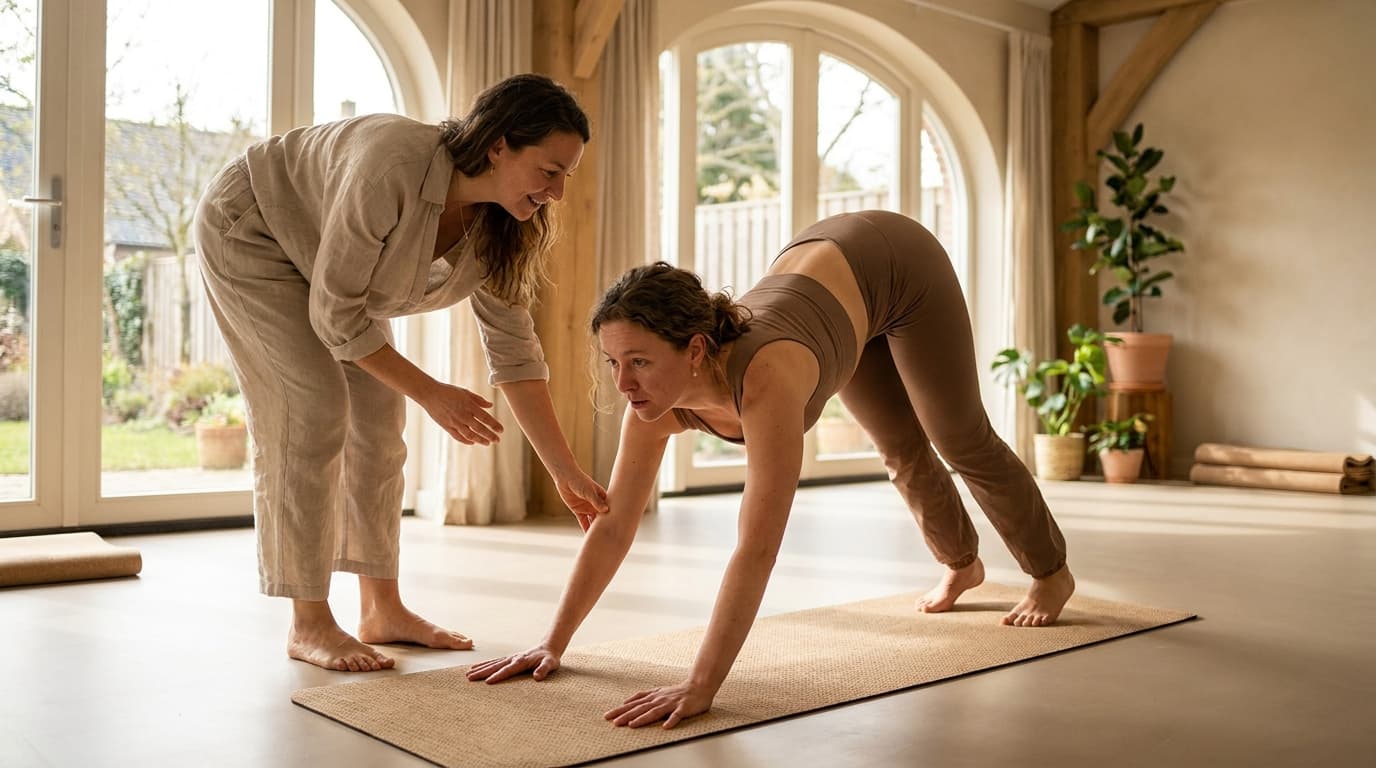
Modifications are not failures. They are intelligent choices. A student who takes Child's Pose when they need rest is more in tune with their body than one who forces through exhaustion to look capable.
Pro Tip: Print this list and share it with students before their first class. Dissolving these misconceptions before class starts dramatically improves the experience.
10 Foundational Poses Every Beginner Needs
These are the building blocks of a beginner vinyasa class. Teach these shapes well, and students can navigate most beginner and intermediate sequences.
You can explore all of these in our pose library, which includes alignment cues, modifications, and contraindications.
Build this sequence on your phone
The same 420+ pose library and drag-and-drop builder, free on iPhone, iPad and Android.
A Complete Annotated 60-Minute Beginner Vinyasa Class
This is a real, teachable class. Times are approximate. Modifications are included at each section.
Arrival and Centering (0-5 minutes)
Invite students to find a comfortable seat. Offer props freely.Guide a simple body scan, inviting students to notice where they're holding tension without trying to fix anything. Introduce three-part breath (diaphragm, ribcage, chest). Offer the intention of curiosity — "notice what you actually feel today, not what you think you should feel."
Warm-Up: Awakening the Spine (5-15 minutes)
All poses done slowly, 3-5 breaths each.Standing Sequence (15-35 minutes)
The heart of the class. Move slowly — one breath per movement at first, then hold key shapes.Sun Salutation A (Simplified):
Mountain → Forward Fold → Halfway Lift → Step back to Plank → Lower to ground → Cobra → Child's Pose → Downward Dog → Walk or step feet forward → Halfway Lift → Forward Fold → Mountain.
Do this 2 times with the class watching, then 2 times together slowly. Modification: Skip Chaturanga entirely — go from Plank directly to Child's Pose or lower to belly for Cobra.
Warrior Sequence (right side, then left):
Balance Pose (35-42 minutes)
Go here only if the energy is good. Otherwise, stay floor-based.Floor Work and Cool-Down (42-55 minutes)
Savasana (55-60 minutes)
5 full minutes minimum. Cover students with a blanket if available. Offer an eye pillow. Guide a brief body relaxation — "let the floor hold you completely." Then fall silent. Ring a soft bell to close.
Modifications for Every Body
Wrist sensitivity: Fists (knuckles down), forearm plank, or use a wedge under the heels of the hands.
Tight hamstrings: Bent knees in all forward folds, blanket under knees in seated poses, blocks under hands in Down Dog.
Knee issues: Skip deep lunges, use a folded blanket under the knee in Low Lunge, avoid forced flexion in seated poses.
Neck tension: Gaze at the floor in Warrior I rather than looking up. Support the head with a rolled blanket in savasana.
Lower back pain: See our dedicated guide on yoga flows for lower back pain for specific modifications and contraindications.
Pro Tip: At the start of class, invite students to share any injuries or limitations privately or by raising a hand. A 30-second check-in saves you from scrambling mid-class and shows students you genuinely care.
Teaching Tips for Your First Beginner Vinyasa Class
Set up the room for success. Arrange mats so every student can see you. Make props (blocks, straps, blankets) visible and normalized — not tucked in a corner like they're for the weak. Say explicitly: "Blocks are not for beginners. They are for intelligent practitioners."
Your first five minutes matter most. Students are nervous. They're scanning the room, judging themselves, wondering if they belong. Use your opening to normalize difficulty, celebrate showing up, and invite curiosity over accomplishment.
Cue breath constantly, especially in challenge moments. When students are struggling, the breath is the lifeline. "If you've lost your breath, take the easier version. The pose isn't worth it without the breath."
Speak in plain language. "Left knee over left ankle" lands better than anatomical terminology in a beginner class. Save Sanskrit for after students know the shapes.
Teach less, teach it better. Beginner students don't need 30 different poses. They need 10 poses taught deeply, with time to feel them. Resist the urge to overfill the class.
Use FLOW's free sequence builder to map out your beginner class in advance. Seeing the arc visually — warmup, building, peak, cool-down — helps you pace transitions and ensure you're not front-loading or rushing the ending.
For a broader look at building beginner flows, our beginner yoga flows guide covers pacing, language, and common structural mistakes in detail.
Frequently Asked Questions
Q: How often should a beginner practice vinyasa?
Two to three times per week is an excellent starting point. This allows the body to adapt and recover between sessions while building familiarity with the foundational shapes quickly.
Q: Is vinyasa yoga good for weight loss?
Vinyasa yoga burns more calories than gentle or yin yoga due to its dynamic nature, but it's most powerful as part of an overall wellness practice. Many students find that vinyasa supports healthy habits, stress reduction, and body awareness more than direct calorie expenditure.
Q: What should a beginner bring to their first vinyasa class?
A mat (most studios provide them), comfortable clothes that move freely, a water bottle, and an open mind. No special equipment is needed. Arrive 10-15 minutes early to introduce yourself to the teacher and mention any physical considerations.
Q: How long does it take to feel comfortable in vinyasa?
Most students begin to feel at home in vinyasa after 8-12 classes. The first 3-4 are typically disorienting — this is completely normal. Progression is not linear, and it helps to take the same beginner class multiple times before advancing.
Q: Can someone with no yoga experience take a vinyasa class?
Yes, especially a class specifically designated for beginners. If it's an all-levels class, speak to the teacher beforehand. A good teacher will be able to scale the practice to meet you exactly where you are.
Frequently Asked Questions (5)
How often should a beginner practice vinyasa?
Two to three times per week is an excellent starting point. This allows the body to adapt and recover between sessions while building familiarity with the foundational shapes quickly.
Is vinyasa yoga good for weight loss?
Vinyasa yoga burns more calories than gentle or yin yoga due to its dynamic nature, but it's most powerful as part of an overall wellness practice. Many students find that vinyasa supports healthy habits, stress reduction, and body awareness more than direct calorie expenditure.
What should a beginner bring to their first vinyasa class?
A mat (most studios provide them), comfortable clothes that move freely, a water bottle, and an open mind. No special equipment is needed. Arrive 10-15 minutes early to introduce yourself to the teacher and mention any physical considerations.
How long does it take to feel comfortable in vinyasa?
Most students begin to feel at home in vinyasa after 8-12 classes. The first 3-4 are typically disorienting — this is completely normal. Progression is not linear, and it helps to take the same beginner class multiple times before advancing.
Can someone with no yoga experience take a vinyasa class?
Yes, especially a class specifically designated for beginners. If it's an all-levels class, speak to the teacher beforehand. A good teacher will be able to scale the practice to meet you exactly where you are.