
Table of Contents
Introduction
There is a reason sun salutations have been practiced for thousands of years. In a single flowing sequence, they warm every major muscle group, synchronize breath with movement, build heat from the inside out, and focus a wandering mind. For yoga teachers, sun salutations are the most versatile tool in the kit — they can open a class, form the backbone of a 60-minute session, or stand alone as a complete daily practice.
Yet despite their familiarity, sun salutations are often taught on autopilot. Students rush through the shapes. Teachers call out poses without cues. The breath gets lost. The result feels mechanical rather than meditative.
This guide is for teachers who want to teach sun salutations with precision and intention. We will walk through the complete 12-step sequence, explore five meaningful variations, and share exactly how to build an entire class around surya namaskar — including pacing guidance for beginners, intermediates, and advanced students.
If you want to map out your full class before you teach it, FLOW's free sequence builder lets you drag and drop every pose, set timings, and print or share your sequence in minutes.
What Is a Sun Salutation?
Surya Namaskar — sun salutation in Sanskrit — is a linked series of yoga poses performed in a continuous, breath-coordinated flow. The practice dates back centuries in various forms, though the specific 12-step sequence most widely taught today was popularized in the early 20th century and later integrated into Ashtanga and Vinyasa traditions.
On a physical level, sun salutations do a remarkable amount of work. They lengthen the spine in both directions (forward fold and backbend), open the shoulders and chest, strengthen the core and arms, and stretch the hip flexors and hamstrings. Done at a moderate pace, they elevate the heart rate and increase circulation to the joints, making them an ideal warm-up for deeper pose work.
On a subtler level, the breath-movement synchronization activates the parasympathetic nervous system even as the body heats up — a paradox that practitioners describe as alert calm. This is one reason the sequence is taught at the beginning of class: it transitions students from the distracted state of daily life into a focused, embodied awareness.
Sun salutations come in several forms. The two most taught in modern classes are:
The 12 Steps Explained
Below is the classic Sun Salutation A with cueing notes for each transition. Note that what gets counted as "12 steps" can vary slightly by tradition — this is the most widely used version.
1. Mountain Pose (Tadasana)
Stand at the top of your mat, feet together or hip-width apart. Ground through all four corners of the feet. Stack hips over ankles, shoulders over hips. Hands at heart center. This is the pause before the flow — invite students to arrive here fully before moving.
Cue: "Feel your feet on the mat. Take one breath to arrive here completely."
2. Upward Salute (Urdhva Hastasana)
Inhale: Sweep the arms out and overhead, palms together or shoulder-width. Lift through the fingertips without compressing the low back.
Cue: "Inhale, reach your arms overhead. Lift out of the waist — make space between every vertebra."
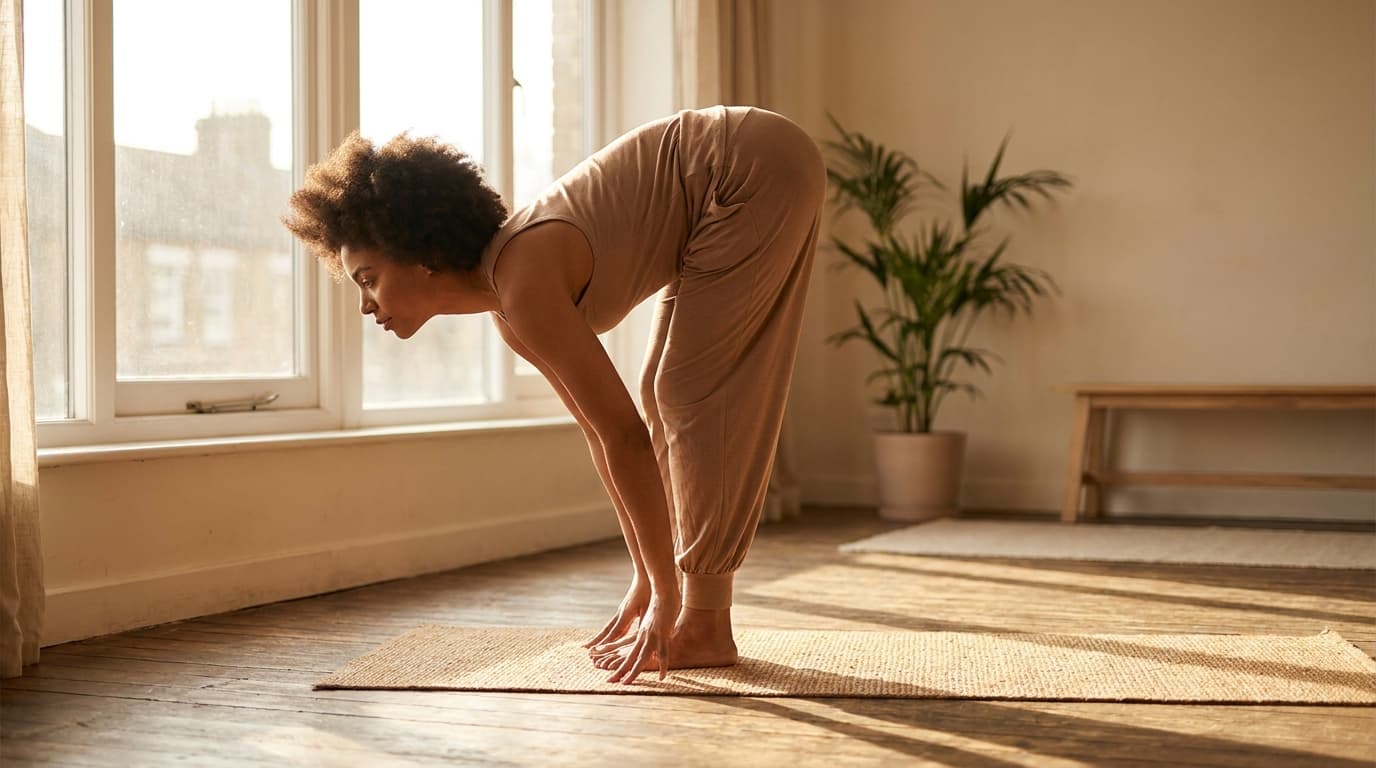
3. Standing Forward Fold (Uttanasana)
Exhale: Hinge at the hips, release the crown of the head toward the floor. Bend the knees generously. Let the neck relax completely.
Cue: "Exhale, fold forward. Soft knees. Let gravity do the work."
4. Half Lift (Ardha Uttanasana)
Inhale: Lengthen the spine, hands to shins or fingertips to the floor. Look forward with a long neck.
Cue: "Inhale, halfway lift. Long spine, flat back. Collar bones wide."
5. High Plank or Four-Limbed Staff (Chaturanga Dandasana)
Exhale: Step or jump back to plank. Lower slowly with elbows hugging the ribs, stopping when upper arms are parallel to the floor. This is where most students need the most attention.
Cue: "Exhale, step back to plank. Squeeze the elbows in. Lower halfway — hold the integrity of the pose."
Pro Tip: Most students lower too fast and collapse the chest in chaturanga. Teach them to pause at the top of plank for one breath before lowering. This builds the strength needed to do the transition safely.
6. Upward-Facing Dog (Urdhva Mukha Svanasana) or Cobra (Bhujangasana)
Inhale: Roll over the toes or flip to the tops of the feet. Press the tops of the feet and the hands into the mat. Lift the thighs off the floor for up-dog, or keep them down for cobra. Open the chest and roll the shoulders back.
Cue (up-dog): "Inhale, roll to the tops of the feet. Lift the thighs. Press through the hands. Open the chest."
Cue (cobra): "Inhale, peel the chest up. Keep the elbows soft. Use your back muscles, not your arms."7. Downward-Facing Dog (Adho Mukha Svanasana)
Exhale: Tuck toes, lift hips up and back. Press the floor away with spread fingers. Let the heels lower toward the mat — they do not need to touch.
Cue: "Exhale, downward dog. Press the floor away. Long spine. Soft knees if needed. Breathe here for five breaths."
8. Half Lift (Ardha Uttanasana)
Inhale: Walk or jump to the top of the mat. Halfway lift — long spine.
9. Standing Forward Fold (Uttanasana)
Exhale: Fold deeply.
10. Upward Salute
Inhale: Rise with a long spine, sweeping arms overhead.
11. Mountain Pose
Exhale: Hands to heart. Arrive back where you began — but not the same as when you left.
12. Rest / Pause
Many teachers include a brief pause here to feel the effects before beginning the next round. This moment of stillness is as important as the movement.
Sun Salutation B: The Extended Version
Sun Salutation B follows the same structure but opens with chair pose (Utkatasana) before the forward fold, and adds warrior I on each side after downward dog. This creates a longer, more heating sequence with significant leg and hip work.
Key additions in Sun Sal B:
Sun Salutation B typically takes twice as long as A. For a 60-minute class built around sun salutations, alternating A and B gives students a good balance of intensity and recovery.
Build this sequence on your phone
The same 420+ pose library and drag-and-drop builder, free on iPhone, iPad and Android.
5 Sun Salutation Variations
One of the most important skills a yoga teacher develops is the ability to adapt. Here are five variations that make sun salutations accessible and interesting for different populations.
1. Half Sun Salutation
Perfect for beginners or as a warm-up within a warm-up. The sequence goes: mountain pose → upward salute → standing forward fold → half lift → forward fold → rise back to upward salute → mountain pose. No floor work, no chaturanga. Students can feel the breath-movement connection without the complexity of the full sequence.
When to use: Opening rounds of a beginners class, senior yoga, prenatal classes, or as a recovery option when students are tired.
2. Chair Sun Salutation
All the same shapes, done while seated in a chair or standing beside one for support. Arms reach overhead, trunk folds forward over the thighs, a gentle spinal extension replaces cobra. This variation is genuinely meaningful — it is not a compromise but a legitimate practice.
When to use: Chair yoga classes, accessible yoga, corporate wellness, rehabilitation settings, or any time mobility prevents floor work.
3. Moon Salutation (Chandra Namaskar)
Where sun salutations are linear and forward-backward, moon salutations move laterally and are traditionally practiced in the evening or under a full moon. The sequence includes wide-legged standing poses, crescent lunge, goddess pose, and side stretches. The pace is slower and the feeling is cooling rather than heating.
When to use: Evening classes, yin-vinyasa transitions, or when your class needs grounding rather than stimulation.
4. Seated Adaptation
Performed on the mat with no standing. A modified standing forward fold becomes seated forward fold, cobra replaces up-dog, child's pose replaces down-dog. This version honors the spirit of the sequence for those with lower extremity limitations.
When to use: Students with hip or knee replacements, significant balance challenges, or those working with chronic pain.
5. Power Sun Salutation
The classic sequence accelerated, often with added jump-throughs, arm balances, or extra chaturangas. Some teachers insert crow pose or side plank after down-dog. Pace is faster, breath is shorter, heat builds rapidly.
When to use: Advanced vinyasa classes, flow-focused workshops, heated yoga environments. Always ensure students have the foundation before adding intensity.
Teaching Tips and Cueing
The Breath Is the Teacher
In sun salutations, the breath is more important than the shape. If students are holding their breath, they are doing the sequence incorrectly — no matter how perfect their chaturanga looks. Return to the breath repeatedly in your cuing.
Use Minimalist Cues
A common mistake is over-cueing. With 12 shapes flowing on one breath each, there is no room for paragraphs of instruction. Aim for one cue per pose — either the action, the alignment point, or the breath. Vary what you choose each round.
Instead of: "Now as you step your right foot forward between your hands, make sure your knee is stacking over your ankle and your back heel is pressing down and your arms are coming up toward the ceiling..."
Try: "Step forward. Arms rise. Feel the length of the lunge."
Pace for the Population
| Class Level | Recommended Pace |
|---|---|
| All Levels | 1-2 breaths per pose for the flow, 5 in down-dog |
| Intermediate | 1 breath per pose, hold down-dog 3 |
| Advanced | Flow, or add holds for challenge |
Mirror Your Students
When demonstrating, face away from students to avoid left-right confusion. Or use the "reverse image" method — when facing students, physically mirror what they should do so your right becomes their left.
Teach Chaturanga Separately
Do not assume students know how to lower safely. Before the first full round, demonstrate the low-to-high push-up motion from the knees. Tell students that cobra is always a valid choice and that protecting the shoulders is more important than performing the "full" version.
Pro Tip: Assign a "research round" — one full sun salutation where students explore on their own without your cues. This builds proprioception and independence. Follow it with one round where you cue with precision. The contrast is powerful.
Common Mistakes to Avoid
1. Collapsing in chaturanga. The most common injury risk in the sequence. Teach students to lower with control and to use cobra instead. There is no shame in cobra — it is the pose for most bodies.
2. Dumping into the low back in up-dog. Students tend to crank the neck back and compress the lumbar. Cue length through the spine and engagement of the legs.
3. Rushing through the sequence. When pace outstrips breath, the practice becomes aerobic exercise without the meditative quality. Slow down.
4. Ignoring the half lift. This transitional pose is often skipped. But ardha uttanasana lengthens the spine and sets up the jump-back. Teach students to actually arrive here.
5. Teaching the same two rounds, the same way, every class. Vary pace, variation, focus, and cueing. Sun salutations should feel fresh each time.
Building a 60-Minute Class Around Sun Salutations
Sun salutations are flexible enough to structure an entire class. Here is one framework that works beautifully:
Phase 1: Centering (5 minutes)
Seated or supine. Pranayama or body scan. Introduce the theme — the quality you want students to carry through the practice.
Phase 2: Half Sun Salutations (5 minutes)
2 to 3 rounds of the half version. Establish breath-movement rhythm without overwhelming anyone.
Phase 3: Full Sun Salutation A (15 minutes)
4 to 6 rounds. First round very slow with full cuing. Middle rounds fluid. Final round silent — let students practice independently.
Phase 4: Sun Salutation B (15 minutes)
3 to 4 rounds with warrior I on each side. Teach warrior I alignment in the first round. Build fluency in subsequent rounds.
Phase 5: Standing Pose Peak (10 minutes)
The heat generated by sun salutations makes this the ideal time for warrior II, triangle, or any peak pose. The body is warm, the nervous system is engaged.
Phase 6: Floor Work and Cool-Down (7 minutes)
Hip openers, supine twists, or anything that counters the backbending of the sequence.
Phase 7: Savasana (3 minutes)
Short but non-negotiable. This is when the body integrates the practice.
Want to plan this class in advance? FLOW's free sequence builder lets you map out every phase, set timing for each section, and print a clean cue sheet to bring to class. You can also explore our full pose library to find the perfect standing poses for phase five.
For a broader look at sequencing principles, check out our guide on how to create a yoga sequence — it covers the full arc of class planning from warm-up to savasana.
Frequently Asked Questions
Frequently Asked Questions (6)
How many sun salutations should I include in a 60-minute class?
For a standard vinyasa class, 6 to 12 rounds is typical. Begin with 3 slow, instructional rounds for warm-up, then build speed for 3 to 6 dynamic rounds before moving into standing poses. For an all-levels class, 4 to 6 mindful rounds is usually enough.
What is the difference between Sun Salutation A and Sun Salutation B?
Sun Salutation A is the foundational 12-step sequence using mountain pose, forward fold, plank, cobra or upward dog, and downward dog. Sun Salutation B adds chair pose (Utkatasana) at the beginning and warrior I on each side, making it longer, more heating, and more challenging.
Is it safe to teach sun salutations to complete beginners?
Yes, with modifications. Use the half sun salutation or chair variation and spend extra time on each shape. Avoid pressuring students through chaturanga before they have the strength. The seated adaptation is excellent for absolute beginners or those with mobility concerns.
How do I cue breath in sun salutations without losing the class?
Give the breath cue before the movement cue. Say "inhale, reach your arms overhead" rather than "arms overhead, inhale." This trains students to breathe first and move second, which is the whole point of vinyasa. Keep cues short — one breath, one word.
Can I adapt sun salutations for students with wrist injuries?
Absolutely. Common adaptations include coming onto fists for plank and chaturanga, using yoga blocks under the hands to reduce wrist extension, shifting weight back in downward dog, or replacing floor-based poses with dolphin pose (forearm variation) throughout.
How do I use FLOW to plan a sun salutation class?
Open FLOW's free sequence builder and start with mountain pose, then add the 12 sun salutation poses in order. You can duplicate the sequence block, add your standing poses after, and see the full class at a glance. It saves hours of prep time.