
Table of Contents
Introduction
There is something magnetic about a heated yoga room. The moment the door opens and warm air rolls out, students either light up with anticipation or take a cautious half-step back. As a hot yoga teacher, you work with a unique environment — one that amplifies every physical sensation, demands heightened safety awareness, and produces results that students often describe as transformative.
Whether you are new to teaching in the heat or looking to move beyond the classic Bikram script and build your own heated sequence, this guide walks you through everything you need: the history that shaped modern hot yoga, the science behind the benefits, a thorough breakdown of the 26+2 poses with usable cues, and a practical framework for designing your own legally distinct hot yoga class.
If you want to start building your sequence right now, FLOW's free sequence builder lets you drag and drop poses, organize them into a heated-class structure, and add timing and cue notes — all in your browser.
Hot Yoga History: Bikram, the 26+2, and Modern Evolution
Bikram Choudhury and the 26+2 Series
Hot yoga as a mainstream phenomenon traces almost entirely to one man: Bikram Choudhury, an Indian-American yoga teacher who in the early 1970s began teaching a fixed sequence of 26 Hatha yoga postures and 2 pranayama exercises in a room heated to replicate the climate of Kolkata. His stated rationale was physiological — heat increases flexibility by warming connective tissue, and the specific sequence was designed so that each posture compressed and released the body's organs and glands in a deliberate order, like "wringing out a wet cloth."
Choudhury opened his Beverly Hills studio in 1974, and his method grew rapidly. By the 1990s, Bikram Yoga College of India had trained thousands of instructors worldwide. The practice was distinctive: 90 minutes, 40°C, the same 26 poses in the same order every single class, scripted dialogue delivered in a specific tone, no music. Students who loved it loved the predictability. Knowing exactly what was coming allowed them to push deeper each session.
The Copyright Case That Changed Everything
For decades, Choudhury aggressively enforced copyright over his sequence, threatening studios that taught similar formats. That changed in 2015 when the Ninth Circuit Court of Appeals ruled in Bikram's Yoga College of India v. Evolation Yoga that yoga sequences — like other forms of exercise — cannot be copyrighted. The court applied the merger doctrine: because there are only so many ways to express a sequence of yoga poses that achieves a particular physiological purpose, protecting the sequence would effectively give one person a monopoly on the underlying idea.
This ruling opened the field. Former Bikram teachers who had distanced themselves from Choudhury (who later faced serious criminal allegations) were now free to teach 26+2-inspired classes under independent branding. Organizations like Bishnu Ghosh's lineage schools and the 26+2 Project now offer non-Bikram certifications in the same sequence. Independent studios began teaching their own hot yoga formats freely.
Modern Hot Yoga: A Diverse Landscape
Today "hot yoga" is an umbrella covering a wide range of formats:
Understanding this landscape helps you position your own class clearly for students.
Science-Backed Benefits of Hot Yoga
The claim that "hot yoga detoxifies the body" has become one of the most debated statements in wellness. Here is what the research actually shows — and what it doesn't.
Cardiovascular Benefits
A 2013 study published in The Journal of Strength and Conditioning Research found that a single Bikram yoga session produced heart rate and metabolic responses comparable to moderate-intensity aerobic exercise (around 57% of VO2 max for experienced practitioners, and significantly higher for beginners). This places hot yoga in the "moderate" cardiovascular benefit zone — meaningful, though not equivalent to vigorous running or cycling.
A larger 2018 study from Colorado State University tracked participants through an 8-week Bikram program and found modest but statistically significant improvements in cardiovascular fitness, lower body strength, and deadlift performance compared to a control group.
Flexibility and Connective Tissue
Warm muscles and connective tissue genuinely are more extensible. Research consistently shows that passive flexibility improves faster in heated conditions. A 2013 Texas State University study found Bikram practitioners had significantly greater flexibility in the lower back and hamstrings compared to non-practitioners. The heat allows students to safely explore a deeper range of motion — though teachers must consistently remind students not to overstretch simply because they can.
Bone Density
A study published in the Journal of Yoga & Physical Therapy found that premenopausal women who practiced Bikram yoga for five years had significantly greater bone mineral density in the neck and hip compared to controls. This is a noteworthy finding given yoga's relatively low-impact nature.
Mental Health and Stress Reduction
Hot yoga shares the psychological benefits of yoga broadly: reduced cortisol, improved mood, better sleep. The specific focus required to maintain form in an uncomfortable environment also builds mental resilience. Many practitioners report that managing physical challenge in the heated room teaches them to stay calm under general life stress.
The "Detox" Claim
Sweating does not meaningfully detoxify the body beyond what the liver and kidneys perform continuously. The body eliminates trace amounts of heavy metals and other compounds through sweat, but the volume is clinically negligible. Be honest with your students about this — the real benefits (cardiovascular improvement, flexibility, stress reduction) are compelling without the detox mythology.
Pro Tip: When students ask about detox, redirect to the real science. "The heat helps your muscles release more deeply, and the intensity gives your cardiovascular system a real workout — that combination is genuinely powerful" is both accurate and compelling.
The 26+2 Poses Explained with Teaching Cues
The traditional Bikram sequence moves through a logical physiological arc: beginning with standing balance and strength postures, transitioning to floor work, and concluding with spinal twisting and forward folding. Below is an overview of each posture with key alignment cues.
You can explore the full details of individual poses in our pose library.
Standing Series (Postures 1–20)
1. Pranayama (Standing Deep Breathing) — Standing with hands interlaced under the chin, students inhale to open elbows wide, exhale to close elbows and drop the head back. Six rounds. This activates the respiratory system and begins warming the body gently. Cue: "Let the breath lead; elbows to ears on the inhale."
2. Half Moon Pose (Ardha Chandrasana with Pada Hastasana) — A side bend plus forward fold combination. Cue alignment: "Stack your hips, lengthen the side body before bending. Arms stay glued to your ears throughout."
3. Awkward Pose (Utkatasana — three parts) — The first of three sections is a standard chair pose. The second rises to tiptoes. The third brings the thighs parallel with toes pointed forward. Cue: "Keep the weight in the heels as you sit back."
4. Eagle Pose (Garudasana) — Standing balance with arms and legs wrapped. Cue: "Sink the hips before wrapping. Elbows at shoulder height."
5. Standing Head to Knee (Dandayamana Janushirasana) — A challenging standing balance holding the foot with both hands, eventually extending the leg and bringing forehead to knee. Most students work at earlier stages; never rush the progression.
6. Standing Bow Pose (Dandayamana Dhanurasana) — Kick back and up while tipping forward, creating a full bow shape from one standing leg. Cue: "Kick as much as you stretch forward — equal effort in both directions."
7. Balancing Stick (Tuladandasana) — A T-shape balance, arms forward, leg extended behind. Held for only 10 seconds but intensely cardiovascular. Cue: "One straight line from fingertips to heel."
8. Standing Separate Leg Stretching (Dandayamana Bibhaktapada Paschimotthanasana) — Straddle stance, forward fold with hands interlaced behind the head. Cue: "Separate the feet four to five feet. Fold from the hip crease, not the waist."
9. Triangle Pose (Trikonasana) — A vigorous version with bent front knee. Cue: "Knee over ankle, open the chest to the ceiling."
10. Standing Separate Leg Head to Knee Pose (Dandayamana Bibhaktapada Janushirasana) — Turn to face front, forward fold over one straight leg. Cue: "Chin tucked, round the back intentionally."
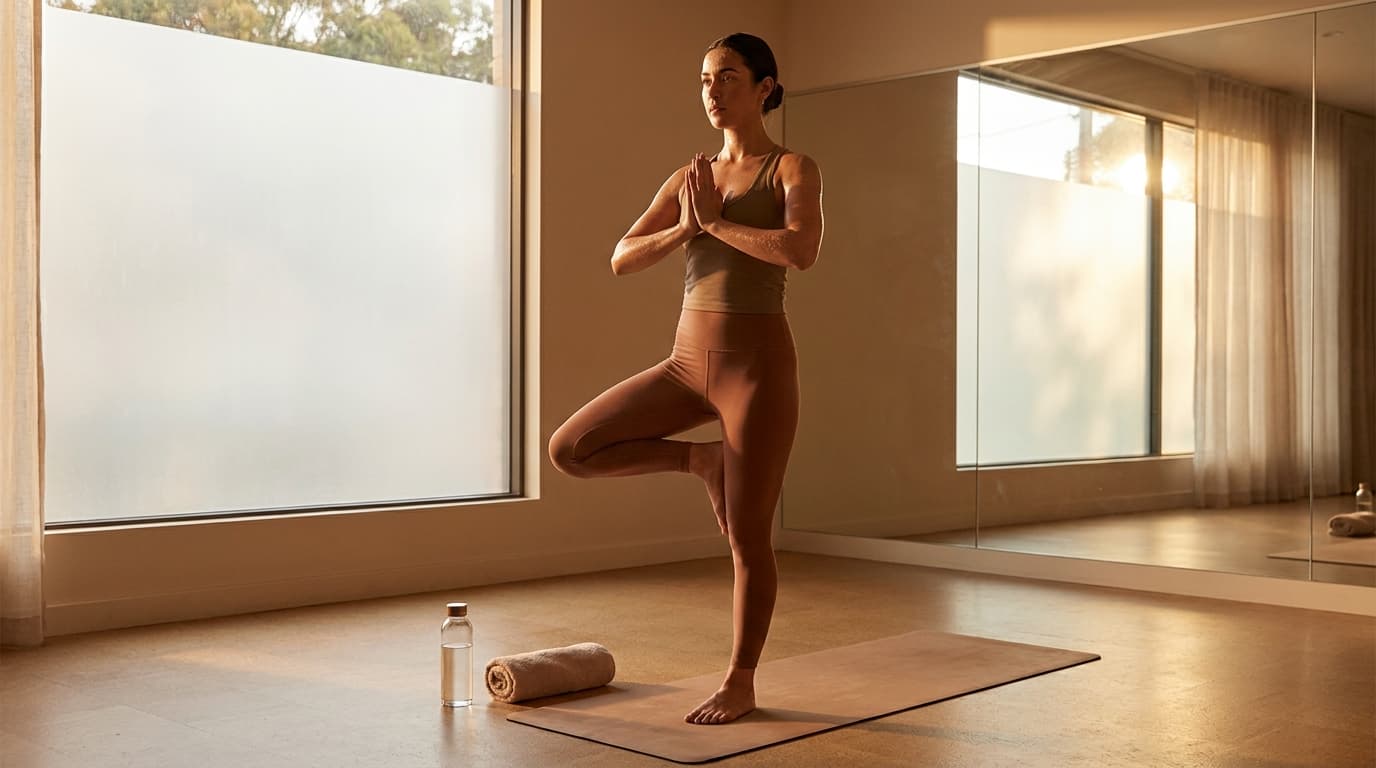
11. Tree Pose (Tadasana) — Standing balance with foot at inner thigh, hands at prayer. Cue: "Gaze fixed, breathe normally."
12. Toe Stand (Padangustasana) — From tree, lower to balance on one bent knee, foot on tiptoe. Modifications for tight knees: keep the foot lower or practice tree only.
Standing series continues through postures 13–20 addressing back strengthening, hip flexibility, and spine mobility...
Floor Series (Postures 21–26)
21. Dead Body Pose (Savasana) — Two minutes between each floor posture. This is not optional downtime — it is physiologically essential for integration and recovery.
22. Wind Removing Pose (Pavanamuktasana) — On the back, draw one knee to chest, then both. Massages the digestive organs. Cue: "Hold the shin, not the knee cap."
23. Sit Up — A vigorous abdominal exercise between postures. Arms reach overhead then forward-fold over extended legs.
24. Cobra Pose (Bhujangasana) — Low cobra, elbows bent, using spinal strength rather than arm push. Cue: "Shoulders away from ears. How high can you lift with just your back muscles?"
25. Locust Pose (Salabhasana — three parts) — Single leg lift, then both legs, then full body lift. Cue: "Arms under the body, palms face down."
26. Full Locust / Bow Pose (Dhanurasana) — Reach back for ankles, kick feet into hands to lift the chest. Cue: "Look up, breathe, kick."
Followed by Fixed Firm, Half Tortoise, Camel, Rabbit, Head to Knee with Stretching Pose, and Spine Twisting Pose — each building on the preceding backbends to create a complete spinal wave.
Breathing Exercise (Kapalbhati) closes the series — a rapid exhalation exercise that energizes and clears the airways.
Build this sequence on your phone
The same 420+ pose library and drag-and-drop builder, free on iPhone, iPad and Android.
Creating Your Own Legal Hot Yoga Sequence
Since the 2015 ruling, you are legally free to teach any yoga sequence in a heated room. Here is how to build one that is thoughtful, effective, and distinctly yours.
The Physiological Framework
A well-designed hot yoga class follows this arc regardless of specific poses:
Choosing Your Poses
Begin with poses from our pose library that you know well and have taught confidently. For a hot yoga format, prioritize:
Using FLOW to Build Your Sequence
FLOW's free sequence builder is purpose-built for exactly this work. You can organize your class into phases, drag poses into your preferred order, add personalized cues and timing notes, and share the sequence digitally with assistants or studio managers. Many hot yoga teachers use FLOW to standardize their class structure across multiple instructors teaching in the same studio — ensuring consistent quality even when the head teacher is absent.
Room Setup: Temperature, Humidity, and Equipment
Temperature and Humidity
The classic Bikram environment is 40°C (104°F) at 40% relative humidity. Modern hot yoga studios often moderate this slightly:
Humidity matters enormously. At low humidity, sweat evaporates quickly, cooling the body effectively but potentially causing faster dehydration. At high humidity (above 60%), sweat cannot evaporate, body temperature rises faster, and heat exhaustion risk increases. The 40% figure is a carefully considered midpoint.
Heating Systems
Conventional HVAC heating (forced air) is the most common. It heats the room uniformly but can dry the air. A separate humidifier is typically needed.
Infrared panels emit radiant heat that warms bodies and objects directly rather than heating air. Many practitioners prefer infrared for a less stifling feel. Setup cost is higher but operating costs are often lower.
Flooring and Equipment
Pro Tip: Check your room temperature and humidity before every single class, not just at the start of the day. HVAC systems drift. A room that was 38°C at 9am may be 41°C by 11am if the system is underpowered.
Safety Protocols and Hydration Guide
Hydration Protocol for Students
Teach this to every new student and repeat it regularly for your regulars:
24 hours before: Drink consistently throughout the day — not just in the final hours before class. Aim for 2–3 litres of water or electrolyte-containing beverages depending on body size and activity level.
2–3 hours before: Avoid a full meal. A small snack 90 minutes out is fine. A full stomach in a heated room leads to nausea.
During class: A sip of water between postures is appropriate. Gulping large amounts between every pose, however, can cause cramping. Teach students to listen — if they feel faint, they should drink more.
After class: Rehydrate and replenish electrolytes immediately. Water alone after a heavy sweat session may not be enough; encourage coconut water, electrolyte tablets, or a light salty snack.
Medical Contraindications
Hot yoga is not appropriate for everyone. Always include contraindications in your intake forms and pre-class communication:
For students with knee concerns, direct them to your yoga for knee pain resources before their first hot class.
Heat Illness Recognition
Train yourself and any assistants to recognize:
Cueing in the Heat: Teaching Tips for Hot Yoga
Your Voice in a Hot Room
The heat makes everything more intense — including the way students receive verbal cues. A few adaptations:
Speak more slowly than you think you need to. Students processing physical sensation and heat simultaneously have less cognitive bandwidth. Long, complex cues get lost.
Use silence strategically. After giving alignment cues, let there be quiet. Students need to feel, not just hear.
Normalize rest. Say it explicitly and often: "If you need to take child's pose or lie down, please do. Resting when your body needs it IS the practice." Students new to the heat will push past their limits if they feel social pressure to keep up.
Managing the Energy of the Room
Hot yoga classes have a particular energy — intensely focused, often silent, with a collective determination that can be both motivating and pressurizing. As the teacher, you set the tone.
Post-Class Communication
Dedicate two minutes after each class — once the room has cooled slightly — to briefly check in with students. New students especially benefit from hearing: what was normal (dizziness, feeling overwhelmed), what to do before their next class (hydrate more), and what to watch for if symptoms persist (contact a doctor).
This kind of communication is exactly the sort of professional touchpoint that builds a loyal hot yoga community. For more on student communication and class structure, see our guide on teaching your first yoga class.
Pro Tip: Keep a printed card with heat illness first aid steps at your teacher station. You hope to never use it, but its presence grounds your confidence and your students' safety.
Hot yoga is one of the most physically demanding and deeply rewarding environments you can teach in. The combination of heat, structure, and physical challenge creates conditions where students often experience breakthroughs — in flexibility, in mental resilience, and in their relationship with discomfort. Your job as the teacher is to make that experience as safe, informed, and empowering as possible.
Start building your heated class structure in FLOW's free sequence builder — organize your standing and floor series, add timing and cue notes, and have a professional sequence ready before your next class.
Frequently Asked Questions (5)
What is the difference between Bikram yoga and hot yoga?
Bikram yoga is a specific trademarked sequence created by Bikram Choudhury consisting of exactly 26 postures and 2 breathing exercises (26+2), practiced in a room heated to approximately 40°C (104°F) at 40% humidity. Hot yoga is a broader term for any yoga style practiced in a heated room. After a US court ruled in 2015 that yoga sequences cannot be copyrighted, many independent studios now teach Bikram-inspired sequences under the "hot yoga" label with their own modifications.
Is hot yoga safe for beginners?
Hot yoga can be safe for most healthy beginners with proper precautions: arrive well-hydrated, avoid eating 2 hours before class, listen to your body, rest in child's pose or savasana whenever needed, and inform the teacher of any medical conditions. Anyone with cardiovascular issues, pregnancy, heat sensitivity, or low blood pressure should consult a doctor first. The first few classes feel intense — this is normal, and experienced teachers normalize taking breaks.
Do I need special certification to teach hot yoga?
You need a foundational yoga teacher training (200-hour RYT minimum) to teach hot yoga legally. For the original Bikram sequence, teachers traditionally completed a 9-week Bikram Yoga College of India training. For your own hot yoga sequence, you do not need Bikram-specific certification — your 200-hour RYT plus a hot yoga workshop or specialty training is sufficient. Always check your studio's and insurer's requirements.
How hot should a hot yoga room be?
Traditional Bikram rooms are maintained at 40°C (104°F) with 40% humidity. Many modern hot yoga studios use slightly lower temperatures — typically 35–38°C (95–100°F) — especially for flow-style classes where practitioners generate significant internal heat through movement. Humidity matters as much as temperature: too-dry heat can cause dehydration faster, while very high humidity reduces the body's ability to cool via sweat evaporation.
How do I prevent students from getting too hot in class?
Prevention starts before class: remind students to hydrate for 24 hours beforehand and not eat within 2 hours of class. During class, pace your cues to allow rest moments, actively encourage students to take child's pose or savasana as needed without judgment, monitor the room for anyone who looks pale or unsteady, keep cold towels and water available, and ensure exits are clearly marked. Know the signs of heat exhaustion (dizziness, nausea, weakness, pale skin) and have a cooling protocol ready.