
Table of Contents
Introduction: Flexibility Is a Practice, Not a Gift
Here's the thing about flexibility: it's not something you have or don't have. It's something you build, deliberately and consistently, over time. The person in your yoga class who can fold in half didn't arrive on their mat that way — they practiced, repeatedly, with patience.
This guide is your 30-day roadmap. It includes the science of why some approaches work and others don't, a clear week-by-week progression, the 15 most effective poses for flexibility, how to track your progress honestly, and the five mistakes that quietly undermine your results.
Whether you're a student trying to touch your toes or a teacher designing a flexibility program for your students, this is the most practical guide you'll find on the subject.
The Science of Flexibility: What's Actually Happening in Your Body
Fascia vs. Muscle: Know What You're Stretching
Most people think of flexibility as muscle length. It's more complex than that. The real story involves fascia — the connective tissue web that surrounds and interconnects every muscle, bone, organ, and nerve in your body. Fascia is the primary limiting factor in most flexibility restrictions, not muscle fiber length.
Fascia responds to slow, sustained pressure much more than quick, forceful stretching. This is why a 30-second hamstring stretch does far less than a 90-second hold in the same position. Fascia needs time to remodel, and that process is aided by heat (hence the value of warming up thoroughly before stretching) and consistent repetition over weeks.
PNF Stretching: The Gold Standard
Proprioceptive Neuromuscular Facilitation (PNF) stretching consistently outperforms static stretching in research. The basic mechanic: contract the muscle you're trying to lengthen (for 6-10 seconds), then release and deepen the stretch. This works by temporarily overriding the stretch reflex — the nervous system mechanism that causes muscles to tighten protectively when they sense they're being elongated rapidly.
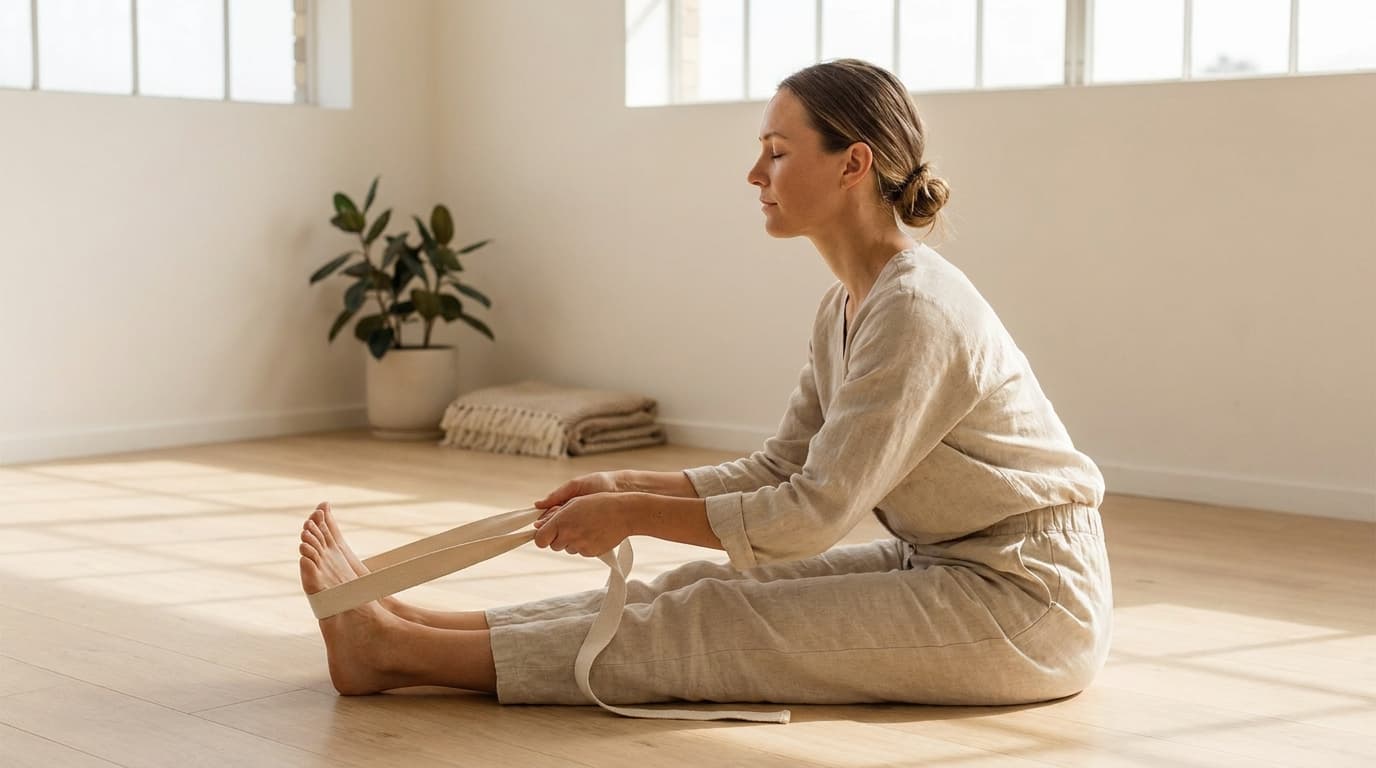
A simple yoga application: in Seated Forward Fold, press your feet gently into a strap (contracting your hamstrings) for 8 seconds, then exhale and fold deeper. Repeat 2-3 times per side. This reliably produces greater range than passive folding alone.
Proprioception: The Nervous System Factor
True flexibility isn't just about tissue length — it's about whether your nervous system trusts the range of motion. A muscle can be physically capable of greater length but remain restricted because the nervous system judges the position unsafe. This is why yoga's combination of strength and flexibility training is so effective: building strength in new ranges signals to the nervous system that those ranges are stable and safe, leading to lasting flexibility improvements.
Pro Tip: Strength and flexibility are not opposites. They are partners. For every lengthening pose you practice, include a pose that strengthens through that same range. This is what makes flexibility gains permanent rather than temporary.
Three Types of Flexibility (and Why All Three Matter)
1. Static Flexibility — how far you can stretch and hold a position without movement. This is what most people think of when they think "flexibility." Improved by long, held poses and yin yoga practices.
2. Dynamic Flexibility — your range of motion during active movement. Think kicking your leg forward in a dance kick, or the range you can access in a Sun Salutation. Improved by controlled, repetitive movements through range.
3. Functional Flexibility — the flexibility you can access when your body needs it in real life or demanding physical activities. This is the bridge between the yoga mat and the world. Improved by integrating strength and stability into new ranges.
A complete flexibility program, like the 30-day plan below, develops all three types simultaneously.
The 30-Day Flexibility Plan
How This Plan Works
Before Every Session
Always begin with 5 minutes of joint mobilization: wrist circles, ankle rolls, neck rolls, hip circles, Cat-Cow. Flexibility work on cold, unmobilized joints is both less effective and more risky.
Week-by-Week Breakdown
Week 1: Foundation and Awareness (Days 1-7)
Focus: Learning where your actual current range is — without pushing, forcing, or comparing yourself to anyone else.
Daily sequence (25 minutes):
Week 1 mantra: "I am learning my body, not competing with it."
What to notice: Where do you feel restriction — in the tissue (a pulling, stretching sensation) or in the joint (a pinching or sharp feeling)? Tissue sensation is the right neighborhood. Joint sensation means back off immediately.
Week 2: Building Tolerance (Days 8-14)
Focus: Gradually increasing hold times and introducing PNF techniques.
Daily sequence (30 minutes):
Week 2 addition: Begin each day by noting one specific area where you notice a small change. Observation accelerates progress.
Week 3: Deepening (Days 15-21)
Focus: Longer holds (2-3 minutes), introducing challenge poses, beginning to work with the breath as a tool for release.
Daily sequence (35-40 minutes):
Week 3 principle: The breath is the key to deeper release. Each exhale is an opportunity for tissue to soften. Don't muscle into poses — breathe your way in.
Week 4: Integration and Consolidation (Days 22-30)
Focus: Combining what you've learned, exploring peak flexibility poses, and beginning to build strength in new ranges.
Daily sequence (40-45 minutes):
Week 4 challenge poses (choose based on your progress):
Explore these poses and their alignment cues in our pose library.
Build this sequence on your phone
The same 420+ pose library and drag-and-drop builder, free on iPhone, iPad and Android.
The 15 Best Poses for Flexibility (With Timing Guidance)
| Pose | Target Area | Minimum Hold | Optimal Hold |
|---|---|---|---|
| Half Pigeon | Hip rotators, glutes | 90 sec | 3-5 min |
| Lizard Pose | Hip flexors, groin | 90 sec | 2-3 min |
| Bound Angle (Baddha Konasana) | Inner thighs, groin | 60 sec | 2-3 min |
| Wide-Legged Forward Fold | Adductors, hamstrings | 90 sec | 2-4 min |
| Pyramid Pose | Hamstrings, calves | 60 sec | 90 sec |
| Low Lunge | Hip flexors, psoas | 60 sec | 2 min |
| Downward-Facing Dog | Hamstrings, calves, shoulders | 5-8 breaths | 2 min |
| Reclined Hero | Quadriceps | 60 sec | 3 min |
| Cat-Cow | Spine (all directions) | 8 rounds | 15 rounds |
| Supine Twist | Spinal rotators, IT band | 60 sec | 2 min |
| Sleeping Swan (Yin) | Hip rotators, sacrum | 3 min | 5 min |
| Double Pigeon | Hip rotators | 90 sec | 3 min |
| Child's Pose | Hips, lower back, shoulders | 5 breaths | 2-3 min |
| Reclining Butterfly | Inner thighs, groin | 2 min | 5 min |
For detailed alignment instructions for each pose, visit our pose library.
5 Common Flexibility Mistakes That Slow Your Progress
Mistake 1: Bouncing instead of holding.
Ballistic (bouncing) stretching activates the stretch reflex and causes microtears. It feels like progress but actually increases injury risk and inhibits flexibility gains. Hold positions still.
Mistake 2: Stretching cold.
If you roll out of bed and immediately attempt Pigeon Pose, you're asking cold, stiff fascia to lengthen under load. Always warm up for at least 5-10 minutes first. Body temperature is not metaphorical — it's a measurable variable that affects tissue behavior.
Mistake 3: Only stretching, never strengthening.
Without strength in new ranges, flexibility gains are unstable. The nervous system will restrict range of motion it doesn't trust. This is the most common reason people plateau. Balance every flexibility pose with a strengthening pose through the same range.
Mistake 4: Skipping the boring basics.
Students obsess over advanced poses (Full Splits, Wheel, King Pigeon) while neglecting the foundational poses that build toward them. Half Pigeon is not an obstacle on the way to King Pigeon — it IS the practice. Go deep into the basics.
Mistake 5: Inconsistency disguised as intensity.
One brutal 2-hour flexibility session per week does less than 20-minute daily practice. Fascia remodels in response to consistent, repeated input — not occasional extreme demands. Daily short practice is the single most important variable. See more on building sustainable habits in our beginner yoga flows guide.
How to Track Flexibility Progress Safely
Progress in flexibility is real but subtle, and measuring it poorly leads to frustration and injury. Here's how to track it well:
1. Benchmark before you begin. On Day 1, gently explore Seated Forward Fold, Half Pigeon, and a standing balance. Note in a journal what you feel — not how far you go, but what specific sensations and restrictions you encounter.
2. Use qualitative markers over quantitative measurements. "I can now rest my forehead on my shin in Pigeon after 2 minutes instead of hovering 6 inches above my knee" is more useful than trying to measure angle changes.
3. Take photos at weeks 1, 2, and 4. Visual comparison, especially in the same poses with the same lighting, often reveals progress you can't feel in the moment.
4. Notice daily ease. Flexibility gains show up first in everyday life: getting up from the floor more easily, less back tension while sitting, more comfortable mornings. These are the real signs of progress.
5. Re-benchmark at Day 30. Return to the exact poses and sensations you noted on Day 1. Comparison will be striking.
Pro Tip: Progress in flexibility is not linear. You will have days where you feel more restricted than the day before. This is normal and physiologically expected — hydration, sleep quality, stress levels, and your menstrual cycle (if applicable) all affect daily tissue behavior. Trust the overall trend, not the daily fluctuation.
Using FLOW's free sequence builder to plan and save your flexibility sequences means you can come back to the exact same sequence week after week with notes, making progress tracking effortless. Consistent sequences also make it easier to notice genuine improvement.
For additional yin-style flexibility sequencing, our yin yoga sequencing guide goes deep on long-hold philosophy and programming, which complements this 30-day plan beautifully.
Frequently Asked Questions
Q: How quickly can I expect to see results?
Most students notice meaningful change in 2-3 weeks of daily practice. The biggest changes typically occur between days 14 and 30 as fascia remodeling accumulates. However, significant flexibility transformations — like accessing full splits — often take 6-12 months of consistent practice for most adults.
Q: Does yoga flexibility transfer to sports performance?
Yes, particularly functional flexibility gained through yoga's strength-integrated approach. Many athletes find yoga-derived flexibility superior to standard static stretching for sport performance because it's trained with stability and control. See research on yoga in athletic training, particularly for runners, cyclists, and climbers.
Q: Is it safe to stretch every day?
Yes, with appropriate variation. Avoid doing intense deep stretching of the same muscle groups on consecutive days. This 30-day plan is designed with this in mind — daily sequences emphasize different areas, allowing recovery. If a specific area feels particularly sore or inflamed, rest that area for 24-48 hours.
Q: Can older adults improve flexibility?
Absolutely, though the rate of improvement may be slower due to decreased tissue elasticity. The same principles apply at any age, but older adults should be particularly diligent about warming up thoroughly and preferring longer, gentler holds to aggressive stretching.
Q: What role does diet play in flexibility?
Hydration is the most important dietary factor — dehydrated fascia is significantly less pliable than well-hydrated tissue. Anti-inflammatory foods (fish, berries, leafy greens, turmeric) support tissue recovery. Magnesium-rich foods may help reduce muscle tension. Overall, the lifestyle factors that support tissue health are the same ones that support general wellbeing.
Frequently Asked Questions (5)
How quickly can I expect to see flexibility results?
Most students notice meaningful change in 2-3 weeks of daily practice. The biggest changes typically occur between days 14 and 30 as fascia remodeling accumulates. However, significant transformations — like accessing full splits — often take 6-12 months of consistent practice for most adults.
Does yoga flexibility transfer to sports performance?
Yes, particularly functional flexibility gained through yoga's strength-integrated approach. Many athletes find yoga-derived flexibility superior to standard static stretching for sport performance because it's trained with stability and control.
Is it safe to stretch every day?
Yes, with appropriate variation. Avoid doing intense deep stretching of the same muscle groups on consecutive days. The 30-day plan in this guide is designed with this in mind — daily sequences emphasize different areas, allowing recovery. If a specific area feels particularly sore or inflamed, rest that area for 24-48 hours.
Can older adults improve flexibility with yoga?
Absolutely, though the rate of improvement may be slower due to decreased tissue elasticity. The same principles apply at any age, but older adults should be particularly diligent about warming up thoroughly and preferring longer, gentler holds to aggressive stretching.
What role does diet play in flexibility?
Hydration is the most important dietary factor — dehydrated fascia is significantly less pliable. Anti-inflammatory foods support tissue recovery. Magnesium-rich foods may help reduce muscle tension. Overall, the lifestyle factors that support tissue health are the same ones that support general wellbeing.