
Table of Contents
Introduction
Yoga does not have an age limit — but it does require thoughtfulness. A 70-year-old student who has never practiced yoga has different needs, abilities, and concerns than a 30-year-old beginner. The teacher who understands those differences can offer something genuinely life-changing.
The research on yoga for older adults is compelling. Benefits include improved balance and reduced fall risk, better bone density, reduced arthritis pain, enhanced cognitive function, lower rates of depression and anxiety, and greater overall quality of life. These are not small claims — for many seniors, regular yoga practice materially changes the trajectory of aging.
This guide provides six complete sequences across a range of durations and focus areas, along with the safety knowledge and teaching skills needed to work confidently with older adult students. Use FLOW's free sequence builder to adapt these sequences for your specific population, add notes for individual students, and build a library of senior-friendly variations.
Research-Backed Benefits for Seniors
Balance and Fall Prevention
Falls are the leading cause of injury-related death among adults over 65 in the United States. A 2015 meta-analysis in the Journal of Aging and Physical Activity found that yoga significantly improved balance and reduced fall risk in older adults. Standing balance poses, single-leg work, and slow, controlled weight-shifting all train the proprioceptive and vestibular systems that govern stability.
Bone Density
Weight-bearing exercise stimulates bone formation. Yoga provides weight-bearing in multiple planes — not just vertical loading (like walking) but lateral, diagonal, and inverted loading. A 2016 study from Columbia University found that 12 minutes of daily yoga improved bone density in the spine and femur in older adults. The key: poses must be weight-bearing and held long enough to create the osteogenic stimulus.
Arthritis Management
The Arthritis Foundation recommends yoga for both osteoarthritis and rheumatoid arthritis. Research shows yoga reduces pain, stiffness, and fatigue while improving joint function and psychological well-being. The gentle, non-impact nature of yoga is particularly well-suited to joints that cannot tolerate high-impact or high-load exercise.
Cognitive Function
A 2014 study from UCLA found that a 3-month yoga and meditation program reduced age-related cognitive decline more effectively than memory training alone. Yoga appears to reduce cortisol (which damages the hippocampus with prolonged elevation), increase BDNF (brain-derived neurotrophic factor, often called "Miracle-Gro for the brain"), and improve attention and processing speed.
Mental Health
Loneliness and depression are epidemic among older adults. Regular yoga class attendance addresses both the physiological and social dimensions of mental health. In a group yoga setting, students form real community bonds. The physical practice itself stimulates serotonin and GABA production, reducing anxiety and depression symptoms.
Pro Tip: Share these findings with your students — especially with those who come under pressure from a doctor or family member and aren't yet personally motivated. Understanding the "why" increases commitment and helps seniors advocate for their practice with their healthcare providers.
Safety Guidelines and Contraindications
Universal Safety Principles for Senior Classes
Always have chairs available. Even students who never use them feel safer knowing they are there. It lowers the anxiety threshold for trying balance poses.
Warm up more, longer. Older joints and connective tissue need more time to prepare. A 10–15 minute gentle warm-up is minimum for a 60-minute class.
No pain, full stop. Distinguish discomfort (normal stretch sensation, mild muscle fatigue) from pain (sharp, joint-based, worsening). Students should exit any pose that causes the latter.
Transitions slowly and verbally prepared. Announce every transition ("We're going to slowly come to standing now — take your time, use your hands to push up") to prevent rushed movements that cause falls.
Never leave the room during class. Senior students occasionally have medical events during class (falls, dizziness, cardiac events). You need to be present.
Know your students' conditions. Create a simple intake form. Key conditions to know about: osteoporosis, osteopenia, artificial hips or knees, recent surgeries, cardiovascular conditions, blood pressure issues, vertigo, neurological conditions.
Key Contraindications
Osteoporosis: Avoid deep spinal flexion (rounded forward folds), high-impact transitions, and poses that place significant torque on the vertebrae.
Artificial hip: Students typically have a 90-degree flexion restriction and no internal rotation for 6–12 weeks post-surgery; long-term, they often maintain some restrictions. Check with the student's physical therapist.
Glaucoma / recent eye surgery: Avoid inversions (including Downward Dog for acute glaucoma). Increased intraocular pressure is dangerous.
Uncontrolled high blood pressure: Avoid inversions; monitor for overexertion.
Recent surgery: Get physician clearance before returning to class; modify based on specific restrictions.
Addressing Common Concerns
"I'm Too Old for Yoga"
This is the most common objection — and the least valid. The oldest student on record to complete a yoga teacher training was in her 80s. The oldest documented daily yoga practitioner, Tao Porchon-Lynch, was teaching yoga until her death at age 101. Age is not a disqualifier; it is simply a context that requires appropriate adaptation. Gently challenge this belief with facts and with the reality that every senior in your class is proof it isn't true.
"I'm Not Flexible Enough"
Flexibility is a result of yoga practice, not a prerequisite. Remind students that every person who is now flexible was once inflexible — flexibility is trained, not born. Props make every pose accessible regardless of current flexibility. The goal of yoga is never a specific shape; it is the internal experience of the pose. A deeply introspective Seated Forward Fold with the torso barely past vertical can be more meaningful than a show-stopping hypermobile fold.
"I Have Arthritis / My Knees Are Bad"
Validate the concern, then reframe it: gentle, intelligent yoga movement is one of the best evidence-based interventions for joint health. Not moving is actually more harmful to arthritic joints than moving gently. The synovial fluid that lubricates joints is produced by movement; stillness leads to stiffness. The modifications in the arthritis-friendly sequence below are specifically designed around joint protection principles.
"I've Had a Fall and I'm Scared to Try Balance Poses"
Fall fear — a well-recognized syndrome in older adults — is itself a risk factor for further falls, because it leads to movement restriction and deconditioning. Yoga in a safe environment with chairs available and a knowledgeable teacher is exactly the right intervention. Start close to the wall or chair, progress extremely gradually, and celebrate every small success.
Build this sequence on your phone
The same 420+ pose library and drag-and-drop builder, free on iPhone, iPad and Android.
6 Complete Sequences for Seniors
Sequence 1: Gentle Wake-Up (15 Minutes)
Perfect for home practice or as a morning class offering. Entirely seated or standing near a chair.
Sequence 2: Balance Focus (30 Minutes)
Designed to build fall-prevention strength and proprioception. Chair within arm's reach throughout.
Sequence 3: Arthritis-Friendly (45 Minutes)
All poses prioritize joint protection. No weight on the wrists; fist or forearm support substituted throughout.
Pro Tip: In arthritis-friendly classes, replace mat-based push-up transitions with rolling directly from supine to sitting. "Push up to sitting on an exhale, using both hands for support" eliminates Chaturanga-style wrist loading entirely.
Sequence 4: Osteoporosis-Safe (45 Minutes)
All spinal flexion is performed with a neutral or extended spine. No deep forward folds with rounded back.
Avoid in this sequence: Seated Forward Fold with rounded spine, deep twists that compress the vertebrae, any pose that puts significant weight through the wrists.
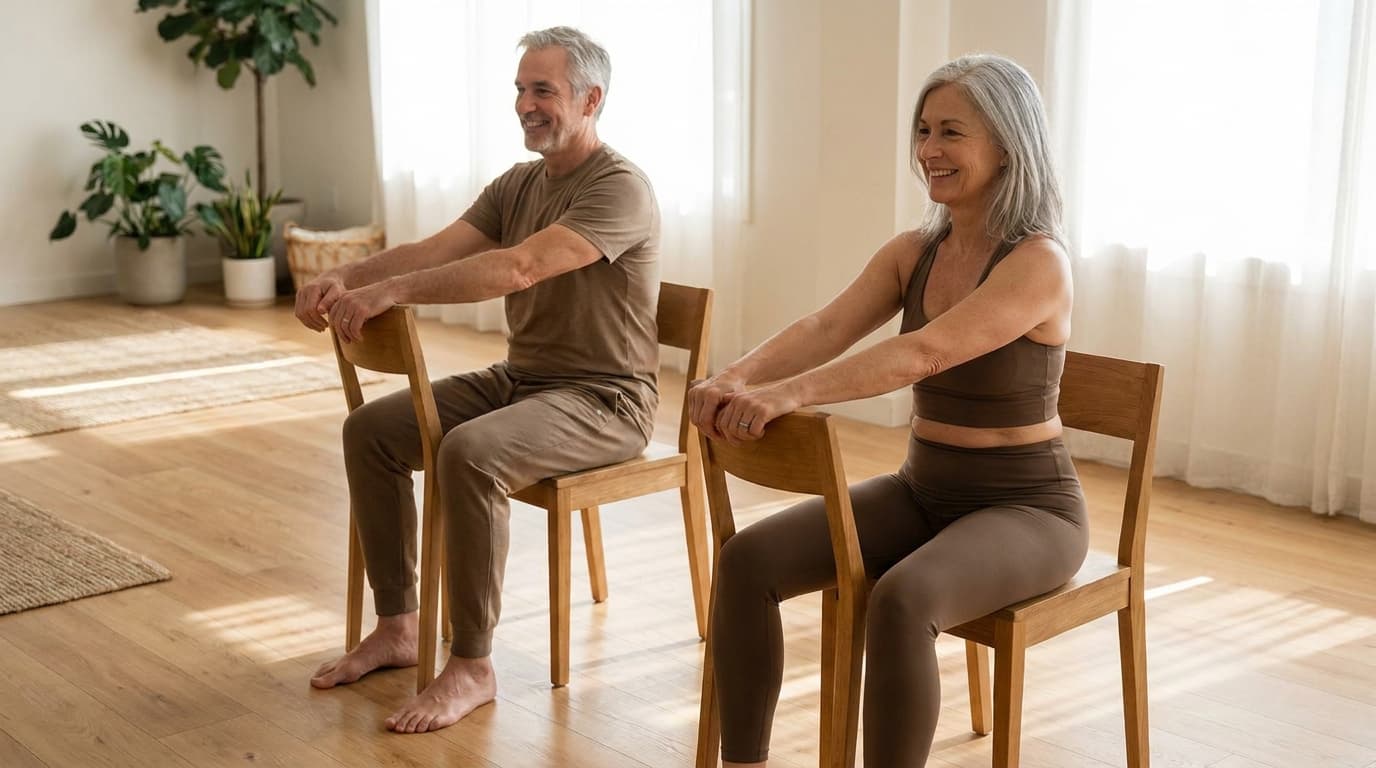
Sequence 5: Chair Yoga (30 Minutes)
Entirely chair-based. Suitable for students who cannot safely transition to the floor, or for community settings (senior centers, care facilities, workplaces).
Sequence 6: Community Seniors Class (60 Minutes)
A full-length class suitable for ongoing senior yoga programs at studios, community centers, or retirement communities. This sequence incorporates elements from all the above while including a community moment.
Opening (5 minutes): Welcome and brief check-in. "How is everyone's body feeling today? Any new concerns?" — this both builds community and surfaces safety information. Pranayama (5 minutes): Nadi Shodhana or Three-Part Breath. Seated warm-up (10 minutes): Joint mobility, Cat-Cow, neck and shoulders. Standing sequence with chairs (15 minutes): Balance poses, Warrior series. Floor sequence (15 minutes): Supine hip openers, gentle twists, Bridge. Restorative close (5 minutes): Supported Savasana with blanket. Community moment (5 minutes): Brief sharing or simple breathing in silence together.
Props and Classroom Setup
Essential props for senior yoga:
Classroom setup:
How to Teach Seniors Effectively
Pace and Language
Speak more slowly than you think you need to. Use clear anatomical landmarks: "bring your right knee toward your chest" rather than "draw the right knee in." Minimize Sanskrit unless students are interested in it. Repeat key cues more often. Announce what is coming before the transition begins.
Building Trust
Many seniors have been told their bodies are fragile. Your job is to gently rebuild their relationship with physical capacity while being genuinely honest about appropriate caution. Celebrate small victories. Notice and comment on improvements — "Your balance has gotten so much stronger over these past few weeks."
Community Building
Senior yoga classes often become the social anchor of participants' weeks. Facilitate this:
Knowing Your Limits
If a student presents with symptoms that concern you — chest pain, severe dizziness, neurological changes — stop and respond appropriately. Have an emergency plan. Know the location of the nearest exit and first aid kit. Your role is teacher and wellness guide, not medical provider; know when to refer out.
Marketing Your Senior Yoga Program
Senior yoga is an underserved and growing market. In the US alone, there are more than 70 million adults over 60 — and fewer yoga teachers specifically trained and interested in serving this population than you might expect.
Where seniors look for classes:
Messaging that works:
Pricing and format:
If you are building your teaching practice, senior yoga is a niche worth developing. The students are grateful, consistent, and refer prolifically. For more on building your teaching career, see our first yoga class guide.
Frequently Asked Questions
Frequently Asked Questions (5)
What age is considered "senior" for yoga purposes?
There is no strict cutoff — physiological age varies enormously between individuals. As a practical guideline, most senior yoga programs are designed for adults 60 and over. However, the determining factors are really physical considerations: joint health, bone density, balance, cardiovascular fitness, and any relevant diagnoses. Some 55-year-olds need gentler sequences than some 75-year-olds. Always assess the individual, not just the age.
Is yoga safe for seniors with osteoporosis?
Yes, with important modifications. Yoga is actually recommended by many osteoporosis specialists for its weight-bearing benefits. The key modifications: avoid deep forward folds with rounded spine (risk of vertebral compression fracture), avoid spinal twists that compress the vertebrae, and avoid poses that place significant weight on the wrists if wrist fracture risk is high. The osteoporosis-safe sequence in this guide follows these guidelines. Encourage students with osteoporosis to get clearance from their physician and to disclose their diagnosis to you.
Can seniors with severe arthritis practice yoga?
Yes — and research suggests they should. Multiple studies show yoga reduces arthritis pain and improves joint function in both osteoarthritis and rheumatoid arthritis. The adaptations needed are: avoid loading inflamed joints, modify grips (use fists instead of flat palms if wrist joints are affected), provide more props to reduce joint stress, and encourage students to skip any movement that causes sharp or worsening pain. Mild discomfort during gentle stretching is normal; sharp, acute, or worsening pain is not.
How do I structure a senior yoga class differently from a regular class?
The main differences are pace (slower transitions with more verbal preparation), environmental setup (chairs always available, non-slip surfaces, clear pathways to exits), cueing style (simple language, fewer Sanskrit terms, more body-landmark cues like "bring your right knee toward your chest"), longer warm-up proportionally, and community emphasis. Many senior practitioners come as much for the social connection as for the yoga itself — build in brief check-in moments and allow a few minutes of conversation at the end of class.
What qualifications do I need to teach senior yoga?
There is no single required credential, but the most respected options are: a 200-hour RYT plus a specific senior yoga or gentle yoga training (typically 20–85 hours), a Yoga Alliance RCYT or E-RYT designation with senior-specific workshop hours, or the IYTA Senior Yoga Teacher certification. Beyond certification, practical experience working with older adults — ideally in a supervised or mentored setting initially — is invaluable. Knowledge of common age-related conditions (osteoporosis, arthritis, Parkinson's, post-stroke limitations, COPD) will serve you well.