
Table of Contents
Introduction
For a long time, yoga and athletics lived in separate worlds. Yoga was soft, contemplative, feminine. Sport was hard, aggressive, goal-oriented. That divide has dissolved almost entirely, and for good reason: some of the most compelling evidence for yoga's value comes not from wellness studies but from sports science.
Runners in particular have discovered that yoga is one of the most effective tools available for injury prevention, recovery acceleration, and sustained performance. The muscles, joints, and fascial systems that running hammers — hip flexors, hamstrings, IT band, calves, thoracic spine — respond extraordinarily well to the targeted mobility and release work that yoga provides.
This guide is for runners and coaches who want clear, practical sequences they can use immediately — no fluff, no spiritual prerequisite, just intelligent movement. You'll find five complete recovery sequences, an anatomy guide to the muscles athletes most neglect, and a framework for integrating yoga into a training week.
Pro Tip: The best yoga investment a runner can make is not one 60-minute class a week — it's 15 minutes daily. Consistency with shorter sessions produces dramatically better results than infrequent long ones, especially for injury prevention.
Why Athletes Need Yoga: The Science
Flexibility and injury prevention: A 2019 study published in the International Journal of Sports Physical Therapy found that athletes with limited hip mobility were significantly more likely to experience lower extremity injuries. Yoga improves hip mobility more effectively than isolated stretching because it trains movement in patterns, not just isolated muscles.
Recovery and inflammation: Yoga activates the parasympathetic nervous system (rest-and-digest), which directly opposes the sympathetic activation (fight-or-flight) that sport produces. A 2015 study found that yoga practitioners had lower levels of cortisol and inflammatory cytokines compared to controls. For athletes whose training generates significant inflammation, the ability to deliberately trigger the parasympathetic response is a genuine recovery superpower.
Proprioception and neuromuscular efficiency: Yoga requires constant proprioceptive feedback — where is my foot, is my knee tracking, is my weight balanced? This neuromuscular training directly improves movement economy in sport. Athletes who do yoga report that their regular sport feels smoother and more efficient.
Mental performance: Sport performance is enormously influenced by the ability to stay focused under pressure, manage pre-competition anxiety, and recover mentally from setbacks. Yoga's breath and mindfulness training develops exactly these capacities. The breath control that gets you through a 5-minute pigeon pose is the same skill that keeps you breathing efficiently in mile 20 of a marathon.
Strength in end range: Unlike passive stretching, yoga builds strength through full ranges of motion. A hamstring that is flexible but weak at full length is still an injury risk. Yoga develops what strength coaches call "active flexibility" — the ability to control and stabilise at the limits of your range.
Sport-Specific Muscles Athletes Neglect
Understanding which muscles sport chronically tightens helps you sequence more effectively.
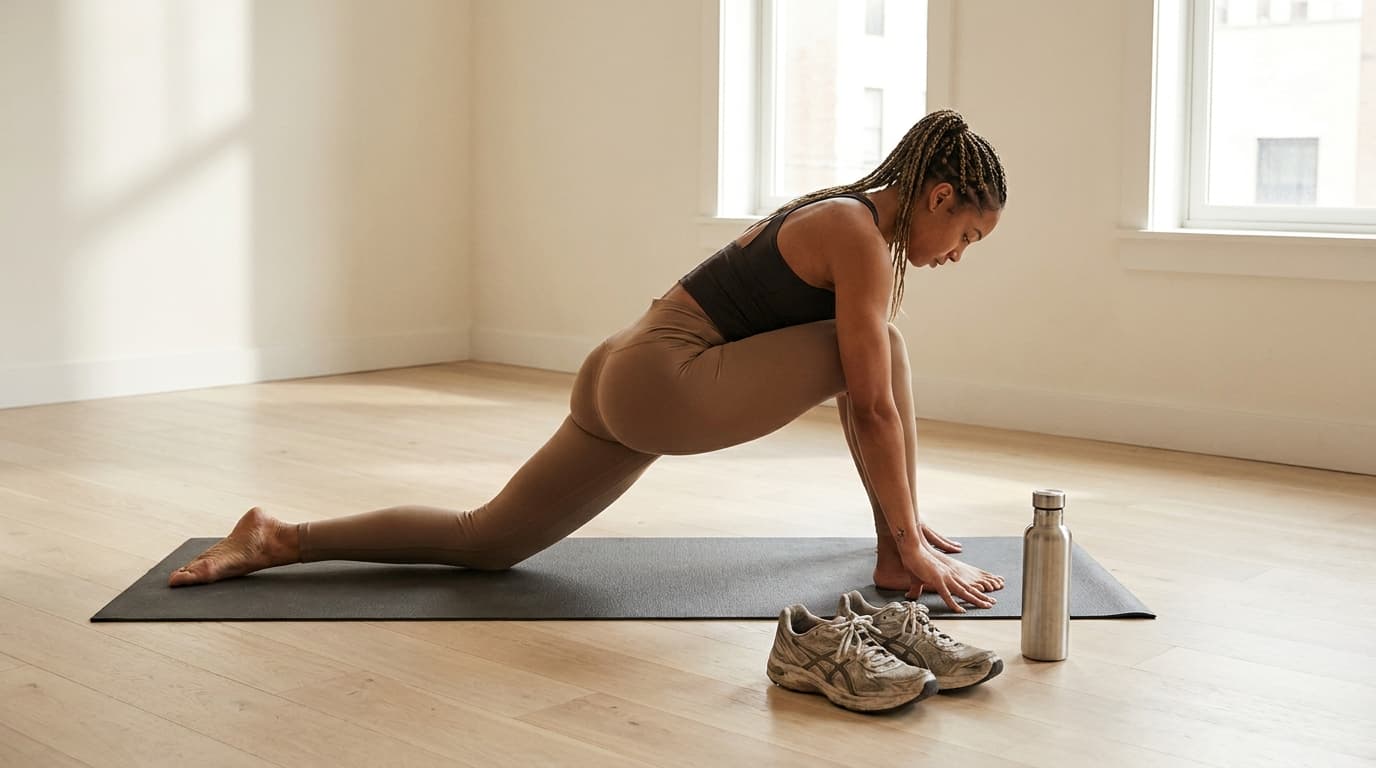
Hip flexors (psoas and iliacus): Runners spend hours in hip flexion. The psoas in particular — the deep muscle connecting the lumbar spine to the femur — shortens and tightens with repetitive forward motion, pulling the lumbar spine into compression. Tight hip flexors alter running gait, reduce stride length, and are a primary contributor to lower back pain in runners.
Hamstrings: Running strengthens the hamstrings eccentrically but shortens them chronically. Tight hamstrings pull the pelvis into a posterior tilt, loading the lower back and reducing hip mobility. They also make the hip flexors work harder, creating a cycle of tightness.
IT Band and TFL: The IT band — a thick band of fascia running from the hip to the knee — is the most common site of overuse injury in runners. The TFL (tensor fasciae latae) at the top of the IT band is almost universally tight in high-mileage runners.
Calves (gastrocnemius and soleus): Every footstrike loads the calf complex. These muscles are chronically tight in runners and, when they become very restricted, contribute to Achilles tendinopathy and plantar fasciitis.
Thoracic spine: Road runners tend to run with a slightly forward-hunched upper body. Over thousands of miles, this creates significant thoracic stiffness and compensatory neck tension. Restoring thoracic mobility improves running posture, breathing efficiency, and shoulder function.
Glutes and hip external rotators: Paradoxically, despite how hard runners work their glutes, the deep external rotators (piriformis, obturator group) become both tight and inhibited. Addressing this complex is key to resolving many cases of IT band syndrome, piriformis syndrome, and hip pain.
Build this sequence on your phone
The same 420+ pose library and drag-and-drop builder, free on iPhone, iPad and Android.
5 Recovery Sequences
Sequence 1: Post-Run 15-Minute Wind-Down
The essential daily recovery practice. Do this immediately after your run while the tissues are warm.
Sequence 2: Pre-Competition Dynamic Warm-Up
This is active, dynamic yoga — not passive stretching — appropriate before a race or hard training session.
Sequence 3: Marathon/Long Run Recovery — 45 Minutes
After a race or very long training run, the body needs both deep release and nervous system down-regulation. This sequence does both.
Pro Tip: After a marathon, the immune system is suppressed for 24–72 hours. Keep post-race yoga very gentle and avoid deep muscle compression poses for the first 48 hours. Focus on circulation, nervous system rest, and gentle range of motion.
Sequence 4: Strength Athlete and Cross-Training Mobility
For powerlifters, cyclists, swimmers, and team sport athletes — focusing on thoracic mobility and hip function.
Sequence 5: Weekly Maintenance Yoga — 30 Minutes
A sustainable weekly practice for athletes who want ongoing maintenance without a major time commitment.
Use FLOW's free sequence builder to build, save, and time all five of these sequences. The timing feature is particularly useful for ensuring you hold recovery poses long enough to produce real change.
Building Your Weekly Schedule
The key to integrating yoga with a training programme is strategic placement, not volume.
Runner's Week Example:
Cross-Training Athlete Week:
When to Do Yoga vs. Train
This question matters more than most athletes realise.
Best times for yoga:
Avoid yoga:
The timing of yin and restorative yoga deserves special mention. Yin yoga (long-held passive stretches targeting the deep connective tissue) is best done on easy or rest days, not immediately before or after high-intensity training. The deep fascial remodelling it stimulates needs time to consolidate. Our yin yoga guide covers this in detail.
For athletes who are also dealing with stress, anxiety, or burnout — which is extremely common in high-training-volume periods — the principles in our yoga for stress and anxiety guide are directly applicable.
The athletes who perform best over the long term are rarely the ones who train hardest. They're the ones who recover smartest. Yoga is one of the highest-leverage recovery investments you can make.
Frequently Asked Questions (5)
Should I do yoga before or after running?
For most athletes, yoga is best done after running (as recovery) or on separate days entirely. Static stretching before a run can temporarily decrease power output and reaction time. A short dynamic warm-up (leg swings, hip circles, walking lunges) is more appropriate before running. Save the deeper, longer yoga practice for post-run or rest days.
Can yoga replace stretching for runners?
Yes and then some. Yoga does everything traditional static stretching does, plus adds strength in end-range positions, breath coordination, body awareness, and nervous system regulation. Athletes who add yoga to their recovery routines typically see improvements in flexibility, injury rates, and even race performance compared to those who do isolated static stretching.
How long should a yoga recovery session be for runners?
Even 15 minutes done consistently produces measurable improvements over time. A 15-minute post-run practice targeting the hip flexors, hamstrings, and IT band is far more effective than a 60-minute session done once a month. Aim for daily short practices (10–20 min) rather than infrequent long ones.
What are the best yoga poses for IT band syndrome?
The most effective poses for IT band syndrome are standing forward fold with crossed legs (emphasising the outer hip), low lunge with a lateral lean, reclined figure four, half pigeon, and lying IT band stretch. The IT band itself doesn't stretch (it's dense connective tissue), but releasing the TFL (tensor fasciae latae), gluteus maximus, and hip flexors that feed into it makes a significant difference.
Will yoga make me less explosive as an athlete?
No — this is a persistent myth. Studies consistently show that regular yoga improves athletic performance across measures including power, speed, and reaction time. The improved joint mobility, reduced muscle bracing, and enhanced proprioception from yoga all contribute to more efficient, powerful movement. Elite athletes from Lebron James to Novak Djokovic credit yoga as a key component of their performance.