
Table of Contents
Introduction
If you've ever ended a long work day with a neck that feels like concrete and shoulders that seem to be auditioning for earrings, you're in good company. Neck and shoulder tension is one of the most common physical complaints in the modern world — and yoga is one of the most effective, accessible tools for addressing it.
This isn't about forcing your body into pretzel shapes. It's about smart, targeted movement that undoes the postural patterns your daily life creates. In this guide you'll find 12 carefully chosen poses, three complete sequences ranging from 5 to 45 minutes, practical anatomy context, and a simple daily maintenance plan you can actually stick to.
Whether you're a yoga teacher designing a class for students who sit at desks all day, or someone who just wants relief, this guide gives you everything you need.
Pro Tip: Before you start any neck-focused yoga session, spend 60 seconds simply noticing your breath and the weight of your head. This brief check-in helps your nervous system downshift from fight-or-flight, which is often what's keeping those muscles locked in the first place.
Why Desk Workers Get Neck and Shoulder Tension
We are living through a tech neck epidemic. The average person now spends 7–11 hours a day looking at screens — phones, laptops, televisions — and the postural cost is enormous.
The mechanics of tech neck: Your head weighs about 10–12 pounds in neutral alignment. For every inch your head drifts forward of your shoulders, the effective load on your cervical spine roughly doubles. At a 45-degree forward tilt — which is how most of us look at our phones — that load climbs to around 49 pounds. Your neck and upper back muscles are doing marathon-level work just to keep your head from dropping onto your chest.
The stress connection: It's not just posture. When we're stressed, anxious, or in threat-response mode, we instinctively brace in the upper body — shoulders creep toward ears, jaw clenches, breathing becomes shallow. For many people, the neck and shoulders have become the body's primary stress storage site. Addressing the physical tension without addressing the nervous system piece only gets you halfway there.
Who is most affected: Desk workers and programmers are obvious candidates, but so are yoga teachers (who spend hours demonstrating and adjusting), drivers, surgeons, musicians, parents of young children (carrying, feeding, looking down), and anyone who sleeps on their stomach or with too many pillows.
The good news: the yoga practice that undoes this damage is surprisingly simple. You don't need an advanced practice. You need the right poses, done consistently.
Anatomy Basics: What Is Actually Tight
You don't need a degree in anatomy to practice effectively, but a little knowledge goes a long way in understanding why certain poses feel so transformative.
The upper trapezius runs from your skull down to your shoulder blade and clavicle. It's the muscle most people grab when they say their shoulders are tense. It works constantly to hold your head up and stabilise your shoulder girdle, and it is chronically overworked in forward-head postures.
The levator scapulae connects your neck vertebrae to the top of your shoulder blade. When tight, it creates that deep, aching feeling at the base of your neck and the top of your shoulder blade — often mistaken for shoulder pain when it's really a neck issue.
The suboccipitals are a group of tiny muscles at the base of your skull. They work overtime when your head is forward, and when they're tight they can contribute to tension headaches that feel like a band around the head.
The pectorals and anterior deltoids at the front of the chest pull shoulders forward into that rounded, protective posture. Releasing the front body is just as important as stretching the back.
The thoracic spine — the mid-back — is meant to have a gentle curve and reasonable mobility. When it becomes stiff and kyphotic (over-rounded), the neck compensates by hyperextending, creating compression at the top of the spine.
Understanding these relationships explains why the most effective sequences address the chest, mid-back, and arms — not just the neck itself.
12 Poses for Neck and Shoulder Relief
1. Ear to Shoulder Stretch
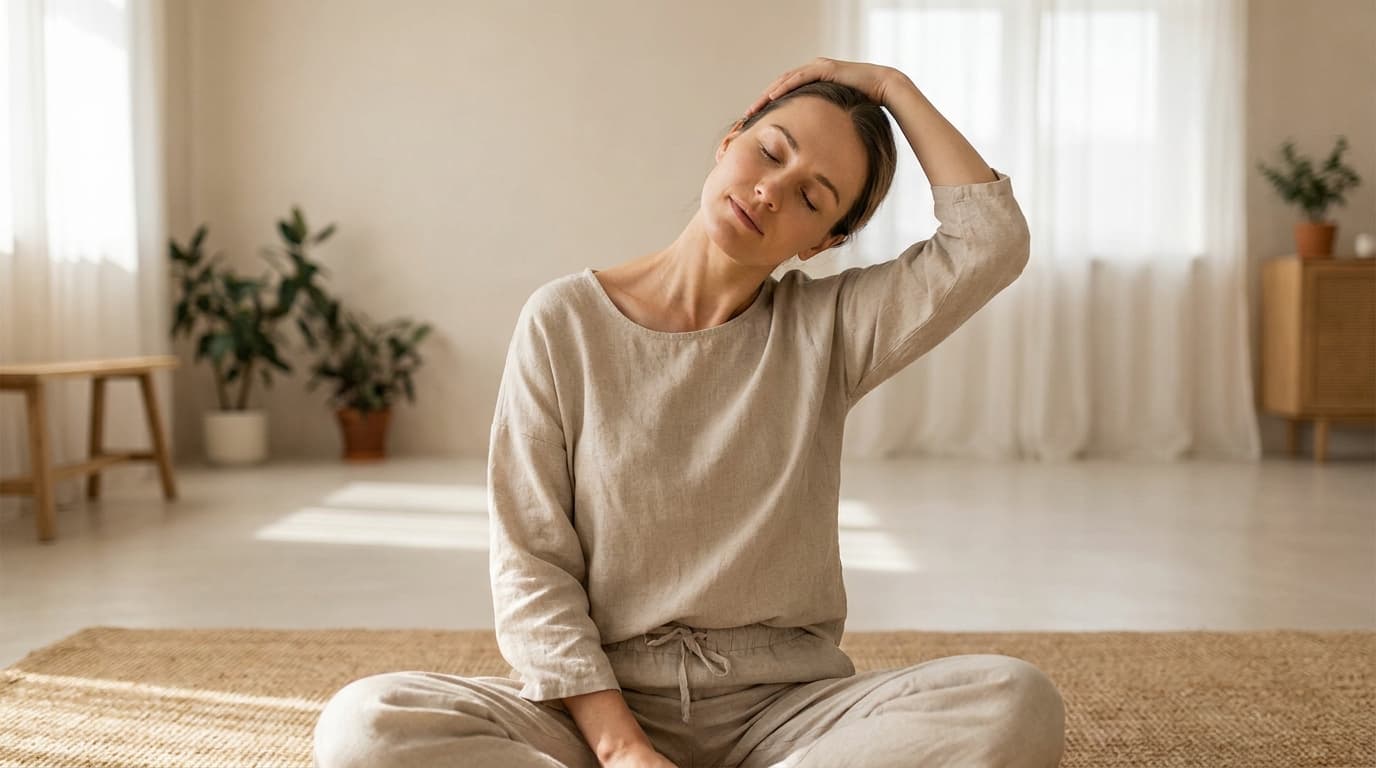
How to: Sit tall in a chair or cross-legged on the floor. Gently drop your right ear toward your right shoulder without rotating your head. Keep your left shoulder heavy. For a deeper stretch, place your right hand very lightly on the left side of your head — no pulling. Hold 45–90 seconds per side.
What it targets: Upper trapezius, levator scapulae, sternocleidomastoid.
2. Chin Tucks
How to: Sit or stand with a neutral spine. Gently draw your chin straight back (as if making a double chin). Hold for 3–5 seconds, release, repeat 10 times. This is simple and profoundly effective for restoring neutral cervical alignment.
What it targets: Deep cervical flexors, suboccipitals. Directly counters forward-head posture.
3. Cat-Cow with Cervical Articulation
How to: Start in tabletop on hands and knees. On your inhale, let the spine drop, chest lift, and gaze rise gently (cow). On your exhale, round the spine, tuck the chin deeply to the chest (cat). Move slowly and let the movement flow from your tailbone all the way through your neck. 8–12 slow cycles.
What it targets: The entire spine, with particular relief at the cervical-thoracic junction. See our pose library for detailed alignment cues on cat-cow.
4. Thread the Needle
How to: From tabletop, inhale to lift your right arm toward the ceiling. Exhale and thread your right arm under your body, sliding your right shoulder and cheek toward the floor. Let the left arm stay long or bend the elbow for support. Hold 60–90 seconds per side.
What it targets: Thoracic rotation, rhomboids, posterior deltoid, and the muscles around the shoulder blade. One of the most satisfying releases in this entire list.
5. Eagle Arms (Garudasana Arms)
How to: Extend both arms forward at shoulder height. Cross your right elbow over your left, then bend both elbows and work your forearms to wrap and bring palms toward each other. Lift the elbows slightly to feel the stretch across the upper back. Hold 60 seconds, switch sides.
What it targets: The posterior capsule of the shoulder joint, rhomboids, and the space between the shoulder blades. Particularly effective for that "between the shoulders" ache.
6. Cow Face Arms (Gomukhasana Arms)
How to: Reach your right arm up, bend the elbow to drop your hand between your shoulder blades. Reach your left arm down and back, bend at the elbow to reach up toward your right hand. Use a strap if the hands don't meet. Hold 60–90 seconds per side.
What it targets: Triceps, anterior deltoid, biceps, and the chest — a comprehensive shoulder rotation stretch.
Pro Tip: If you're sequencing a class around these poses, eagle arms and cow face arms pair beautifully back-to-back. They address opposing movement patterns of the shoulder joint, and students often feel immediate relief in combination.
7. Doorway Chest Opener (Standing Chest Stretch)
How to: Stand in a doorway or use a wall. Place your forearm against the surface at a 90-degree angle, elbow at shoulder height. Gently rotate away from the arm to open the chest. Hold 45–60 seconds per side. You can also do this with arms lower (chest focus) or higher (shoulder focus).
What it targets: Pectoralis major and minor, anterior deltoid, and the front of the shoulder. Directly counteracts the hunched posture that loads the neck.
8. Supported Fish Pose (Matsyasana Variation)
How to: Place a rolled blanket or bolster horizontally across your mat. Sit in front of it and lie back so the roll supports your mid-thoracic spine, just below the shoulder blades. Let your arms rest to the sides with palms up, and allow your chest to open passively. Keep your neck long — use a folded blanket under the head if needed. Hold 2–4 minutes.
What it targets: Thoracic extension, intercostals, pectorals, anterior throat. This pose is deeply passive and allows the nervous system to genuinely release.
9. Downward-Facing Dog
How to: From tabletop, tuck toes and lift hips to form an inverted V. Press through the whole hand, especially the thumb and index finger. Let the head hang freely between the arms without dropping or lifting it forcefully. Pedal through the feet to stay dynamic if you need movement. Hold 60–90 seconds.
What it targets: Full spinal decompression, hamstrings, calves, and crucially — the shoulder girdle and thoracic spine. The traction effect through the neck when the head hangs free is genuinely therapeutic.
10. Seated Neck Rolls (Modified)
How to: Sit tall. Drop your chin to your chest, then slowly roll your right ear toward your right shoulder, pause, and return to center before rolling left. Never roll the head fully back — avoid loading the posterior cervical vertebrae. Move slowly and breathe into any areas of resistance. 3–4 rolls per side.
What it targets: All neck muscles, with a particular emphasis on the areas of most holding. The modified version (no full back roll) keeps this safe for everyone.
11. Supine Twist (Jathara Parivartanasana)
How to: Lie on your back. Draw your right knee to your chest, then guide it across your body to the left with your left hand. Extend your right arm out at shoulder height and gently turn your gaze to the right. Hold 90 seconds to 2 minutes per side.
What it targets: The thoracic rotators, quadratus lumborum, and hip external rotators — but the real gift for neck pain sufferers is the thoracic rotation that takes tension out of the paraspinals all the way up to the base of the neck.
12. Legs Up the Wall (Viparita Karani)
How to: Sit sideways near a wall, then swing your legs up as you lie back. Scoot your hips as close to the wall as comfortable. Let the arms rest open at the sides, palms up. Close your eyes. Stay 3–5 minutes.
What it targets: This is a nervous system regulation pose as much as a physical stretch. The mild inversion encourages parasympathetic activation, directly addressing the stress-tension cycle that drives chronic neck and shoulder holding.
Build this sequence on your phone
The same 420+ pose library and drag-and-drop builder, free on iPhone, iPad and Android.
3 Complete Sequences
Sequence 1: 5-Minute Desk Break
This sequence is designed to be done at your desk or in a small office space, no mat required.
Teaching note: Encourage this sequence every 90 minutes during a workday. Frame it as a circuit-breaker, not a workout — even one round breaks the postural holding pattern and resets the nervous system.
Sequence 2: 20-Minute Relief Practice
For students with moderate to significant neck and shoulder tension who have 20 minutes before or after work.
Teaching note: This sequence moves from active to passive, which allows the body to first warm the tissues and then deeply release. Avoid rushing the supported fish — it's where the real magic happens.
Sequence 3: 45-Minute Class
A complete yoga class for neck and shoulder relief, suitable for a studio or workplace wellness setting.
Pro Tip: For this longer class format, dim the lights after the standing sequence and play slower, more ambient music. The shift in environment signals to the nervous system that it's safe to release, dramatically deepening the effect of the floor and wall poses.
You can build and save this sequence (and all three above) using FLOW's free sequence builder, where you can add time cues, notes, and custom modifications for each pose.
Modifications and Props
For students with acute neck pain or injury: Skip all poses that require weight-bearing through the arms (tabletop, downward dog). Focus on supported fish, legs up the wall, and gentle seated stretches. Never force range of motion.
For hypermobile students: Hypermobile necks need stability work, not more stretching. Chin tucks, gentle isometric resistance exercises, and proprioceptive awareness cues are more appropriate. Avoid deep passive neck stretches.
Props that make a real difference:
Pregnancy modifications: Avoid deep supine twists after the first trimester. Supported fish works well on a bolster incline. Focus on seated and standing variations. For a complete approach to safe sequencing during pregnancy, see our prenatal yoga sequencing guide.
Building a Daily Maintenance Routine
The biggest mistake people make with neck and shoulder yoga is treating it like a once-a-week rescue mission. Chronic tension is built day by day — it needs to be addressed day by day.
Morning (5 minutes): Start with 10 chin tucks before getting out of bed or while making your first cup of coffee. Add ear-to-shoulder stretches and a few cat-cows. This sets your cervical alignment for the day before the habits kick in.
Midday check-in: Set a reminder every 90 minutes during your workday to do one minute of any of the following: shoulder rolls, eagle arms at your desk, chin tucks, or simply noticing your posture and taking three deep breaths.
Evening release (15–20 minutes): This is your most important practice. The evening session lets you process the day's accumulation before it becomes overnight stiffness. Use the 20-minute sequence above, or simply spend 5 minutes in supported fish and 5 minutes in legs up the wall.
Sleep hygiene for neck health: Your pillow choice matters enormously. Side sleepers need enough pillow height to keep the neck in neutral (roughly the width of one shoulder). Back sleepers do best with a relatively thin pillow. Stomach sleeping is the most problematic for cervical alignment — if you can't avoid it, placing a pillow under the abdomen rather than the head reduces the cervical rotation.
Ergonomics: The yoga practice will be far more effective if you also address the source. Laptop screen at eye level, wrists neutral at the keyboard, phone held higher. These changes aren't glamorous but they're profoundly supportive.
For teachers designing ongoing programmes, pairing a physical practice with lifestyle guidance produces the best long-term outcomes. Refer students to resources like our yoga sequencing guide for broader curriculum ideas.
The neck and shoulders are where so many of us store the weight of modern life — the deadlines, the screens, the worries. A consistent yoga practice isn't just a physical intervention here. It's a daily act of paying attention to yourself and choosing, even briefly, to let go.
Frequently Asked Questions (5)
How often should I do yoga for neck and shoulder pain?
For chronic tension, aim for a short 5–10 minute practice daily rather than one long session weekly. Consistency matters far more than duration. Even three targeted poses before bed can produce noticeable results within two weeks.
Can yoga make neck pain worse?
Yes, certain poses can aggravate neck issues — especially deep backbends, shoulder stands, and any movement that compresses the cervical spine. Always move within a pain-free range, skip poses that cause sharp or radiating pain, and consult a physiotherapist or doctor for diagnosed conditions like herniated discs.
Which yoga poses are best for "tech neck"?
The most effective poses for tech neck are ear-to-shoulder stretches, cat-cow with cervical articulation, thread-the-needle, supported fish pose, and eagle arms. These directly counter the forward-head posture and protracted shoulders that come from screen use.
Is it safe to do neck stretches every day?
Gentle neck stretches — like ear-to-shoulder and gentle rotation — are safe daily. Avoid aggressive or forceful stretching, deep cervical flexion under load, or holding painful positions. If you experience headaches, tingling, or dizziness after neck stretches, stop and seek professional guidance.
How do I sequence a yoga class focused on neck and shoulder relief?
Start with gentle breath awareness and body scan, move into seated neck and shoulder mobilisation, progress to standing chest-openers and arm variations (eagle, cow face), then floor work (cat-cow, thread-the-needle, supported fish), and close with a long Savasana. Keep the tone slow and restorative. Use [FLOW's free sequence builder](/builder) to plan and save your sequences easily.