
Table of Contents
Introduction
In 2026, yoga is practiced by over 36 million Americans. Roughly a third of them are men. LeBron James does it. Novak Djokovic credits it with his comeback. The New Zealand All Blacks use it in their training. Navy SEALs and Army Rangers have integrated yoga into physical preparation programs. And yet the stereotype persists: yoga is something women do while men lift weights.
If you have been curious about yoga but held back by that image, this guide is for you. If you teach yoga and want to better serve your male students — understanding why they hesitate, what they need physically, and how to design sequences that feel genuinely relevant to their lives — this guide is also for you.
We are going to cover the science, dismantle the myths, walk through six complete sequences from 20 to 60 minutes, and give you practical modification strategies for the poses that tight-bodied men most commonly struggle with.
Use FLOW's free sequence builder to customize any of these sequences for your own body or your students.
5 Yoga Myths Men Believe (Debunked)
Myth 1: "You Need to Be Flexible First"
This is the number-one reason men give for not starting yoga — and it is exactly backwards. Tight hamstrings and hips are not disqualifications; they are precisely what yoga addresses. Walking into your first yoga class with a 45-degree forward fold limitation is not embarrassing. It means you have a large amount of potential progress ahead of you, and you will feel the results of the practice much faster than someone who is already flexible.
Every yoga teacher knows this. The person in the front row touching their nose to their knee is not more impressive to the teacher than the person in the back row working honestly within their limitations.
Myth 2: "Yoga Is for Women"
The history of yoga is entirely male. The practice originated in ancient India as a discipline primarily practiced by men — the classical yoga texts, including Patanjali's Yoga Sutras, were written by and largely for male practitioners. The Western association of yoga with women is a historical peculiarity of the 20th century, driven partly by marketing choices in the 1990s wellness industry, not by anything inherent to the practice.
Yoga's current Western demographic is shifting. Male enrollment in yoga teacher trainings has increased by over 40% since 2018 according to Yoga Alliance data. The perception gap between yoga's actual gender distribution and its image is closing.
Myth 3: "Yoga Is Not a Real Workout"
Tell that to anyone who has held chair pose for 90 seconds, moved through 10 consecutive Chaturangas, or attempted any arm balance for the first time. Yoga can be as physically demanding as you make it. Power Yoga and Ashtanga sequences are classified as moderate to vigorous aerobic exercise by sports science researchers. A 60-minute hot yoga class can burn 400–600 calories.
More relevantly: yoga builds functional strength — the kind that prevents injury, improves athletic performance, and makes daily movement easier. It is not primarily a cardiovascular workout, but its combination of strength, balance, and mobility training is exactly what most men's fitness routines lack.
Myth 4: "Yoga Is Too Slow and Boring"
Vinyasa flow and power yoga classes move at a pace that surprises most new male students. There is no downtime. The breath is continuous, the transitions are choreographed, and the sustained muscular engagement demands real concentration. Even slower Hatha classes, which include longer pose holds, test mental endurance in ways many men find genuinely challenging — sitting with discomfort without being able to push through it with effort is a different kind of hard.
Myth 5: "Yoga Is Spiritual / Religious and I'm Not into That"
Yoga has deep philosophical and spiritual roots in Hindu and Buddhist traditions. In most Western studio yoga classes, those roots are present at varying levels of depth — some teachers integrate a lot of philosophy, some almost none. You can practice yoga as a purely physical discipline and receive significant benefit. You can also, if you choose, engage with the philosophical dimensions. Neither approach is more correct. The spiritual elements are not a requirement for entry.
Science-Backed Benefits Specific to Men
Testosterone and Cortisol Balance
A 2010 study published in the Journal of Health Research found that men who practiced yoga regularly showed lower salivary cortisol levels than sedentary controls. Chronically elevated cortisol suppresses testosterone production — meaning that yoga's stress-reduction effect has direct implications for hormonal health in men. Reducing cortisol is one of the most evidence-based ways to support healthy testosterone levels.
Injury Prevention in Athletes
Research published in the International Journal of Sports Physical Therapy has consistently linked limited hip mobility and hamstring flexibility to increased injury rates in male athletes across sports including running, football, basketball, and soccer. Yoga directly addresses these limitations. Studies of yoga interventions in competitive athletes show significant reductions in injury rates, particularly in the lower body.
Cardiovascular and Metabolic Health
Men have higher baseline risk for cardiovascular disease than women across most age groups. A meta-analysis published in the European Journal of Preventive Cardiology in 2014 found yoga associated with meaningful reductions in blood pressure, resting heart rate, LDL cholesterol, and body weight — comparable to improvements seen with aerobic exercise, and particularly significant for men at elevated cardiovascular risk.
Sleep Quality
Men report poorer sleep quality than women at higher rates. Research from Harvard Medical School found yoga practitioners significantly outperformed controls on sleep efficiency measures. The combination of physical fatigue, nervous system regulation, and breath-focused practice addresses the hyperactivated stress response that underlies most sleep disruption in men with demanding professional lives.
Mental Health
Men are significantly less likely than women to seek mental health support and significantly more likely to experience depression and anxiety silently. A 2019 meta-analysis in the Journal of Psychiatric Research found yoga produced effects on depression comparable to antidepressant medication in some populations. The bodily focus of yoga — which requires men to pay attention to sensation rather than suppress it — may specifically address the somatic disconnection that accompanies depression in men.
Pro Tip: When introducing yoga to male students, lead with the performance and recovery benefits. "This will help your deadlift, protect your knees, and improve your sleep" opens doors that "this is a spiritual journey" closes.
Why Men Quit Yoga — and How to Keep Them Coming Back
Understanding why men disengage is essential for teachers and for men designing their own practice.
They feel incompetent. The first few yoga classes are uniquely humbling for men who are strong and fit in other contexts. A marathon runner who cannot forward fold past his knees feels exposed. The antidote: remind yourself (or your male students) that the limitation is tissue adaptation, not weakness. Progress comes fast.
The class tempo feels wrong. Men who come from gym backgrounds often expect a clear sequence with defined sets and reps. The fluid, continuous nature of yoga flow can feel disorganized. Providing clear structure — this is the warm-up, this is the building block, this is the peak — helps men orient and engage.
Lack of visible progression markers. Gym culture is built on quantified progress: heavier weights, faster miles. Yoga progress is more qualitative and slower to register. Teachers who help male students track specific markers (how far their forward fold extends, hold time in plank, hip-to-floor distance in pigeon) provide the kind of feedback loop men respond to.
They feel socially conspicuous. Being the least capable person in the room in front of others is genuinely uncomfortable. Small group or private yoga removes this barrier. Online classes are particularly popular with men partly because they allow private practice before joining group classes.
The language doesn't resonate. Teachers who frame everything in terms of energy flow and spiritual surrender lose male students who came for physical results. Meet students where they are: lead with the physical benefit, let the deeper experience develop on its own timeline.
Build this sequence on your phone
The same 420+ pose library and drag-and-drop builder, free on iPhone, iPad and Android.
6 Complete Yoga Sequences for Men
Sequence 1: Morning Power Flow (20 minutes)
An energizing start to the day that activates the full body without requiring lots of time.
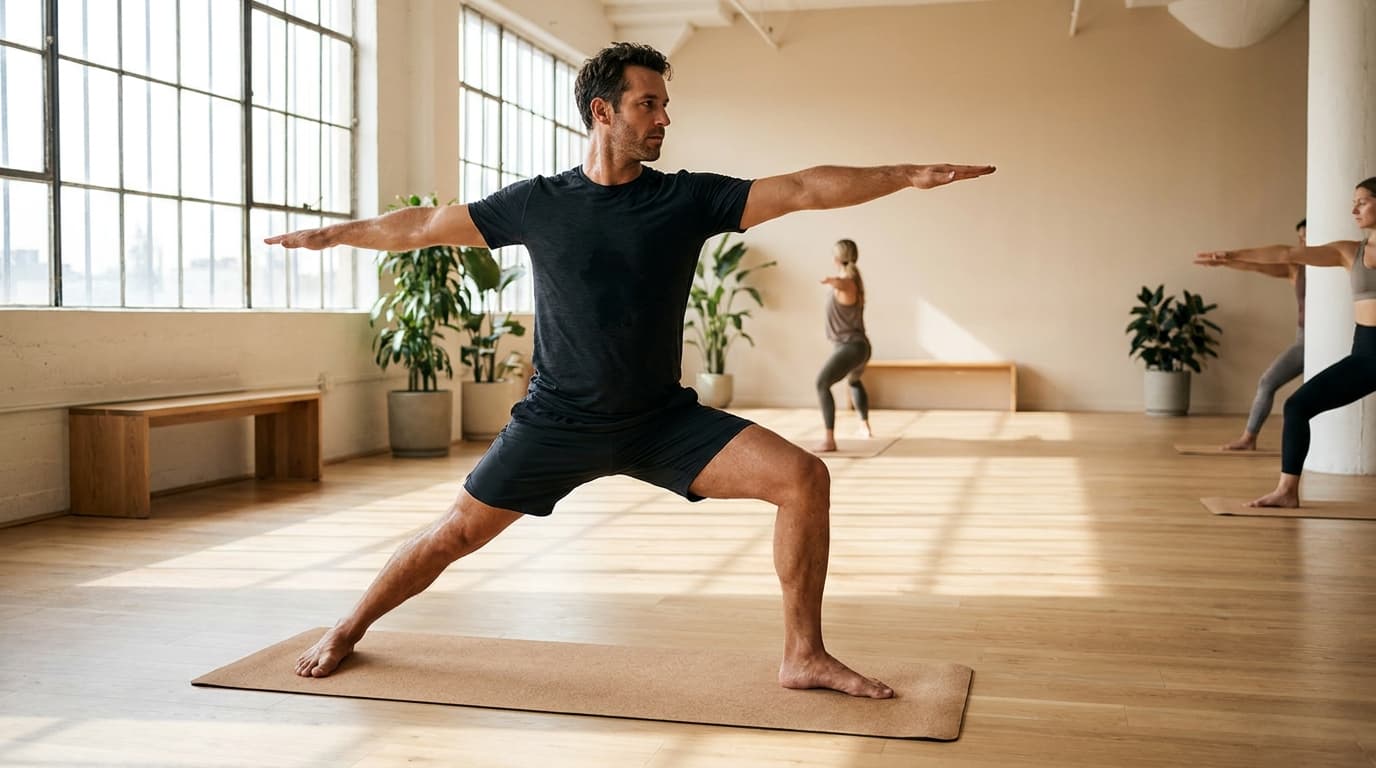
Structure: Cat-Cow × 5 breaths | Downward Dog → Plank × 3 | Sun Salutation A × 3 | Sun Salutation B × 2 | Warrior I + Warrior II + Triangle each side | Bridge pose × 3 | Supine twist | Savasana 2 min
Focus: Full-body activation, breath-movement connection, mental clarity for the day ahead.
Who it's for: Men with busy mornings who want something consistent and not too long.
Sequence 2: Athlete Performance Yoga (30 minutes)
Designed for men who play sport or train regularly. Targets the mobility and recovery patterns most commonly limiting athletic performance.
Structure: 5 min standing warm-up (hip circles, shoulder rolls, world's greatest stretch) | Lunge series (low lunge, crescent, warrior II) each side | IT band and quad stretch series | Hamstring sequence (standing forward fold, half-splits) | Hip opener sequence (lizard, half pigeon) | Shoulder and thoracic spine mobility | Child's pose | Savasana
Focus: Undoing the tightening patterns created by sport-specific training.
Who it's for: Runners, cyclists, gym-goers, team sport athletes.
Sequence 3: Upper Body Strength (30 minutes)
Targets the shoulders, chest, triceps, and core — muscles that yoga builds differently than weightlifting.
Structure: Shoulder warm-up | Plank hold 60 seconds | Dolphin × 5 | Chaturanga flow × 8 | Downward Dog push-up × 10 | Side plank each side (30-60 seconds) | Wheel pose or bridge with blocks × 3 | Thread-the-needle × 3 each side | Eagle arms | Child's pose
Focus: Functional upper body strength, shoulder mobility, core integration.
Who it's for: Men wanting to complement weightlifting with functional movement.
Sequence 4: Hip Flexibility for Tight Guys (45 minutes)
The sequence most men need most but resist the longest. Addresses the hip, hamstring, and groin tightness that affects posture, athletic performance, and lower back health.
Structure: Supine hip rotation warm-up | Figure-four (reclined pigeon) × 3 min each side | Lizard lunge series | Half pigeon or pigeon → stay 3–5 min each side | Bound angle (butterfly) with forward fold | Wide-legged forward fold | Seated twist | Legs-up-the-wall 5 min | Savasana
Focus: Deep hip and hamstring release. Parasympathetic nervous system activation.
Who it's for: Any man with tight hips — which is most men. Can be done as a standalone recovery session.
Pro Tip: For tight men in pigeon pose, place a block or folded blanket under the hip of the bent leg. This is not a modification that reduces the pose — it is the correct alignment for most male bodies.
Sequence 5: Stress Management (20 minutes)
A shorter sequence optimized for nervous system regulation. Excellent after a high-stress workday.
Structure: Seated breathing (4-7-8 breath × 5) | Neck release and shoulder rolls | Cat-Cow × 8 | Child's pose 2 min | Supine twist each side | Legs-up-the-wall 5 min | Savasana 5 min
Focus: Parasympathetic activation, cortisol reduction, sleep preparation.
Who it's for: Men under high work stress, anyone struggling with sleep, men managing anxiety.
For more on the science and additional sequences, our guide to yoga for stress and anxiety provides a fuller picture.
Sequence 6: Total Body 60-Minute Flow
A complete class that can stand alone as a primary workout.
Structure: 8 min warm-up (breath work, cat-cow, hip circles) | Sun Salutations × 5 | Standing series (Warrior I, II, III, Triangle, Reverse Triangle) | Balance series (Tree, Eagle) | Core series (Boat, Plank variations) | Peak pose: Crow preparation or Side Plank Star | Hip opener series (pigeon, half-splits) | Back body (locust, cobra) | Twist series | 5 min savasana
Focus: Comprehensive strength, flexibility, balance, and recovery.
Who it's for: Men who want yoga as a primary fitness practice or as a comprehensive cross-training session.
Build and customize all six of these in FLOW's free sequence builder and save them to your profile for use whenever and wherever you practice.
Poses Men Most Struggle With (and How to Modify)
Pigeon Pose (Eka Pada Rajakapotasana)
Why it's hard: Men typically have tighter hip external rotators and less hip flexor flexibility than women. Pigeon requires both — the front hip external rotation and the back hip flexor extension simultaneously.
Modification: Reclined pigeon (figure-four on the back) is functionally equivalent and much more accessible. Place the right ankle on the left thigh, flex the right foot, and draw both legs toward the chest. Hold 2–3 minutes per side before attempting floor pigeon.
When you're ready for floor pigeon: Place a block or folded blanket under the right hip if the hip floats far from the ground. The hip should rest on the support — forcing it to the floor without support strains the knee.
Standing Forward Fold (Uttanasana)
Why it's hard: Tight hamstrings, combined with posterior pelvic tilt (the lower back rounding before the hip folds), make a deep forward fold both difficult and potentially injurious for many men.
Modification: Bend the knees generously — as much as needed to allow the pelvis to tip forward rather than the lower back to collapse. A mild bend with a flat back is both safer and more effective than a straight-leg fold with a rounded spine. Over months, the hamstrings lengthen and the knee bend reduces naturally.
Downward Facing Dog
Why it's hard: Men with tight hamstrings and calves often experience downward dog as a lower back stretch rather than a hip and hamstring stretch — the back rounds because the hips can't hinge far enough to keep the spine long.
Modification: Bend the knees significantly and focus on sending the hips back and up rather than pressing the heels down. A bent-knee down dog with a long spine is always better than a straight-leg down dog with a curved back. Pedal the feet (bend one knee at a time) to begin warming the hamstrings.
Seated Forward Fold (Paschimottanasana)
Why it's hard: The same hamstring and posterior pelvic tilt issue as standing forward fold, but now gravity assists the body into a rounded position that can compress the lumbar discs.
Modification: Sit on the edge of a folded blanket (raises the hips and reduces posterior tilt). Bend the knees and loop a yoga strap around the soles of the feet. Hinge forward from the hips, keeping the spine long, using the strap to avoid collapsing forward. For more sequences that address this safely, see our yoga for knee pain and neck and shoulder resources.
Bound Angle / Butterfly (Baddha Konasana)
Why it's hard: Tight inner groin (adductors) keep the knees elevated high in butterfly, which can strain the hip joint if forced down.
Modification: Place blocks under each knee to support the weight of the thighs. Let gravity gradually increase the range without forcing. Never press the knees toward the floor externally — this can injure the medial collateral ligaments.
Getting Started: A Practical Guide
Week 1–2: Choose one of the 20-minute sequences (morning power flow or stress management) and commit to practicing it three times. The goal is to become familiar with the structure before adding complexity.
Week 3–4: Add the hip flexibility sequence once per week. This is the practice that will produce the most noticeable results for most men and benefits every other physical activity you do.
Month 2–3: Explore a 30 or 45-minute session. Begin attending a studio class if you haven't yet — the experience of practicing with a teacher and community has benefits that home practice alone does not replicate.
Month 3+: You now have enough embodied experience to follow a more intuitive practice. Mix sequences based on what your body needs that day. Use FLOW to design custom sequences around your specific goals.
If you are a yoga teacher reading this to better serve male students, consider applying the same framework: start accessible, progress gradually, and always provide visible modifications. The male students who stick with yoga long-term are those who feel genuinely seen — not those who were pushed to perform before they were ready.
For new teachers working with diverse student populations, our guide on teaching your first yoga class covers the fundamentals of inclusive, effective instruction.
Yoga for men is not a niche or a modification of "real" yoga. It is yoga — a practice that has always served bodies of all shapes, strengths, and limitations. The idea that it requires flexibility you don't have, or takes place in a world you don't belong to, is simply not true.
LeBron James, Novak Djokovic, Andy Murray, the New Zealand All Blacks, and the US military have not collectively made a mistake. They have found what millions of male practitioners worldwide already know: yoga makes you stronger, more mobile, less injured, less stressed, and longer in your career.
Start with one sequence. Practice it three times this week. That's it.
Build your personalized sequence in FLOW's free sequence builder — it's free, takes five minutes, and gives you a professional class plan you can follow anywhere.
Frequently Asked Questions (5)
Do men need to be flexible before starting yoga?
No — and this is the most common misconception that stops men from starting. Flexibility is an outcome of yoga practice, not a prerequisite for it. In fact, men who are very tight benefit more from yoga in their early sessions than naturally flexible people do, because they have more room to improve. You do not need to touch your toes to begin. You need a mat, an open mind, and the willingness to feel uncomfortable for a few sessions.
How many times a week should a man practice yoga?
Two to three times per week produces measurable flexibility and strength improvements within 8–12 weeks. For men using yoga as a supplement to an existing fitness routine (gym, running, sports), two sessions per week is a realistic and effective target. For men whose primary exercise is yoga, four to five times weekly is sustainable. Daily yoga is excellent and achievable with a varied intensity approach — not every session needs to be 60 minutes of intense flow.
Will yoga make me less muscular or bulky?
Yoga will not reduce your muscle mass — but it will change how your muscles function. Yoga lengthens muscles that have shortened through weightlifting or sport-specific repetition, which often makes athletes look and move more athletically, not less. Many strength athletes find that adding yoga allows them to use heavier weights more safely because their range of motion improves. LeBron James, an athlete who depends on size and strength, has credited yoga with extending his career. Flexibility and muscle mass coexist easily.
Are some yoga styles better for men than others?
No style is gendered, but different styles suit different preferences. Men who want a physical challenge often gravitate to Power Yoga, Ashtanga, or Vinyasa — faster-paced flows with real strength demands. Men interested in recovery and flexibility often prefer Yin, Restorative, or longer-hold Hatha. Men using yoga for stress management may find Kundalini or meditation-focused practices particularly useful. Try two or three styles before deciding what works for your body and goals.
I'm the only man in my yoga class. Is that normal?
Very common, and the gap is closing. Current yoga industry data shows male practitioners represent approximately 28–32% of yoga students in the US, up from 18% a decade ago. That said, in many studio environments men are still the minority. The most useful mindset: nobody in a yoga class is thinking about you nearly as much as you think they are. Everyone is focused on their own practice. Being the only man in a room does not mean the practice is not for you — it means you are ahead of the curve.