
Table of Contents
Introduction
There's a version of yoga that happens without a mat, without bare feet on hardwood floors, without any of the trappings we've come to associate with the practice — and it may be the most important yoga being taught right now.
Chair yoga makes the physical and mental benefits of yoga accessible to people who would otherwise be excluded: seniors with limited mobility, people recovering from surgery or injury, office workers with no space to unroll a mat, beginners who find floor yoga intimidating, and anyone managing chronic pain.
If you're a yoga teacher, chair yoga is also one of the most in-demand — and undersupplied — specialisms in the industry. Senior centres, hospitals, corporate wellness programmes, and community organisations are actively looking for qualified chair yoga teachers.
This guide gives you everything: who benefits from chair yoga, 20 foundational poses with complete teaching cues, four full sequences, room setup guidance, safety protocols, and advice on growing a chair yoga teaching practice.
Pro Tip: The biggest mental shift new chair yoga teachers need to make is letting go of the idea that the chair is a limitation. The chair is a tool — just like a block or bolster. The best chair yoga classes feel every bit as rich and complete as a floor-based class.
Who Is Chair Yoga For?
Seniors and Older Adults
This is the primary and most obvious population. Falls are the leading cause of injury and injury-related death in adults over 65. Yoga improves balance, proprioception, strength, and body awareness — all of which directly reduce fall risk. The chair provides security for students who are nervous about balance challenges, making it possible to get the benefits without the fear.
Beyond falls, chair yoga addresses the cascade of physical changes that come with aging: reduced spinal mobility, decreased hip flexibility, diminished cardiovascular capacity, and the social isolation that comes from reduced physical activity. A chair yoga class is also a community, and that's worth naming.
Office and Desk Workers
After eight hours hunched over a keyboard, the last thing many people want to do is drive to a yoga studio. Chair yoga can be done at a desk, in a conference room, or in a small break room. A 10–15 minute seated practice in the middle of a workday reduces physical tension, mental fatigue, and stress — without requiring a change of clothes or a shower.
Corporate wellness is a growing market. If you're a yoga teacher looking to expand your income streams, pitching a lunchtime chair yoga programme to local businesses is worth serious consideration.
People with Limited Mobility or Injury
Whether someone is recovering from hip replacement surgery, managing multiple sclerosis, living with Parkinson's disease, or dealing with severe lower back issues, chair yoga provides a framework for movement that doesn't require getting up and down from the floor. This is enormously important — not being able to do "regular" yoga is a barrier that keeps many people who desperately need movement from accessing it.
Beginners
For someone who has never done yoga and is intimidated by the images of people doing impressive poses, chair yoga is an exceptionally gentle and non-threatening entry point. It builds the foundational body awareness, breath connection, and confidence that makes a floor practice possible later — if the student wants to go there.
Chair Yoga vs. Floor Yoga
The goals are identical: mobility, strength, breath, mindfulness, stress reduction. The tools differ. Chair yoga replaces the mat with a chair and substitutes chair-based positions for floor poses. A forward fold becomes a seated forward fold. Warrior II becomes a chair warrior. Savasana becomes a supported seated rest or guided relaxation. The intelligence of sequencing — warming up, building, releasing — applies exactly the same way.
20 Foundational Chair Yoga Poses
1. Seated Mountain Pose (Tadasana in Chair)
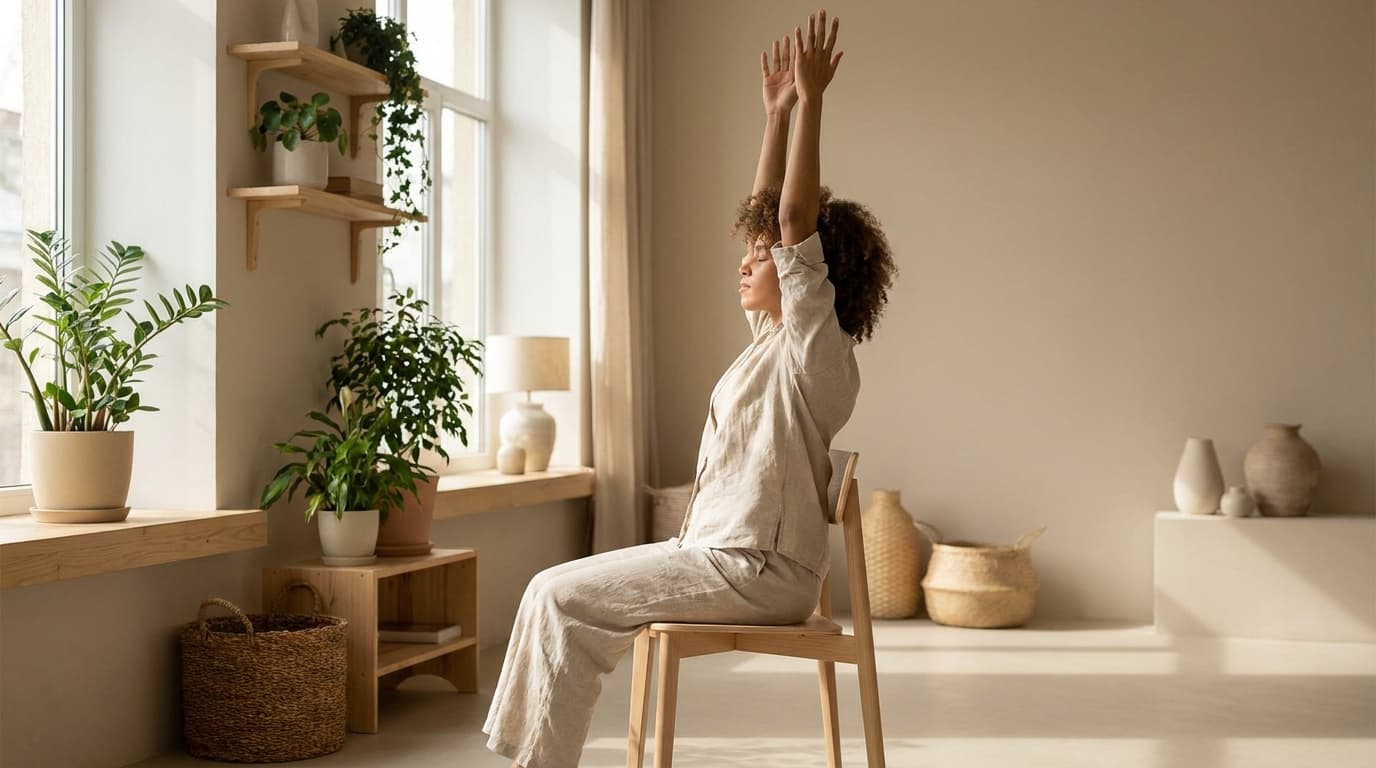
Sit toward the front edge of the chair. Feet flat, hip-width apart. Spine tall, crown of the head lifting. Hands resting on thighs, palms down. Take 5 slow breaths, feeling the connection of feet to floor and sitting bones to seat. This is the foundation — always return to it between poses.
2. Seated Cat-Cow
Hands on thighs. Inhale — lift chest, slightly arch the back, look gently upward (cow). Exhale — round the spine, tuck chin to chest (cat). Move with the breath, 8–10 cycles. This is a profound warm-up for the entire spine and the first breath-movement coordination students experience.
3. Seated Neck Rolls
From seated mountain, drop the right ear toward the right shoulder. Hold 30 seconds, return to center, switch. Then slowly rotate the head right and left. Never roll the head fully back. Encourage students to breathe into the side of the neck that feels tighter.
4. Shoulder Rolls
Roll both shoulders forward in large circles × 5, then backward × 5. Then alternate: one forward, one back in opposition. This warms the shoulder girdle, stimulates circulation, and begins releasing the upper trapezius holding.
5. Eagle Arms (Chair Version)
Cross right elbow over left at shoulder height, wrap forearms, work palms together. Lift elbows slightly, breathe into the space between the shoulder blades. Hold 45 seconds per side. One of the most effective upper back releases available in a seated practice.
6. Seated Side Stretch
Reach the right arm up, then arc it to the left, creating a long lateral stretch through the right side body. Left hand stays on the left thigh for support. Hold 45–60 seconds per side. Encourages lateral breathing and intercostal release.
7. Seated Spinal Twist
Sitting tall, place the right hand on the outer left knee and the left hand on the back of the chair or on the right hip. On the inhale, lengthen the spine. On the exhale, rotate to the left. Hold 5 breaths per side. Keep both sitting bones equally grounded — avoid collapsing in the spine.
8. Seated Forward Fold
From seated mountain, hinge forward from the hips (not the waist) and let the torso drape toward the thighs. Arms hang long toward the floor or hands rest on shins. Keep the neck relaxed, head heavy. Hold 60–90 seconds. This is deeply calming for the nervous system and a wonderful hamstring and lower back release.
See our pose library for detailed cues on forward fold variations.
9. Seated Figure Four (Chair Pigeon)
Cross the right ankle over the left thigh, flex the right foot to protect the knee. Keep the spine tall or hinge forward slightly for a deeper hip stretch. Hold 90 seconds per side. This is the chair yoga version of pigeon pose and is one of the most requested and loved poses in any chair yoga class.
10. Seated Warrior I
Pivot in the chair so you're sitting sideways, with your right leg extending behind you as far as comfortable, toes tucked or resting on the floor. Left knee is bent at 90 degrees. Reach both arms overhead and breathe into the hip flexor stretch of the extended leg. Hold 5–8 breaths per side.
11. Seated Warrior II
Sit sideways. Left knee bent, right leg extended to the side. Open the arms wide — left arm forward, right arm back. Gaze over the left hand. Feel the openness across the chest and the work in the left thigh. Hold 5–8 breaths per side.
12. Chest Opener with Interlaced Fingers
Interlace the fingers behind the back, pressing them toward the seat. Lift the chest and breathe into the sternum. Hold 30–45 seconds. This is the antidote to the forward rounding of long-term desk sitting.
Pro Tip: In a group class, after the chest opener, invite students to close their eyes for three breath cycles and notice any shift in how their body feels compared to the start of class. This brief pause builds interoceptive awareness — one of yoga's deepest gifts.
13. Standing Supported Mountain
Have students stand behind their chair, using the chair back as light support. Practice grounding through the feet, engaging the leg muscles, finding neutral pelvis. This bridges the seated and standing practice.
14. Standing Chair Warrior II
Using the chair back for balance support if needed, step the right foot back, turn it out 45 degrees, and open the arms wide. Front knee tracks over the middle toe. Hold 5–8 breaths per side. For students who are comfortable with balance, they can use the chair only lightly or not at all.
15. Standing Side Stretch at Chair
Stand behind the chair, right hand on chair back. Reach the left arm overhead and arc right for a lateral stretch while using the chair for stability. Hold 45 seconds per side.
16. Seated Ankle Circles and Calf Raises
Extend one leg and circle the ankle 5 times in each direction. Then rest feet flat and lift both heels simultaneously (calf raises) × 10. This promotes circulation in the lower legs — particularly important for students who have reduced mobility.
17. Wrist and Finger Stretches
Extend arms forward, flex and extend the wrists. Spread the fingers wide, make a fist, open wide × 5. Circle the wrists. This is essential for office workers and seniors dealing with arthritis or carpal tunnel.
18. Seated Meditation Mudra
Return to seated mountain. Bring hands to a comfortable mudra: palms up in the lap (receptive), palms down on thighs (grounding), or hands at heart centre. Close the eyes. Guide three slow, complete breaths. This is both a transition pose and a way to connect students to the meditation dimension of yoga.
19. Supported Backbend
Sitting toward the front of the chair, place hands on the chair seat behind the hips (or on the thighs). Gently lift the chest and allow a mild thoracic extension, being careful not to throw the head back. Hold 20–30 seconds. Always counterpose with a gentle forward fold.
20. Chair Savasana (Seated Relaxation)
Sit comfortably, back supported or not. Close eyes, let arms rest heavily, feet flat on the floor. Guide a body scan from feet to head: releasing gripping, softening the belly, unhinging the jaw. Play ambient music. Stay 3–5 minutes. This is the most important pose in the class — never skip it.
Build this sequence on your phone
The same 420+ pose library and drag-and-drop builder, free on iPhone, iPad and Android.
4 Complete Chair Yoga Sequences
Sequence 1: 10-Minute Office Refresh
Designed for the workplace. No changing, no mat, no special equipment.
Teaching note: Keep language professional and non-spiritual for corporate settings. Use terms like "focused attention" instead of "meditation," "physical release" instead of chakras. Meet people where they are.
Sequence 2: 30-Minute Senior Chair Yoga Class
Designed for a senior centre, community hall, or residential facility.
Teaching note: Allow extra time for transitions between poses. Offer individualised modifications freely — your willingness to adapt builds deep trust with this population.
Sequence 3: 45-Minute Therapeutic Chair Yoga
Suitable for pain management programmes, hospital-based wellness, or a dedicated therapeutic offering.
Sequence 4: 60-Minute Full Chair Yoga Practice
A complete, rich practice that can stand alongside any studio class in depth and satisfaction.
Use FLOW's free sequence builder to map out any of these sequences, time each section, and add notes for modifications. It makes the teaching preparation process significantly faster.
Teaching Tips and Room Setup
Chair selection and spacing: Use sturdy, armless chairs. Arrange them in rows with enough space for students to extend an arm sideways without touching the person next to them — roughly 3–4 feet between chairs. For smaller groups, a circle or semicircle encourages community and allows you to make eye contact with everyone.
Your positioning: Sit facing the group in your own chair rather than standing. This models the practice, keeps you at eye level with seated students, and is more welcoming for students who feel self-conscious.
Language considerations: With seniors, avoid commands that imply aging is a problem ("for those of you who can't do the full version"). Instead, offer choices: "You can stay here, or if you'd like more, try this." With corporate groups, keep the language body-focused and outcome-oriented.
Pace and timing: Chair yoga classes should move slower than floor yoga classes. Allow extra time for transitions, offer poses on one side before the other, and check in verbally more often. "How does that feel? Any adjustments needed?" builds safety and trust.
Marketing chair yoga classes: Partner with senior centres, libraries, adult day programmes, and community health organisations. Many actively seek programming and may even pay for classes or refer students. For workplace wellness, target medium-sized companies with HR departments. Bring a one-page proposal showing benefits (reduced absenteeism, improved focus, stress reduction) and offer a free demonstration class. Word of mouth in these communities is exceptionally powerful.
For broader yoga teaching strategies, see our yoga sequencing guide for curriculum planning and class design principles.
Modifications and Safety Guidelines
General safety rules:
Students with osteoporosis: Avoid deep forward folds that round the spine and any aggressive spinal flexion. Prioritise extension poses. Spinal twists should be performed gently and within a comfortable range.
Students with recent hip replacement: Skip deep hip flexion (above 90 degrees) and hip external rotation poses like figure four for at least 6 weeks post-surgery, and always consult the student's surgeon.
Students with vertigo or balance issues: Avoid head movements that involve looking down quickly, and ensure the chair is stable and has non-slip feet. Have a wall or table nearby for extra security during any standing work.
Students with cognitive impairment: Use very simple, direct language, demonstrate everything visually, and build a highly repetitive sequence so students can follow along by memory over time. Consistency between classes is a gift.
The goal of chair yoga is never to push limits — it is to open possibility. A student who arrives in pain and leaves feeling a little lighter has had an extraordinary yoga experience, full stop.
For teachers interested in broadening their accessible yoga toolkit, the principles explored in our yoga for stress and anxiety guide translate beautifully into the chair yoga context, particularly around nervous system regulation and trauma-informed cueing.
Frequently Asked Questions (5)
Is chair yoga actually effective, or is it a watered-down version of real yoga?
Chair yoga is a fully legitimate and highly effective practice — not a compromise. For many populations (seniors, people recovering from injury, those with limited mobility), it's actually the most appropriate and safest form of yoga. Research shows chair yoga reduces pain, improves balance, decreases anxiety, and enhances quality of life. The principles of yoga — breath awareness, mindful movement, body-mind connection — are fully present.
What kind of chair should I use for chair yoga?
Use a sturdy, armless chair with a flat seat, ideally with non-slip feet. The seat height should allow feet to rest flat on the floor with knees at approximately 90 degrees. Avoid chairs with wheels, very soft cushions, or rocking mechanisms. For group classes, folding metal or hard plastic chairs work well.
Can chair yoga help with arthritis?
Yes — chair yoga is one of the most studied interventions for arthritis management. A 2017 study published in the Journal of the American Geriatrics Society found that chair yoga significantly reduced pain interference and fatigue in older adults with osteoarthritis. Gentle range-of-motion work lubricates the joints, and breath-based relaxation reduces the inflammatory stress response.
How do I certify to teach chair yoga?
Most yoga teacher training programmes include some chair yoga content, but if you want to specialise, look for dedicated chair yoga certifications (typically 20–50 hours). Some well-regarded providers include Yoga Alliance-registered programmes specifically for chair and therapeutic yoga. You'll also benefit from general continuing education in anatomy, aging, and adaptive yoga.
How do I market chair yoga classes to reach seniors and office workers?
For seniors, partner with senior centres, retirement communities, assisted living facilities, libraries, and community centres. These institutions actively seek programming. For office workers, reach out directly to HR departments and wellness coordinators — frame the offering as "workplace wellness" or "desk yoga." Testimonials and free taster sessions convert very well in both markets.