
Table of Contents
Introduction
Arm balances are among the most requested peak poses in yoga class — and among the most feared. When a student first tips their weight over their hands and hovers, even for a single breath, something shifts. Not just physically. There is a moment of "I did not think I could do that" that carries well beyond the mat.
Teaching arm balances well is a genuine skill. It requires understanding the biomechanics of wrist loading and hip flexion, the psychology of fear and falling, and the art of sequencing a 60-minute class so students arrive at the peak moment warm, strong, and ready — rather than exhausted or anxious.
This guide covers the full arc: why arm balances matter, what prerequisites to assess, a four-stage progression framework, detailed breakdowns of five key arm balances, the handstand journey, and how to put it all together as a sequence. Use FLOW's free sequence builder to map out your peak pose class structure while you read.
Why Arm Balances Build More Than Strength
The Confidence Transfer
Ask any experienced yoga teacher about the moment a student first holds crow pose, and the answer is almost always the same: "Their face completely changes." Arm balances require a combination of physical readiness and mental surrender that makes them uniquely powerful as teaching tools.
The physical components — wrist strength, core engagement, hip flexibility — are learnable and trainable. But the psychological barrier is often larger than the physical one. Students who hold the belief "I'm not strong enough" or "I'm too big for this" carry those narratives directly into the attempt. When they succeed, even briefly, the narrative updates.
This confidence transfer is real and documented. Sports psychology research consistently shows that physical mastery experiences — especially those perceived as difficult or out of reach — produce meaningful improvements in self-efficacy that generalize beyond the original context. Your students who learn to hold crow often report unexpected increases in confidence at work, in relationships, in other areas of physical challenge.
Physiological Benefits
Beyond the psychological, arm balances deliver:
Prerequisite Assessment Before You Begin
Before introducing arm balance progressions to a student or class, assess four areas:
1. Wrist Strength and Mobility
A student with wrist pain, recent wrist injury, or very limited wrist extension (less than 70 degrees) needs wrist preparation before arm balance work. Simple tests:
Students who answer no/yes/yes respectively need wrist-specific prep before arm balances. Fist variations on knuckles can often allow them to participate while building wrist tolerance.
2. Core Strength
Arm balances are not primarily arm exercises — they are core exercises. The abdominals must contract isometrically to prevent the hips from sinking. Test: can the student hold a hollow body position on their back (lower back pressed into floor, legs extended low, arms overhead) for 20+ seconds? If not, target core work first.
3. Shoulder Stability
The shoulder girdle must protract (wrap forward) actively in arm balances rather than collapsing toward the spine. A student who sinks between the shoulder blades in plank is not ready for arm balances — they need serratus anterior activation work first.
4. Fear and Psychological Readiness
This is the prerequisite most teachers overlook. Ask directly: "How do you feel about the idea of putting your weight on your hands?" Students who express significant anxiety benefit from more time in low-stakes preparations (hands on blocks, feet on a wall) before attempting a full balance. Never minimize their concern or push past it.
For students managing anxiety broadly, your yoga for stress and anxiety resources provide useful context on working with the nervous system.
The 4-Stage Progression Framework
Rather than presenting arm balances as binary (can do / cannot do), teach them as a continuous progression through four stages:
Stage 1 — Foundation: Build the strength, mobility, and body awareness required. Planks, dolphin, hollow body holds, wrist circles, shoulder protracting exercises. No arm balancing yet — just honest preparation.
Stage 2 — Preparation: Begin approximating the position. For crow, this means garland pose for hip flexion, plank to Chaturanga for arm strength, and tiptoe chair pose for the hip flexor engagement pattern. Students are learning the shape; the balance is still theoretical.
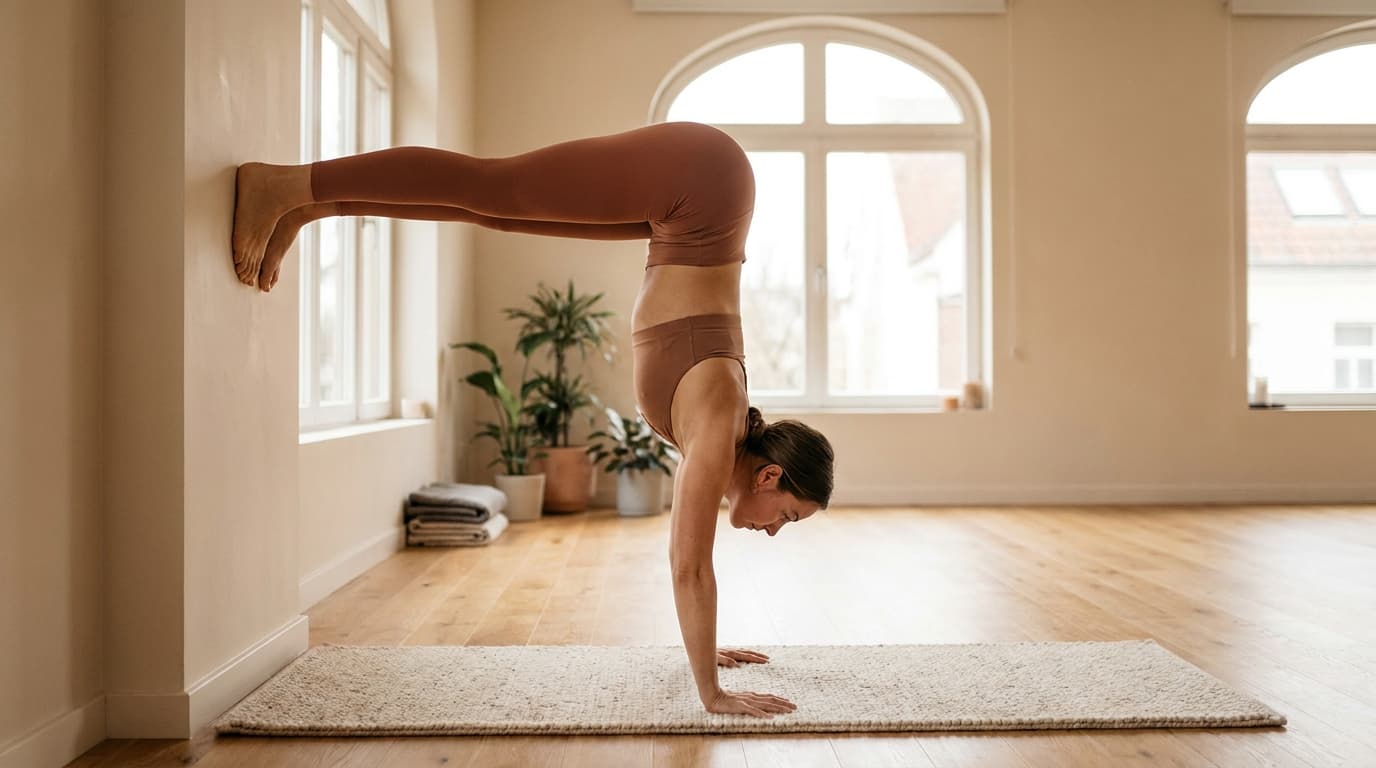
Stage 3 — Approach: First attempts with training wheels. Blocks under the feet to change the weight shift angle, hands on blocks to raise the height, feet remaining on the floor while the torso mimics the balance shape. For handstand: L-shape at the wall. The nervous system begins to adapt to weight-over-hands without the full demand.
Stage 4 — Peak: The full arm balance with briefer holds first (one breath), then extending duration as stability increases. Encourage students to think of the peak as "visiting" rather than "achieving."
This framework prevents the all-or-nothing thinking that leads students to either injure themselves trying before they're ready or abandon the practice because they believe they "can't do it."
Build this sequence on your phone
The same 420+ pose library and drag-and-drop builder, free on iPhone, iPad and Android.
5 Arm Balance Progressions Explained
1. Crow Pose (Bakasana) — The Gateway
Crow is typically the first arm balance taught because the body stays relatively low and compact. The mechanics: from a squat, place hands shoulder-width apart, spread fingers wide, bend elbows back (not out). Bring knees onto the backs of the upper arms. Lean forward until toes naturally lift.
Key cue: "You are not pushing your hands into the floor — you are pressing the floor away from you. Feel the difference."
The common mistake: Students look at the floor directly below their face, which causes them to fall forward. Cue them to look forward, six to twelve inches ahead of their hands.
Progression: Start with one toe lifting, then both, then hold for one breath, then three, then extend.
2. Side Crow (Parsva Bakasana)
From crow prep position, twist and stack both knees on one arm. This requires spinal rotation and hip flexibility in addition to the crow prerequisites, making it a natural "second arm balance" for students who have crow.
Key cue: "Stack the hips — don't let them sag. The twist comes from the thoracic spine, not just the waist."
Teaching note: Side crow requires asymmetric loading of the supporting arm. Students with one weaker wrist should approach this cautiously.
3. Flying Lizard (Uttana Pristhasana variation)
From a low lunge, thread one arm under the front thigh and place the hand on the mat. The thigh rests on the back of the upper arm. Begin to lean forward until the back foot lifts. A more advanced arm balance requiring hip flexibility and lateral arm strength.
Key cue: "The leg is not gripping the arm — the arm is a shelf. Create a stable platform."
4. Firefly Pose (Tittibhasana)
Both legs extended through the arms, parallel to the floor. This requires significant hamstring flexibility, inner groin openness, and core strength. Often approached via a squat with hands between the feet, walking the hands back, and then beginning to lift.
Key cue: "Dorsiflex the feet — flex them hard. This activates the leg muscles that help you hold the position."
Teaching note: Firefly is demanding and best introduced in workshops or advanced classes rather than general sequences.
5. Eka Pada Koundinyasana (Flying Splits)
One leg extends forward, one extends back, in a full split with the body suspended on bent arms. Typically approached from Chaturanga, adding a spinal twist and leg extension. This is an advanced posture requiring months of preparation in most practitioners.
Key cue: "Lower your Chaturanga first. Then, from the low position, extend the legs — not the other way around."
For any of these poses, explore technique details in our pose library.
The Handstand Journey: From L-Shape to Freestanding
Handstand (Adho Mukha Vrksasana) is the peak inversion — and for many students, the ultimate yoga milestone. Teaching it responsibly is a multi-month, multi-stage process.
Stage 1: L-Shape at the Wall
Feet on the wall at hip height, hands on the floor, body in an inverted L. This builds shoulder strength and spinal awareness in partial inversion without the balance demand. Hold for 5–10 breaths. Progress to pressing the heels into the wall and actively lengthening through the spine.
Pro Tip: The L-shape is genuinely excellent as a standalone pose. Many students who "can't do handstands" can hold an L-shape indefinitely — frame it as a posture in its own right, not just a step toward something else.
Stage 2: Kick-Up Drills Against the Wall
From downward dog near a wall, practice kicking one leg up and tapping the wall. The goal is not a full handstand — it is learning the kick-up rhythm, finding shoulder stacking, and experiencing momentary full inversion. Many students practice this for weeks before any balance occurs.
Cue the alignment: "Stack your wrists under your shoulders. Your ears should be between your upper arms — not in front."
Stage 3: Partner Spotting and Tuck Hold
With a spotter holding the student's hips (not lifting — just steadying), students practice tuck holds and straight-body holds. This is often when the "I'm upside down" sensation becomes manageable and even enjoyable.
Stage 4: Freestanding
For most students, freestanding handstands develop through consistent daily practice over 6–18 months. The banana-back handstand (overarched spine) is common early and should be addressed by teaching hollow body shape in the handstand: engage the glutes, ribs drawn in, body as one straight plank rather than a C-curve.
Sequencing a Class Toward an Arm Balance Peak
A well-structured arm balance peak class follows this logic:
Warm-up (10–12 minutes): Wrist circles and wrist strengthening (plank hold, down dog walks), core activation (hollow body, boat pose variations), shoulder awareness (thread-the-needle, dolphin).
Building section (25–30 minutes): Standing postures that build the hip flexion and leg engagement pattern needed — chair pose, crow prep in squat, lizard lunge for hip opening. Chaturanga variations for arm strength. Include at least one vinyasa sequence that moves through plank, Chaturanga, upward dog, downward dog to warm the entire arm-shoulder-core chain.
Peak approach (10–12 minutes): Stage 2 and 3 preparations for your chosen peak. For crow: garland into hands-on-blocks practice, single-toe-lift attempts. Build up the exploration over multiple rounds.
Peak (5–8 minutes): Full attempts with clear instruction and modifications visible. Remind students before every attempt: "If you stay in the preparation shape the entire time, that is the practice."
Integration and cool-down (10–12 minutes): After intense arm work, the wrists and shoulders need care. Eagle arms, gomukhasana arms, gentle wrist stretches. Then a longer savasana — the nervous system has worked hard.
Use FLOW's free sequence builder to map this structure, assign timing to each section, and save your sequence for use across multiple classes.
Spotting Techniques and Psychological Safety
Physical Spotting
For crow and similar poses: stand to the side of the student, one hand near (not touching) their hip, one near the shoulder. You are ready to steady but not to lift. Most students, knowing you are present, relax enough to find the balance naturally.
For kick-up handstands: stand beside the student facing them, hands held open at their hip height. As they kick up, place your palms on their hips to steady — do not grab. Never position yourself directly below a student attempting to kick up.
Creating Psychological Safety
Before arm balance work, establish a clear agreement with your class:
Return to these messages throughout the class. Students who feel psychologically safe are physically more relaxed — and paradoxically, more likely to achieve the balance.
For teachers working with students who have experienced trauma, additional sensitivity around touch and physical challenge applies. See our full guide to trauma-informed yoga sequencing for specific language and approach.
For teachers earlier in their career, building confidence in sequencing complex classes begins with strong fundamentals — our guide on teaching your first yoga class covers the bedrock principles that make advanced teaching possible.
Arm balances and handstands are, at their best, invitations — not demands. The teacher's role is to prepare the conditions so that when a student hovers for the first time, the experience is theirs alone. Your sequencing, your cueing, your patience: all in service of that single moment of flight.
Build your arm balance peak class in FLOW's free sequence builder and be ready for that moment in your next class.
Frequently Asked Questions (5)
How long does it realistically take a beginner to achieve crow pose?
With consistent practice (2–3 times per week) and targeted preparation, most students with reasonable core strength can achieve a brief crow pose hold within 4–12 weeks. The variables are upper body strength, hip flexibility, and psychological comfort with weight over the hands. Some students surprise themselves in their first focused workshop; others take months. The "tipping point" moment when students stop bracing their feet to land and trust their balance is often sudden and joyful.
What should I do when a student falls out of an arm balance?
Normalise it before it happens: "Falling is part of the practice — it means you found the edge." When a student falls, check in calmly ("Are you okay?"), reinforce their bravery for trying, and offer a specific technical adjustment for the next attempt rather than general encouragement. Spotting: stand beside the student with one hand near (not touching) their hip, ready to steady but not to catch. The goal is confidence, not rescue.
Are wrist injuries common in arm balances, and how do I prevent them?
Wrist discomfort is common; acute injury is less so with proper preparation. Prevention comes from three things: spreading the fingers wide and distributing weight across the entire palm (not the heel of the hand), strengthening the wrists through progressive loading over time rather than jumping straight to heavy balances, and not pushing through acute wrist pain. If a student has chronic wrist issues, fists or forearm variations often allow them to participate safely. See your healthcare provider for persistent pain.
Is it okay to teach handstands in a general yoga class?
Handstand prep and drills are appropriate in most intermediate yoga classes when taught progressively. Full freestanding handstands belong in classes where students have been explicitly assessed and prepared. For general classes, L-shape at the wall and kick-up practice give students meaningful progress without the risk of an uncontrolled inversion. Always offer clear alternatives and never make students feel the class requires the peak pose to be valuable.
How do I sequence a full class around an arm balance peak without it feeling forced?
The key is preparing the specific muscle groups and psychological readiness the peak pose requires, without telegraphing the destination so obviously that students feel anxious from the first warrior. Build wrist mobility and core activation into your warm-up naturally. Use planks, dolphin, and Chaturanga variations as strengtheners in the middle section. When you arrive at the peak, students' bodies are genuinely ready — it feels like a natural crescendo rather than an abrupt challenge.