
Table of Contents
Introduction
We live in a culture that is chronically under-rested. Between the blue light of screens, the constant demands of work and family, and a cultural story that equates busyness with worth, many people arrive at night still running at full speed — and then wonder why they cannot fall asleep.
Restorative yoga does not ask the body to do more. It asks it to do less. Completely, deliberately, supported less. And in that space of active rest, something profound happens: the nervous system remembers how to let go.
As a yoga teacher, offering a restorative sleep sequence is one of the most genuinely helpful things you can give your students. The effects are immediate, the research is compelling, and the practice requires no previous yoga experience — which means it is accessible to virtually anyone who walks through your door.
This guide covers everything: the science, the eight core poses, a complete 45-minute bedtime sequence, and the breathing techniques that amplify the effects. If you want to build and customize this sequence for your own classes, FLOW's free sequence builder lets you map out restorative sequences with timing and prop notes that you can print and bring to class.
The Science of Yoga and Sleep
The link between yoga and improved sleep is not anecdotal — it is increasingly well-documented. Here is what the research tells us:
Cortisol reduction. Yoga practice, particularly restorative styles, has been shown to reduce cortisol levels. Cortisol is the primary stress hormone — and elevated cortisol at night is one of the most common physiological reasons people cannot fall asleep or wake frequently.
Parasympathetic activation. Slow, deliberate breathing (the kind cued throughout restorative practice) activates the vagus nerve, which signals the parasympathetic branch of the autonomic nervous system — the "rest and digest" system. This directly counters the sympathetic "fight or flight" activation that keeps people wired at night.
Melatonin support. Some studies suggest that yoga practice can support healthy melatonin secretion, the hormone most directly responsible for regulating the sleep-wake cycle.
Body temperature regulation. During gentle yoga, core body temperature rises slightly. As it cools afterward, this temperature drop acts as a biological signal for sleep — similar to the effect of a warm bath before bed.
Mental decluttering. Perhaps most practically, restorative yoga gives the mind something to focus on that is not tomorrow's to-do list. The attention brought to breath, sensation, and stillness breaks the rumination cycle that keeps many people awake.
For students dealing with our guide to yoga for lower back pain — another common source of disrupted sleep — restorative poses can address both issues simultaneously.
What Makes Restorative Different?
Restorative yoga was largely developed by B.K.S. Iyengar and popularized by his student Judith Hanson Lasater. It uses props — bolsters, blankets, blocks, straps, eye pillows — to completely support the body in passive shapes, held for extended periods.
The key distinction: in restorative yoga, there should be zero muscular effort. Every part of the body is supported so that muscles can fully release. This is different from:
What makes restorative uniquely effective for sleep is the combination of physical stillness, full body support, and breath focus over extended time. The body essentially receives the message: you are safe, you can stop holding on.
Pro Tip: The two biggest mistakes in restorative yoga are not using enough props and not holding poses long enough. When in doubt, add another blanket and give it three more minutes.
8 Poses for Better Sleep
These eight poses form the foundation of a sleep-focused restorative practice. They are arranged in an order that progressively invites the nervous system to down-regulate — starting with gentle opening and ending with complete surrender.
1. Supported Child's Pose (Salamba Balasana)
Props: Bolster or stacked blankets; optional folded blanket for forehead support
Setup: Kneel and place the bolster lengthwise between the knees. Drape the torso over the bolster, arms either hugging it or extended forward. Rest the forehead on the bolster or on stacked hands.
Why it works for sleep: Compression of the belly activates the parasympathetic response. The forward fold quiets the visual field and draws attention inward. The supported weight of the head releases neck tension accumulated throughout the day.
Timing: 5 minutes, turning head to the other side halfway through
2. Supported Supine Butterfly (Supta Baddha Konasana)
Props: Bolster or rolled blanket under the spine; blocks or folded blankets under each knee; optional eye pillow
Setup: Place the bolster vertically on the mat. Sit at the bottom edge, bring soles of feet together, and gently recline over the bolster so it supports the length of the spine. Place support under each knee so the inner groin can release without strain. Eye pillow optional.
Why it works for sleep: Opening the chest and front body while fully supported counters the closed, forward posture of the day. The inner groin release is deeply calming.
Timing: 8-10 minutes
3. Supported Bridge Pose (Setu Bandha Sarvangasana)
Props: Block (medium or high height) under the sacrum; optional folded blanket under the shoulders
Setup: Lie on your back with knees bent. Gently lift the hips and slide a block under the sacrum (not the lumbar spine). Let the hips fully release onto the block. Arms rest alongside the body, palms up.
Why it works for sleep: A gentle passive backbend that opens the hip flexors — the muscles most chronically shortened by sitting — without any muscular effort. The mild inversion of the legs slightly above heart level promotes relaxation.
Timing: 5-7 minutes
4. Reclined Twist (Supta Matsyendrasana)
Props: Bolster or blanket between the knees; optional blanket under the shoulder
Setup: Lie on your back with knees bent, then slowly lower both knees to the right. Place a bolster or folded blanket between the knees to prevent the hips from overrotating. Extend the left arm to the side or overhead. Repeat on the left.
Why it works for sleep: Wrings out tension from the spinal muscles and massages the digestive organs — which is particularly useful if stress or anxiety tends to show up in the gut.
Timing: 5 minutes per side
5. Supported Seated Forward Fold (Paschimottanasana with support)
Props: Bolster or folded blankets on top of the legs; optional folded blanket under the hips for elevation
Setup: Sit with legs extended. Fold the torso forward over the bolster (or blankets stacked on the legs), allowing the chest and forehead to rest completely. Arms wrap around or rest to the sides.
Why it works for sleep: Spinal flexion with support compresses the nervous system in a soothing way. The inward fold is symbolically appropriate for winding down — the body and attention both turn inward.
Timing: 5-8 minutes
6. Legs Up the Wall (Viparita Karani)
Props: Folded blanket or flat bolster under the sacrum; optional eye pillow; legs rest against the wall
Setup: Sit sideways next to a wall, then swing the legs up as you lie back. Shimmy the hips close to the wall. Slide a folded blanket under the sacrum for a mild elevation. Arms rest open at the sides, palms up.
Why it works for sleep: This gentle inversion is one of the most powerful parasympathetic activators in the yoga toolkit. It improves venous return (blood flow from legs back to the heart), reduces swelling, and has an immediate calming effect that many students report feeling within minutes.
Timing: 8-12 minutes
Pro Tip: Legs up the wall is so effective at calming the nervous system that some students will doze off. Have a soft protocol for bringing them gently back — a quiet chime or soft touch on the shoulder, never a sudden voice.
7. Supported Savasana
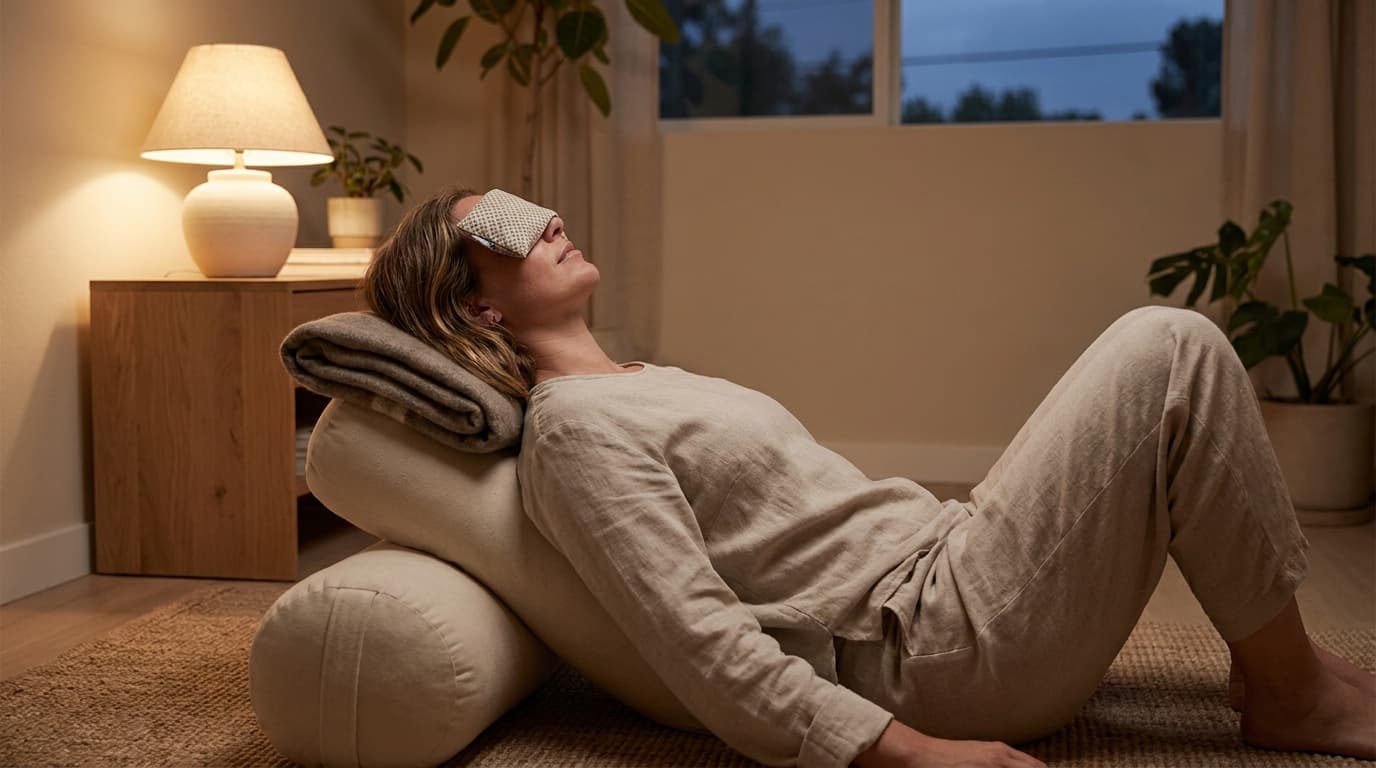
Props: Bolster under the knees; folded blanket under the head; optional blanket over the body; eye pillow
Setup: Lie completely on the back. Bolster under the knees releases the low back. Folded blanket under the head aligns the chin slightly toward the chest, releasing neck strain. Cover the body with a blanket for warmth. Eye pillow over the eyes blocks light and adds gentle pressure that activates the oculocardiac reflex — a calming vagal response.
Why it works for sleep: This is the most complete rest available in yoga. With the body fully supported, warm, and in darkness, the physiological conditions for sleep are replicated exactly.
Timing: 10-15 minutes (or the rest of the session)
8. Side-Lying Rest
Props: Bolster or pillow between the knees; folded blanket under the head
Setup: Roll gently to the right side after savasana. Bolster between the knees protects the hip alignment. This is the natural position many people sleep in — transitioning here at the end of practice bridges the yoga space and the sleep space.
Why it works for sleep: Ending in a sleep-like position anchors the parasympathetic state. Right-side lying specifically is associated with slower digestion and a more restful heart rate in Ayurvedic tradition.
Timing: 2-3 minutes, then students can drift to sleep if practicing at home
Build this sequence on your phone
The same 420+ pose library and drag-and-drop builder, free on iPhone, iPad and Android.
The 45-Minute Bedtime Sequence
| Pose | Timing |
|---|---|
| Supported child's pose | 5 min |
| Supported supine butterfly | 8 min |
| Supported bridge | 5 min |
| Reclined twist (right, then left) | 5 min total |
| Legs up the wall | 10 min |
| Supported savasana | 8 min |
| Side-lying rest / transition to sleep | 1 min |
Total: approximately 45 minutes
You can use FLOW's free sequence builder to build this sequence with notes on prop setup for each pose, then print it as a class card. It is a clean way to keep yourself organized without shuffling papers in a dark room.
Props You Will Need
| Prop | Purpose | Home Substitute |
|---|---|---|
| Blankets (2-3) | Support under head, knees, hips | Folded towels or firm pillows |
| Blocks (2) | Height adjustments, under sacrum | Hardcover books |
| Eye pillow | Darkness and light oculocardiac pressure | Folded sock or small towel |
| Strap | Legs-up-the-wall optional (to loop around legs) | Bathrobe tie or scarf |
Breathing Techniques for Sleep
The breath is the fastest available tool for shifting the nervous system. Here are three techniques to teach alongside the restorative sequence:
4-7-8 Breathing
Inhale for 4 counts. Hold for 7 counts. Exhale for 8 counts. The extended exhale activates the vagus nerve directly. Dr. Andrew Weil popularized this technique as a natural tranquilizer for the nervous system.
When to use: At the start of the practice and in legs up the wall.
Box Breathing (Equal Ratio)
Inhale 4. Hold 4. Exhale 4. Hold 4. The symmetry is regulating and predictable — useful for anxious minds that need structure.
When to use: During the opening breath awareness or supine butterfly.
Extended Exhale Breathing
Simply inhale for 4 and exhale for 8 (or whatever ratio makes the exhale twice the length of the inhale). No holding required. The dominant exhale is the most straightforward way to activate the parasympathetic system.
When to use: Throughout the entire sequence as a baseline instruction.
Pro Tip: Introduce one breathing technique per session rather than teaching all three at once. In a sleep context, simplicity is your ally. Students should be drifting inward, not keeping track of complex ratios.
Teaching this as a class? Check our guide on beginner yoga flows for more ideas on sequencing gentle classes that meet students where they are.
Frequently Asked Questions
Frequently Asked Questions (6)
How soon before bed should I practice restorative yoga?
Ideally 30 to 60 minutes before you plan to sleep. This gives the nervous system time to fully down-regulate and allows the body temperature shift (which rises slightly during yoga and then drops, signaling sleep readiness) to work in your favor. Avoid vigorous yoga within two hours of bedtime.
How is restorative yoga different from yin yoga?
Yin yoga applies stress to the connective tissue through gravity and long holds, often with mild discomfort at the edge. Restorative yoga uses props to fully support the body so there is zero muscular effort — the goal is complete release, not therapeutic stress. Restorative is generally more appropriate for evenings and sleep support.
Can I teach restorative yoga without a bolster?
Yes. Folded blankets, firm pillows, or rolled-up sleeping bags work well as bolster substitutes. Blocks can support the head or chest. Eye pillows can be replaced with a folded sock or small towel. Resourcefulness is part of the practice.
Is restorative yoga suitable for students with insomnia?
It is one of the most research-supported non-pharmacological tools for insomnia. The combination of slow breathing, proprioceptive input from props, and extended stillness directly calms the sympathetic nervous system. For students with chronic insomnia, consistency is key — even three sessions per week can make a measurable difference within a few weeks.
My students say they feel anxious lying still in restorative. What should I do?
This is common, especially for highly active people or those with anxiety. Start with shorter holds (3 minutes rather than 5), ensure they are warm and fully supported, and give them something to focus on — a breath count, a body scan, or soft music. Over time, the tolerance for stillness grows. Normalize the experience and never force anyone to stay in a pose they find distressing.
How do I structure a restorative yoga class for a studio setting?
Keep the class to 5-7 poses with generous timing (5-10 minutes each), include a brief introduction and prop setup time, and finish with a long savasana (10-15 minutes). Speak softly and minimize adjustments unless invited. Turn the lights low. Use FLOW's sequence builder to plan and print your class card in advance so you can be fully present with your students.