
Table of Contents
Introduction
Ask any group of yoga students what they want more of, and at least half will say hip opening. It is one of the most universally requested themes — and for good reason. Tight hips affect how we walk, sit, and sleep. They contribute to low back pain, poor posture, and even emotional tension. And for yoga teachers, hip opening classes are consistently the most well-attended themed sessions on the schedule.
But teaching hip opening well requires more than stringing together a few pigeon poses. Understanding why hips get tight, what anatomy is involved, and how to sequence poses safely makes the difference between a class that leaves students feeling genuinely released and one that leaves them sore the next day.
This guide gives you everything: the anatomy, the 20 best poses with cueing notes, and three complete class plans you can teach this week. If you want to customize any of these plans for your own students, FLOW's free sequence builder makes it easy to rearrange poses, adjust timing, and print a clean sequence card.
Why Are Hips So Tight?
The most common culprit is our sitting culture. The average adult sits for 9 to 10 hours per day — at desks, in cars, on couches. When the hip flexors are held in a shortened position for hours at a time, they adapt by staying short. The hip rotators, meanwhile, are rarely taken through their full range of motion in everyday life, and they stiffen accordingly.
Beyond sedentary habits, there are several other contributors:
Stress and emotional holding. The hips are widely recognized in yoga and somatic therapy as a primary storage site for emotional tension. The psoas muscle — the deepest hip flexor — is directly connected to the diaphragm and responds to the fight-or-flight response. Students who experience anxiety or chronic stress often carry profound tightness here.
Repetitive sports. Running, cycling, and sports involving forward motion shorten the hip flexors without adequately lengthening them. Athletes often come to yoga with extremely tight hip flexors and relatively open hamstrings.
Structural anatomy. Some students have a shallower or deeper hip socket, or a femur that angles differently within the joint. These structural variations mean that the same pose will feel very different in different bodies — and why a pose like pigeon may never be available to some students regardless of how much they practice.
Understanding these causes helps you meet students with empathy rather than judgment when they struggle with poses that seem simple.
Hip Anatomy Basics
You do not need a medical degree to teach hip opening well, but a basic understanding of what you are working with makes your cueing much more specific and effective.
The hip joint is a ball-and-socket joint — the femur head (ball) sits inside the acetabulum (socket) of the pelvis. This design allows for a wide range of motion: flexion, extension, internal and external rotation, abduction, and adduction.
Key muscle groups involved in hip opening:
The IT Band runs along the outer thigh and connects to the hip. While it cannot be stretched directly (it is a thick band of fascia), poses that release the TFL and piriformis can ease IT band tension.
Pro Tip: When students say "I can feel it in my knee" in hip poses, it usually means the hip is not open enough to support the range of motion being asked of it. Move to a more accessible variation first, and let the hip lead the way.
Top 20 Hip Opening Poses
Standing Hip Openers
1. Warrior II (Virabhadrasana II)
The front hip rotates externally while the back hip extends — a dual hip opener in one dynamic pose. Cue the front knee to track over the second toe and the back outer foot to press firmly into the mat.
Hold: 5-10 breaths per side2. Goddess Pose (Utkata Konasana)
Wide stance, toes turned out 45 degrees, knees bent deeply. Excellent for the inner thighs and hip rotators. Cue the tailbone to drop straight down (not tucked under) and the knees to track over the toes.
Hold: 5-8 breaths3. Triangle Pose (Trikonasana)
Lengthens the inner thigh of the front leg and opens the hip rotators. Cue students to let the pelvis tip forward naturally rather than forcing it square.
Hold: 5-8 breaths per side4. Standing Figure-Four (Standing Pigeon)
Balancing on one leg, other ankle crosses over the standing thigh. Excellent hip rotator opener with less knee risk than floor pigeon. A great warm-up for pigeon.
Hold: 5-8 breaths per side5. Wide-Legged Forward Fold (Prasarita Padottanasana)
Inner thighs, hamstrings, and hip adductors all release here. Multiple hand variations allow for different intensities. Give students the option to stay with hands on blocks.
Hold: 8-10 breathsFloor Hip Openers
6. Low Lunge (Anjaneyasana)
The quintessential hip flexor opener. Front knee over ankle, back knee down, hips sinking toward the floor. Cue students to engage the back glute gently to deepen the stretch without collapsing into the low back.
Hold: 8-10 breaths per side7. Lizard Pose (Utthan Pristhasana)
Low lunge with the front foot to the outside of the same-side hand. Drops deeper into the hip flexors and rotators. Option to lower the back knee or add a twist. One of the most effective hip openers available.
Hold: 8-10 breaths per side8. Pigeon Pose (Eka Pada Rajakapotasana)
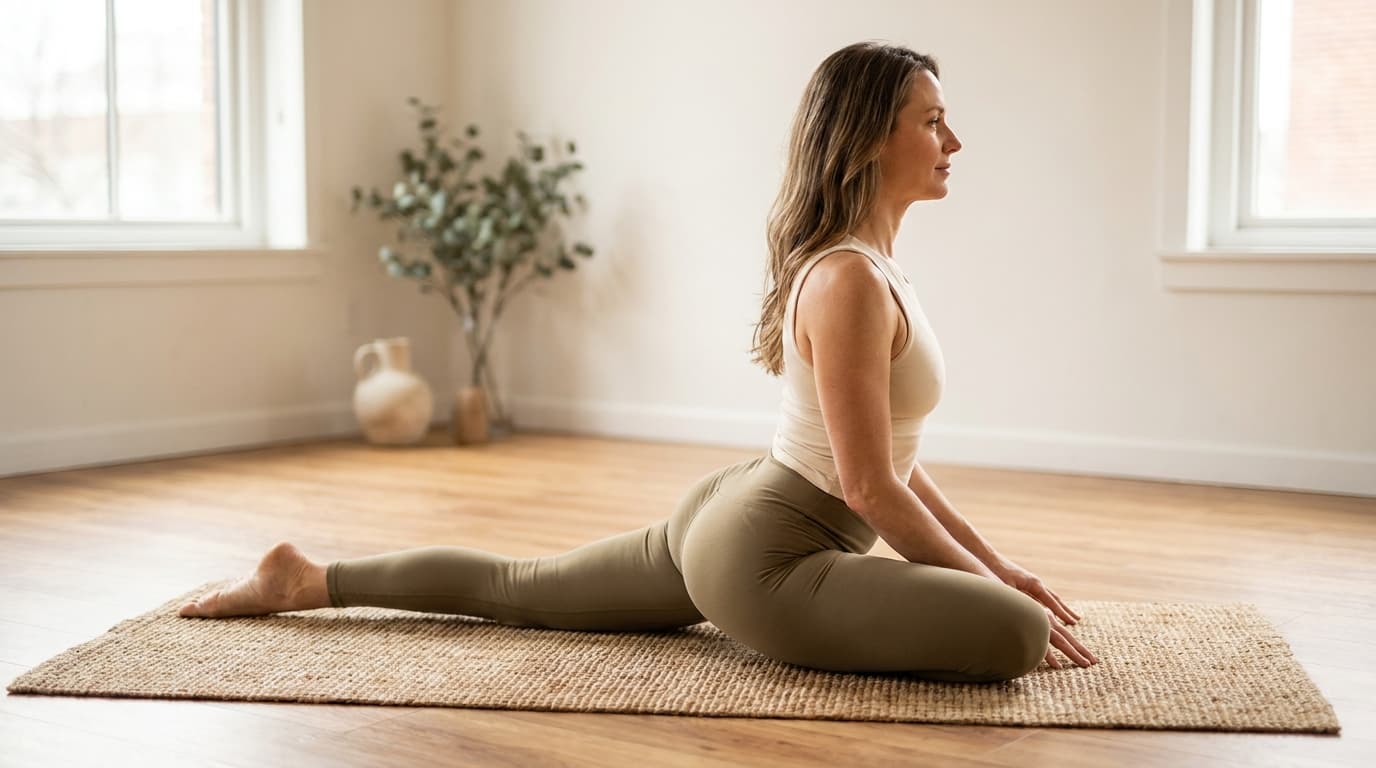
The gold standard of hip rotation openers. Front shin at varying angles depending on the student's range; back leg long behind. Cue the weight to be even across both hip bones — not sinking to one side.
Hold: 10-20 breaths per side (or 3-5 minutes in yin)9. Double Pigeon / Fire Log Pose (Agnistambhasana)
Both shins stacked. Intense external rotation of both hips simultaneously. Appropriate for students with significant hip opening already, not beginners.
Hold: 10-15 breaths per side10. Thread the Needle (Reclined Pigeon / Figure Four)
Lying on the back, one ankle crosses over the opposite thigh. The safest version of pigeon rotation. Excellent for students with knee sensitivity or SI joint issues.
Hold: 10-20 breaths per side11. Bound Angle Pose (Baddha Konasana)
Soles of the feet together, knees dropping to the sides. Opens the inner groin and hip adductors. Cue students to let the knees descend naturally without pushing them — gravity and time do the work.
Hold: 10-20 breaths12. Half Lord of the Fishes (Ardha Matsyendrasana)
A seated twist that targets the hip rotators on the bent-knee side. More accessible than full lord of the fishes. Cue the sitting bones grounded and the spine lengthening before the twist begins.
Hold: 8-10 breaths per side13. Seated Forward Fold (Paschimottanasana)
While primarily a hamstring stretch, it also releases the hip flexors and lower back. Cue students to fold from the hip crease, not the waist.
Hold: 10-15 breaths14. Wide-Legged Seated Forward Fold (Upavistha Konasana)
Inner thighs and hip adductors with an element of hip flexion. Keep a gentle bend in the knees if needed.
Hold: 10-20 breaths15. Cow Face Pose (Gomukhasana)
Deep external hip rotation with the legs crossed. Notoriously intense for students with very tight hips — always offer a modification (sitting on a block or sitting with legs in easy pose).
Hold: 10-15 breaths per sideSupine Hip Openers
16. Happy Baby (Ananda Balasana)
On the back, knees wide toward armpits, hands holding outer feet or big toes. Gently opens the inner groins and creates traction in the hip joints. Naturally calming.
Hold: 10-20 breaths17. Supine Butterfly (Supta Baddha Konasana)
Reclined bound angle pose. Fully passive — gravity does the work as the inner thighs release. Great with support under the knees.
Hold: 3-5 minutes18. Supine Twist (Supta Matsyendrasana)
Releases the outer hip rotators and IT band. Classic and accessible for all levels. Cue both shoulders on the mat and the knees stacked.
Hold: 10-15 breaths per side19. Bridge Pose (Setu Bandha Sarvangasana)
Primarily a hip flexor opener as the front of the hips lengthen when the pelvis lifts. Also strengthens the glutes — an important counterpart to all the stretching.
Hold: 8-10 breaths, or 3 rounds20. Legs Up the Wall (Viparita Karani)
Passive inversion that releases hip flexor tension while calming the nervous system. A beautiful way to close a hip-focused class.
Hold: 3-10 minutesBuild this sequence on your phone
The same 420+ pose library and drag-and-drop builder, free on iPhone, iPad and Android.
Three Complete Class Plans
Plan 1: 30-Minute Hip Opening Flow
This class is efficient and focused. Perfect for a lunch break or an add-on to another session.
| Phase | Poses | Time |
|---|---|---|
| Warm-Up | Cat-cow, thread the needle each side | 5 min |
| Standing | Warrior II, goddess pose (2 rounds) | 7 min |
| Floor | Low lunge, lizard, reclined pigeon (each side) | 10 min |
| Close | Supine twist each side, savasana | 5 min |
Plan 2: 60-Minute Hip Opening Class
A complete, balanced class with time for proper cueing and holds.
| Phase | Poses | Time |
|---|---|---|
| Warm-Up | Cat-cow, hip circles on all-fours, thread the needle | 8 min |
| Standing | Warrior II, triangle, standing figure-four | 10 min |
| Lunge Series | Low lunge, lizard, pigeon (right side) → repeat left | 15 min |
| Seated | Bound angle, seated forward fold, double pigeon (if available) | 10 min |
| Supine | Happy baby, supine twist each side | 7 min |
| Savasana | 5 min |
Plan 3: 90-Minute Yin Yoga for Hips
Long holds, deep fascial release. Excellent for evening or weekend workshops.
| Pose | Time |
|---|---|
| Reclined pigeon — right | 4 min |
| Reclined pigeon — left | 4 min |
| Butterfly fold (seated, forward) | 5 min |
| Dragon (lizard yin) — right | 5 min |
| Dragon (lizard yin) — left | 5 min |
| Sleeping swan (pigeon yin) — right | 5 min |
| Sleeping swan (pigeon yin) — left | 5 min |
| Wide-legged seated forward fold | 5 min |
| Happy baby | 5 min |
| Supine twist — each side | 4 min each |
| Savasana (supported, legs on bolster) | 10 min |
Use FLOW's free sequence builder to customize any of these plans with your own pose selection, timing notes, and props. Our pose library includes full descriptions and modification options for every hip opener listed above.
For teachers building a broader curriculum, our guide on how to create a yoga sequence covers general sequencing principles that apply beautifully to hip-focused classes.
Common Mistakes to Avoid
1. Going straight to pigeon. Pigeon is an intense pose that requires warm hip rotators. Start with standing and reclined variations before moving to floor pigeon. A cold pigeon risks strain.
2. Pushing students past their edge. Hip opening is often uncomfortable, but pain — especially sharp, shooting, or joint pain — is a signal to back off. Teach students to find "intense but tolerable" and stay there.
3. Neglecting the other side. Always practice hip openers bilaterally. Asymmetric work without balance leads to pelvic imbalance over time.
4. Only stretching, never strengthening. Hypermobile students need hip strengthening (bridge, warrior III, standing poses) as much as tight students need stretching. Balance matters.
5. Forgetting the breath. In long holds, students hold their breath. Remind them every minute or so with a simple "keep breathing" cue. The exhale is the release.
Modifications for Beginners and Knee Issues
| Pose | Modification |
|---|---|
| Double pigeon | Seated with feet on floor, one shin on top |
| Lizard | Front foot inside the hand; back knee down; block under hands |
| Bound angle | Bolster or folded blankets under both knees |
| Cow face | Sit on a block; one leg straight if crossing is impossible |
| Wide-legged fold | Knees bent; seated on a folded blanket |
For beginners, always introduce hip poses with support before moving to the full expression. Normalize blocks, blankets, and bolsters as standard tools, not signs of limitation.
Frequently Asked Questions
Frequently Asked Questions (6)
How often should students practice hip opening yoga to see results?
Three to four times per week is ideal for noticeable progress, though even two consistent sessions will help over time. The hips respond more to frequency than intensity — shorter, regular sessions beat one weekly intense stretch. Encourage students to incorporate simple hip flexor stretches daily, even for five minutes.
Is pigeon pose safe for everyone?
Pigeon pose is not suitable for students with acute SI joint issues, certain hip labral tears, or severe knee instability. Always offer reclined pigeon (figure-four stretch on the back) as an alternative. When in doubt, ask students to consult their physiotherapist before practicing deep hip openers.
What is the difference between hip flexor and hip rotator tightness?
Hip flexors (primarily the iliopsoas and rectus femoris) run along the front of the hip and get tight from prolonged sitting. Hip rotators (like the piriformis and the deep external rotators) control rotation and become tight from inactivity or repetitive sports. Most students have tightness in both areas, which is why a well-rounded hip opening class targets both.
Should I include hip opening in every class?
Not necessarily in a dedicated way, but most well-structured classes will naturally include hip work — low lunge, warrior poses, and forward folds all address the hips. Reserve dedicated hip-focused classes for workshops, yin sessions, or themed classes. Your students will appreciate the focus and will likely feel a noticeable difference afterward.
My students complain of knee pain in pigeon pose. What should I do?
Knee pain in pigeon almost always comes from the hip not being open enough to support the external rotation, causing the knee to torque instead. Immediately offer reclined pigeon, or place a block or folded blanket under the hip of the front leg. Ensure the front foot is flexed (not pointed) and that the weight is even across the pelvis.
How do I plan a hip opening class efficiently?
Start with your peak pose — whether that is pigeon, bound angle, or lizard — and work backward to build the warm-up, then forward to plan the cool-down. Use FLOW's free sequence builder to map out the full progression visually. You can see the hip-opening arc at a glance and adjust timing for each phase.